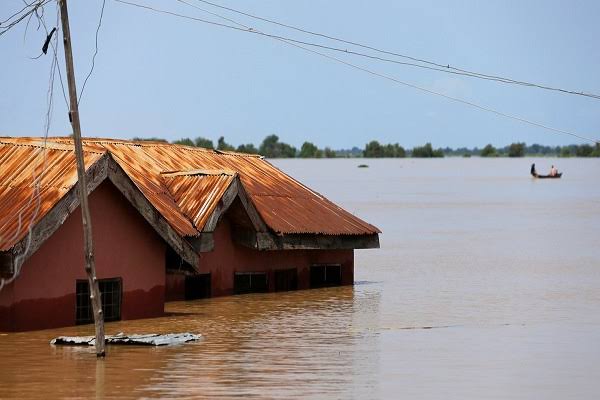
A water resources management expert, Michael Ale, has called for a stronger institutional framework, including an urban planning enforcement law, to address the recurring flooding in Ekiti State.
Ale, the Coordinator of the Global Development Initiative, attributed the persistent flooding in the state to the absence of effective institutions capable of enforcing regulations and imposing sanctions on offenders.
He urged the Ekiti State House of Assembly to enact a Flood Resilience and Urban Planning Enforcement Law to strengthen flood prevention and ensure compliance with environmental and urban planning regulations.
The call followed flooding recorded in parts of the state, particularly Ado Ekiti, the state capital, last week, which resulted in loss of lives and property as well as disruption of socio-economic activities.
Ale, in a statement issued in Ado Ekiti on Wednesday, said the state urgently needed a strong institutional framework to tackle the recurring challenge.
“There is a need for Ekiti State to urgently create a strong institutional framework that will combat the perennial incident of flooding in the state.
“Flooding in Ado Ekiti is predictable. NIMET predicts it. The rivers are known, the causes are known – building on waterways, blocked drains, no dredging before rainy season, refuse in canals. If it is predictable and preventable, why does it happen yearly? It is because we have no institutional framework that enforces consequences,” he stated.
The expert also advocated the establishment of a waste management institution empowered to sanction indiscriminate dumping of refuse in drains, as well as an emergency management institution with a functional early warning system.
Ale said, “Ekiti State has a 30-year Development Plan. It clearly states flood control, sustainable urbanisation and environmental resilience as pillars. But where is the Monitoring and Evaluation?
“We should adhere to such a plan so that as we develop, we do not disrupt channels that protect us from floods. Our government should be proactive in this matter.
“The Ekiti State House of Assembly should pass a Flood Resilience and Urban Planning Enforcement Law that makes annual dredging of Ureje and Elemi mandatory before March, creates 50-meter no-build buffer zones, and criminalises building without drainage clearance.
“The state government can set up a committee of experts that will work on a very big project that will address the flood issue holistically and solve the problem once and for all, like it was done in Ibadan, the Oyo State capital.”
Ale advised the state government to draw lessons from the Oyo State Government, which he said sought assistance from the World Bank after experiencing severe flooding and subsequently received support to address the problem.
He said, “Ekiti State can do the same. Let us ask for meaningful intervention.”