Fear hangs in the salty air of Ugborodo, in the oil-rich Itsekiri community, also known as Excravos, in Warri South-West Local Government Area of Delta State, like a stubborn cloud that refuses to clear. Anxiety has gradually replaced the once familiar rhythm of communal life.
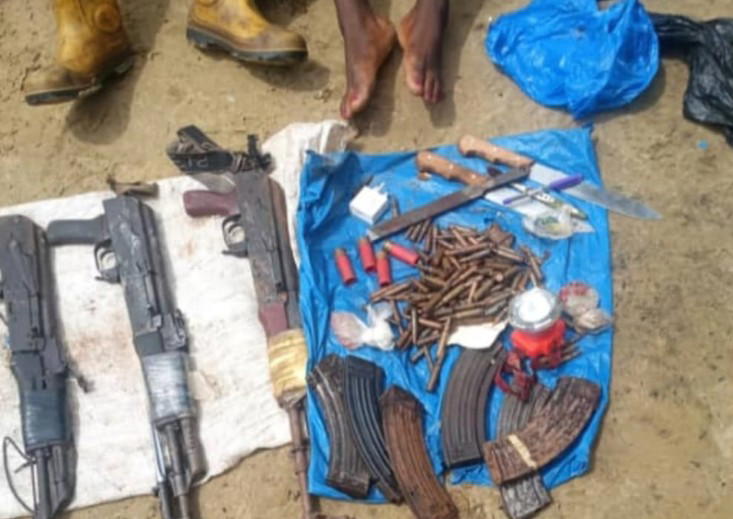
Suspects arrested and paraded by the Army in Ugborodo
For more than two years, the community has remained trapped in a cycle of tension, allegations, sporadic violence and deepening mistrust, forcing many residents to flee their ancestral homes in search of safety. Some indigenes alleged they were not merely displaced by fear, but deliberately driven out by powerful interests who viewed them as threats to activities in the area. Army’s arrest
The latest development came days ago when the Nigerian Army announced the recovery of four AK-47 rifles and the arrest of two suspects in Ogidigben, one of the quarters in Ugborodo.
The Acting Assistant Director, Army Public Relations, 63 Brigade, Asaba, Captain Shuaib Bawa-Rijau, disclosed in a statement that troops moved into the community following reports of sporadic gunfire and rising insecurity
According to him, the operation led to the recovery of four AK-47 rifles, six magazines, 106 rounds of 7.62mm ammunition, knives, machetes and rain boots.
The statement read: “Troops of Headquarters 63 Brigade/Sector 1, Joint Task Force, South-South, Operation DELTA SAFE, recorded significant operational successes following reports of sporadic shooting in the community”.
Open letter to government
Amid the growing concerns, the Chairman of the Governing Council of Ugborodo Community Trust, Mr. Joseph Olori, appealed to Governor Sheriff Oborevwori to urgently constitute an independent panel of inquiry to investigate the lingering crisis.
In an open letter to the governor, the council called for a probe into allegations of violent invasion, murder, arson, abuse of traditional authority and the displacement of indigenes.
The letter read: “In view of these deeply troubling developments, we respectfully urge Your Excellency to intervene decisively in the interest of peace, justice and the rule of law”.
Sponsored
Perhaps the most troubling concern raised by the council was the alleged mass displacement of youths from the community. According to Olori, more than 80 percent of Ugborodo youths have allegedly fled the area due to intimidation and insecurity, a development he warned could have serious implications for democratic participation ahead of the 2027 general elections.
“With the 2027 elections approaching, many citizens may be unable to participate in voter registration and other electoral processes,” he warned, describing the situation as a dangerous erosion of democratic rights.
Community kicks
But in a sharp counter-position, the Ugborodo Community Management Committee insisted that the community remains peaceful and has witnessed unprecedented unity and development under the current traditional and administrative leadership.
The committee, in its own open letter signed by Secretary Besidone Eyengho and others, stated that Ugborodo had enjoyed stability in the last five years under the leadership of the Eghare-Aja of Ugborodo, Eghare Daniel Odoko Uwawah, and the Emmanuel Onuwaje-led UCMC inaugurated in July 2025.
Caught between the conflicting narratives are ordinary residents, many of whom simply want an end to the crisis and a return to normal life.
Several community members who spoke to Vanguard said only an independent panel of inquiry could uncover the true causes of the unrest and chart a path toward reconciliation and lasting peace.
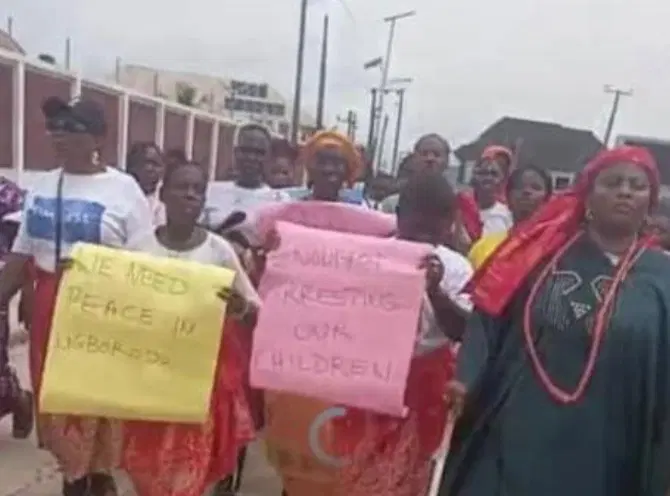
Their fears were reiterated recently by the Voice of Warri Women Kingdom Initiative, led by Mrs. Vivian Mene, whose members staged a peaceful protest at the palace of the Olu of Warri, appealing for urgent government intervention. Mrs. Mene alleged that residents were being harassed and that the crisis was gradually crippling economic activities in the area.
Meanwhile, some community sources alleged that security deployments in the area were focused largely on protecting oil and gas facilities, leaving residents vulnerable. Though the claim could not be independently verified, the perception itself reflects the growing distrust among sections of the community.
One resident, who pleaded anonymity for fear of victimisation, appealed for the deployment of “patriotic security operatives.”
“They only moved troops to protect company operations and not the entire community. We need security men who will do the right thing and not work for those using them,” the source alleged.
For now, Ugborodo remains a community standing at a crossroads : rich in oil, but weighed down by fear; strategically important to the nation’s economy, yet haunted by insecurity and internal divisions. Perhaps, as many residents insist, only an impartial inquiry can separate truth from propaganda, identify those fueling the crisis and offer the troubled community a genuine pathway to enduring peace.
FCT Minister Nyesom Wike has warned that it will be difficult for former Minister of Transportation, Rotimi Amaechi, running mate to the African Democratic...