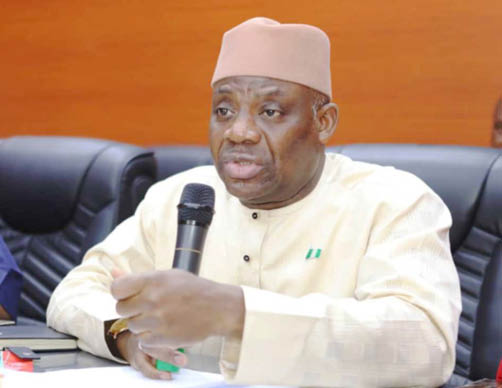
Nigeria’s Minister of Education, Dr Tunji Alausa, has said the deployment of off-grid solar solutions across educational institutions is helping to improve learning conditions.
The off-grid solutions are being rolled out under the Energising Education Programme, executed by the Rural Electrification Agency.
Speaking during a recent interview on the Afropolitan Podcast, Alausa said unsustainable utility expenditures and persistent national grid failures had historically undermined academic stability, crippled scientific research and lowered the overall standard of campus living.
He explained that delivering a dependable learning environment required taking universities off conventional transmission lines entirely.
According to the minister, transitioning tertiary institutions to dedicated solar mini-grids would protect lecture halls and student accommodations from recurring power outages.
“We are taking our campuses off the national grid with dedicated solar power. You cannot build a modern university system where students cannot read at night, laboratories lose power in the middle of experiments, and hospitals attached to our universities are forced to run on noisy, expensive diesel generators,” he said.
Alausa further noted that high energy costs and unreliable power supply had placed an unsustainable financial squeeze on university administrators.
“The burden of electricity tariffs has been one of the heaviest strains on university finances. Instead of universities sinking hundreds of millions into electricity bills every single month- funds that should be expanding faculties or buying equipment- we are solving this structurally with clean, captive energy that operates around the clock,” he stated.
The minister reaffirmed that providing constant, self-sustaining power to tertiary institutions formed a central pillar of the administration’s broader human capital development drive, positioning Nigerian universities as globally competitive research centres capable of anchoring long-term economic transformation.
He added that beyond the immediate benefits, the government had established the Renewable Energy Asset Management Company as a special-purpose vehicle to maintain the mini-grids deployed.
“As Minister, I don’t just want to leave projects that will deteriorate after two years; we are aiming for sustainability that will last beyond my tenure,” he said.