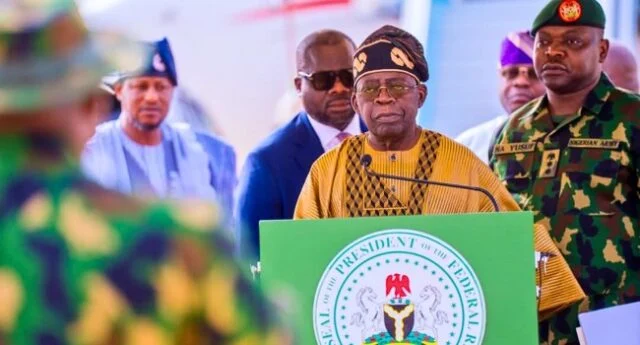
President Bola Tinubu on Friday declared insecurity and poverty as national emergencies, saying both crises pose serious threats to jobs, productivity and Nigeria’s overall stability.
The President made the declaration during the 2026 Workers’ Day celebration held at Eagle Square, Abuja, where he addressed thousands of workers and labour leaders.
Represented by the Secretary to the Government of the Federation, Senator George Akume, Tinubu said there could be no meaningful employment or economic growth in an atmosphere of fear and hardship.
This was contained in a statement by the SGF’s media aide, Yomi Odunuga.
He acknowledged that insecurity and poverty remain significant obstacles to national development, but assured all that his administration is tackling both challenges with urgency through coordinated and sustained actions.
“There cannot be decent work where workers fear for their lives, where wages cannot feed a family, or where insecurity disrupts farms, factories, markets, and other economic activities.
“These hydra-headed challenges, the government notes, have been treated as a national emergency due to their impact on productivity, livelihoods, and the confidence of both workers and employers.
“The administration also acknowledged that insecurity and poverty remain major obstacles to building a peaceful Nigeria where citizens can sleep with their eyes closed, and to achieving the Decent Work Agenda as envisioned by the International Labour Organisation.
“The agenda is not merely an international framework but a national imperative, aligned with its vision of a country where hard work is rewarded, opportunities are accessible without discrimination, and every citizen can reach their full potential, ” he said.
Tinubu cited the Community Protection Guards Initiative, which he said has recruited 45,000 young Nigerians to strengthen community security while creating jobs.
He also highlighted economic and social interventions under his Renewed Hope Agenda, including expanded cash transfer programmes reaching 15 million vulnerable households and lifting an estimated 7.5 million Nigerians out of poverty.
According to him, major infrastructure projects such as the Lagos-Calabar Coastal Highway and the Ajaokuta-Kaduna-Kano Gas Pipeline have generated over 600,000 jobs nationwide.