***Says: We were forced to trek through forest at night
***lThey ate cocoyam, noodles, drank from a waterfall for 56 days —Victims’ relative
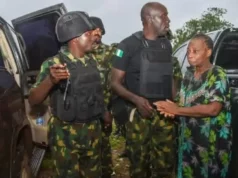
Mrs Alamu spoke after she and the rescued teachers and pupils were officially handed over to Governor Seyi Makinde at the Governor’s Office, Secretariat in Ibadan.
Describing life in captivity, she said the victims spent most of the 56 days in the open forest, exposed to harsh weather conditions while struggling to keep the children alive and emotionally stable.
Narrating her ordeal while in captivity, she said: “You can only imagine it. It was not easy. We were in the forest, in the open, most of the time, under the sun and under the rain, with the children. But we kept going because there was no way out.
“We knew it was only God that could help us, and we believed people were praying for us. That kept us going.”
The rescued principal disclosed that although she was not physically assaulted, several of the younger pupils endured severe beatings whenever they cried or made noise.
She said: “Personally, I was not beaten, but some of the children were beaten. What they hated most was noise because they believed it could attract attention.
“The youngest children suffered the most. They would tie their mouths with pieces of cloth and beat them very well.”
Revealing that the male victims suffered harsher treatment, she said: “The men had it worse than us. They were blindfolded, handcuffed and chained on their legs.”
Despite the harsh conditions, Alamu said none of the victims was sexually molested during the period in captivity.
“There was no form of molestation”, she added.
Relocating captives
According to the principal, the kidnappers constantly relocated the captives whenever they feared their hideouts had been discovered by security forces, forcing adults and children to embark on exhausting nighttime journeys through difficult terrain.
She said: “When the place was discovered, we had to move, and that usually started around seven or eight at night. Sometimes we walked for three to four hours. That is why you see bruises on our bodies.
“The younger ones were carried, but the older children had to walk. They fell many times. It was very difficult.”
10 motorcycles were used to move us
Alamu also narrated how the victims were initially transported deeper into the forest after the abduction.
She said: “My car was used to convey us to a point where we met the primary school pupils and their teacher.
“From there, we walked for about one hour before they brought motorcycles. About 10 motorcycles were used to move us for more than four hours through bush paths they knew very well.”
Reflecting on the impact of the experience on her teaching career, Mrs Alamu admitted that returning to remote rural postings would now require enormous courage.
Her words: “I have worked for 28 years, and I have just about four years to retire. Going to rural areas now will take the grace of God.
“Before this happened, I had already sacrificed a lot because of the distance. Now, coupled with this experience, I don’t know what will happen. I want to see my husband. When I get home, I can think of every other thing,”
They ate cocoyam, noodles, drank from a waterfall, victims’ relatives recount
Also speaking, a relative of one of the pupils rescued after spending 56 days in captivity revealed that the children survived mainly on cocoyam and noodles while drinking water from a nearby waterfall deep inside the Oyo National Forest, where they were held by Ansaru terrorists.
The revelation came as more details emerged on the painstaking efforts by security agencies that culminated in the rescue of the 39 pupils and seven teachers abducted by the terrorists in Oriire Local Government Area of Oyo State.
The relative, who identified herself simply as Olasunbo, described one of the rescued pupils as her nephew.
She said: “We never rested from the day news of the abduction broke. We went from one prayer house to another and also joined online prayer sessions, both day and night. That child is my sister’s first, after seven years of childlessness, so you can imagine the tension we went through.
“My nephew told us they survived mostly on cocoyam and noodles throughout their time in the forest. Sometimes they ate only once a day and drank water from a waterfall near where they were kept.
“From what he narrated, the place was deep inside the forest. They hardly saw anyone apart from the terrorists guarding them. I was spending the weekend with my sister when news of their release reached us. They looked exhausted when they returned, but we thank God they came back alive.”
Expressing gratitude to God for the rescue, she said: “As a family, we are grateful to God and to all the security personnel who risked their lives to rescue them. We understand that some officers paid the supreme sacrifice during the operation, and we pray that God comforts their families.”
How synergy among security agencies paid off
Meanwhile, the rescue operation involved personnel drawn from the Defence Headquarters, the Office of the National Security Adviser, ONSA, the National Counter Terrorism Centre, NCTC, the Nigerian Army, the Nigerian Navy Special Boat Service, SBS, the Nigerian Air Force, the Nigeria Police Force, the Department of State Services, DSS, and other members of the Joint Interagency Task Force.
Although different accounts of how the operation unfolded have emerged from security sources, they all point to weeks of painstaking intelligence gathering and coordinated operations before the eventual recovery of the victims.
Security sources revealed that at least two rescue operations were carried out before the pupils and teachers were eventually freed last Friday.
Ransom negotiations as bait
One security source told Vanguard that one of the earliest breakthroughs came after security operatives reportedly used ransom negotiations as bait to expose members of the terrorists’ network.
According to the source, one suspect was arrested during the process, and intelligence obtained from him enabled security agencies to identify the routes through which food, logistics and other supplies were being ferried to the terrorists inside the forest.
“The information proved invaluable. It enabled security agencies to map the terrorists’ supply routes and gradually cut off their logistics,” the source said.
Another security source, who gave a different account of the operation, disclosed that the initial rescue effort involved a direct military offensive aimed at locating and rescuing the abducted pupils and teachers.
According to the source, troops engaged the terrorists in a fierce gun battle deep inside the forest, but the operation came at a high cost as some security personnel lost their lives in the exchange.
According to him, the long and exhausting marches through thick vegetation and rugged terrain, coupled with the need to avoid detection, slowed the operation but were necessary to protect the hostages and maintain the element of surprise.
Casualties of rescue operation
The operation, however, came at a high cost.
Among the fallen was Lt. Felix Ademe Isaac, a 28-year-old Nigerian Army officer whose courage at the outset of the operation was described by colleagues as instrumental to the mission’s eventual success.
Lt. Isaac was laid to rest with full military honours last Friday, the same day the rescued pupils and teachers regained their freedom after 56 days in captivity.
Military sources said he led the initial assault team into the forest, firing the first shots as troops attempted to breach the terrorists’ position.
During the operation, his convoy reportedly struck improvised explosive devices, IEDs, planted by the terrorists, resulting in his death.
Although he did not live to witness the successful rescue, colleagues said his sacrifice, along with those of other fallen security personnel, laid the foundation for the intelligence-led operation that ultimately secured the victims’ safe return. “We will never forget him,” one of his colleagues said, describing the late officer as a gallant soldier who paid the supreme sacrifice in the service of his country.
A military source said the setback prompted security commanders to reassess their strategy, shifting from a largely kinetic approach to a more intelligence-driven operation that combined surveillance, inter-agency coordination, sustained pressure and the disruption of the terrorists’ logistics and support network, a strategy that ultimately paved the way for the safe recovery of the hostages.
Victims’ location uncovered
Multiple security sources further explained that the abductors chose an extremely secluded location within the vast Oyo National Forest, keeping the pupils and teachers in a concealed shelter close to a flowing stream deep inside the rugged terrain.
According to one of the officers involved in the operation, the thick vegetation covering the area posed a major challenge to rescue efforts, as it significantly limited the effectiveness of aerial surveillance and other technological assets deployed to track the terrorists.
“The area was heavily covered by trees and undergrowth. Visibility from the air was poor, making it difficult to determine their exact position. The environment provided natural cover for the abductors and complicated efforts to locate the victims,” the source said.
Vanguard gathered that investigators eventually recorded a breakthrough through intelligence gathering and communication interceptions.
The source explained that the terrorists periodically moved to locations where they could access communication signals, inadvertently creating opportunities for security operatives to monitor their activities and narrow down their whereabouts.
Armed with the fresh intelligence, security agents pushed deeper into the forest, relying heavily on local guides and hunters familiar with the terrain.
In several instances, the operatives reportedly trekked for between eight and 10 hours, covering long distances through difficult and largely inaccessible terrain before reaching areas suspected to be the terrorists’ hideouts.
According to sources, the continuous flow of intelligence enabled operatives on the ground to maintain their bearings, adapt to changing situations and navigate the dense forest without jeopardising the safety of the hostages.
“Even after security agencies established the general location where the pupils and teachers were being held, commanders deliberately refrained from launching a direct assault, mindful of the risk of exposing the hostages to crossfire. Instead, they sustained military and intelligence pressure on the terrorists, gradually restricting their movement and cutting off their support network. The strategy ultimately paid off, as the abductors became increasingly isolated, making it difficult for them to continue holding the victims before they eventually released them,” one of the security sources said.
Ex-military personnel hail operation
Retired senior military officers have commended the Nigerian Armed Forces and other security agencies for the successful rescue of the 39 pupils and seven teachers, describing the operation as a testament to the growing synergy among Nigeria’s security and intelligence agencies.
Speaking separately to Vanguard, the retired officers said the coordination among the military, intelligence agencies and other security organisations was the defining factor behind the successful outcome.
Brig. Gen. O. Adegbesan (retd), who spoke from the United States of America, said the operation demonstrated that complex hostage rescue missions require “unity of purpose, intelligence sharing and disciplined execution.”
Adegbesan said: “No single service can successfully execute an operation of that magnitude in isolation. What happened in Oyo shows the value of intelligence fusion, coordination and sustained pressure. That is the lesson Nigerians should take away from this operation.”
Another retired senior military officer, Danjuma Saidu, said the operation underscored the importance of allowing security agencies to work quietly without unnecessary public pressure.
Saidu said: “People often expect dramatic gun battles, but hostage rescue operations are different. The first priority is preserving innocent lives. Sometimes patience achieves what force alone cannot.”
Ransom payment unfounded
The retired generals also dismissed persistent claims on social media that a ransom was paid to secure the release of the victims.
One of them described the speculation as unfounded, arguing that if such a payment had indeed been made, credible evidence would likely have surfaced by now.
“In an operation involving multiple agencies and hundreds of personnel, it is difficult to conceal such a transaction indefinitely. If ransom was paid, as is being alleged, it would most likely have become public knowledge by now.
“What is more evident is the painstaking intelligence work, sustained military pressure and coordinated operations that eventually forced the terrorists to abandon the hostages,” the retired officer said.
He cautioned Nigerians against undermining the sacrifices of security personnel by dismissing every successful operation as the result of ransom payment.
Security analysts said the successful rescue has become one of the clearest examples in recent years of how coordinated intelligence, inter-agency cooperation and carefully calibrated military operations can achieve results without exposing hostages to unnecessary danger, while paying tribute to the officers and men who made the ultimate sacrifice in the line of duty.