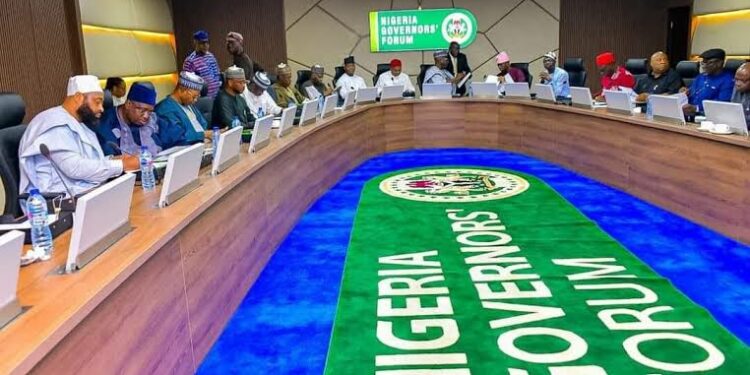
State governors are seeking greater constitutional authority over security operations within their domains and guaranteed funding arrangements for the proposed State Police Services, according to a report of a high-level strategic meeting involving state attorneys-general, legal experts, and senior security officials convened by the Nigeria Governors’ Forum Secretariat in Abuja last week.
The report, contained in the NGF bulletin obtained by The PUNCH, provides one of the clearest frameworks yet for the establishment of state police in Nigeria, detailing proposals on operational powers, funding mechanisms, personnel management, oversight structures, and the relationship between federal and state policing institutions.
According to the report, the meeting was convened to harmonize proposals for a constitutional and institutional framework for the establishment of state police services across the country.
The report described the deliberations as “a significant milestone in ongoing efforts to strengthen the country’s security architecture through a decentralized policing system that balances local security needs with constitutional safeguards and national cohesion.”
The latest push comes amid growing concerns over worsening insecurity across several parts of the country, including terrorism, banditry, kidnapping, communal conflicts, and violent crimes, which have continued to test the capacity of Nigeria’s centrally controlled policing structure.
A major outcome of the meeting was the proposal for greater constitutional recognition of governors’ roles in coordinating security operations within their states.
According to the report, participants reviewed legislative provisions currently under consideration, particularly those relating to governors’ authority in security matters.
“The meeting also reviewed provisions currently under legislative consideration, particularly clauses relating to the authority of governors in directing security operations within their states,” the report stated.
It added that delegates stressed “the importance of recognizing the constitutional role of governors in coordinating security matters within their states while establishing safeguards for professionalism, accountability, and operational independence.”
The proposal is expected to reignite debate over the powers of governors in security administration, an issue that has remained contentious since Nigeria returned to democratic rule in 1999.
Although governors are commonly referred to as the chief security officers of their states, they currently exercise limited direct control over police operations because the Nigeria Police Force remains under federal command.
The governors’ latest recommendations come at a crucial moment in the state police debate, following significant progress recorded by the National Assembly on constitutional amendments aimed at decentralizing policing.
Earlier this month, the House of Representatives approved constitutional amendment proposals seeking to establish state police as part of broader efforts to reform Nigeria’s security architecture and address persistent security challenges across the country.
The amendment seeks to alter relevant provisions of the 1999 Constitution to create a dual policing structure comprising Federal Police Services and State Police Services, with states empowered to establish their own police formations through legislation passed by their respective Houses of Assembly.