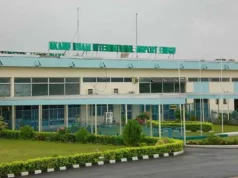
On Thursday, last week, the federal government completed the handover of the Akanu Ibiam International Airport, AIIA, Enugu to Concessionaires, Aero Alliance, who promised to transform the only international airport in the south east into Africa’s leading aviation hub.
The process to concessioning the airport dates back over 20 years ago, revisited under successive administrations as part of airport reform and public-private partnership (PPP) initiatives. The major milestone however came on July 31 2025, when the Federal Executive Council approved the proposal to concession the airport, subject to the final contract.
Another major hurdle was widespread public criticism based on the belief that the airport was being sold outright. When details of a draft concession agreement became public in 2025, reports alleging an 80-year lease generated significant controversy. Many residents, political groups, and stakeholders in the south east interpreted the proposal as a sale of a strategic national asset. The Federal Government however clarified that ownership of the airport would remain with the government, with only the operation and management transferred under a Public-Private Partnership (PPP).
There were also worries about the bidding process, the concessionaire selection process and whether the concession represented value for money. Some aviation experts called for greater disclosure of the concession agreement, evaluation criteria, and financial model before any final approval. Because the airport is the principal international gateway to the South-East, the concession became politically sensitive. Stakeholders sought assurances that the regional economic interests would be protected, local businesses would benefit, airport charges would remain reasonable, and the concession would genuinely improve infrastructure rather than simply transfer public assets to private investors. These hurdles delayed implementation until the government completed regulatory reviews, intensified stakeholder engagement, and clarified that the arrangement was a concession rather than a sale.
On Thursday, therefore, the Federal Government officially handed over the airport to the Aero Alliance Limited, under the PPP arrangement. Aero Alliance will henceforth undertake the financing, rehabilitation, expansion, operation, and management of the airport, ensuring that it meets and sustains internationally recognised standards of safety, efficiency, and passenger experience.
Performing the handover ceremony at the international terminal of the airport, the Minister of Aviation and Aerospace Development, Festus Keyamo, said that governments believes that the private sector would run the airport more professionally and in a more commercially driven manner. He narrated that Governor Peter Mbah requested for the airport concession from President Bola Tinubu to turn Enugu into an aviation and investment hub. Kayamo allayed fears over job losses, noting that the terms of agreement reached by Aero Alliance were such that they would create new jobs rather than trigger job losses.
Governor Mbah described the successful concession of the airport as a major breakthrough and opener of new economic opportunities for the South East, while Aero Alliance vowed to transform AIIA into one of Africa’s leading regional aviation, logistics, and commercial hubs. He said that the concession opens a new chapter of economic possibilities because businesses across the southeast region have for long grappled with logistics constraints that increased costs, lengthened delivery timelines, and limited competitiveness.
The Director-General of the Infrastructure Concession Regulatory Commission (ICRC), Dr. Jobson Ewalefor, said that Enugu Air has signed an agreement for Guangzhou (China) to Enugu flights which he said are enough traffic to create viability.
The Managing Director of Aero Alliance, Saleem Hussain, assured that the consortium would put its over three decades’ experience in the aviation sector to work, focusing on connectivity, cargo and logistics, passenger experience, commercial development, and technology and operational excellence to transform AIIA into one of Africa’s leading aviation hubs.
Ndigbo Angry With Concession
Four days after the handover of the airport to the new private managers, the Igbo Leaders of Thought (ILT) led by Prof. Elochukwu Amucheazi rejected the process, accusing the Tinubu administration of singling out the South East for privatization. The group of Igbo intellectuals, traditional rulers and stakeholders described the concession as another grave act of injustice against Ndigbo and further escalation of the prolonged marginalisation of the region. The Igbo leaders queried why Enugu is the only one of Nigeria’s six international airports slated for private management, while the other five remain under Federal Government funding and control.
“As of today, there is currently no active private concessionaire operating any of the other five international airports in Nigeria, namely, Murtala Mohammed International Airport Lagos, Nnamdi Azikiwe International Airport Abuja, Malam Aminu Kano International Airport, Port Harcourt International Airport and Victor Attah International Airport, Uyo. Why should the case of Enugu International Airport, the only international airport in the South East be different?” the group asked.
They warned that withdrawal of Federal Government funding would compromise the airport’s safety infrastructure, operational efficiency and passenger experience. “Based on our findings, none of the six international airports in Nigeria is profitable. What it means is that they are all relying on government funding to operate. If the federal government stops funding Enugu International Airport, even if for one day, the facilities will go down,” ILT said.
The Igbo leaders pointed to the Federal Government’s recent decision to cancel the concession bidding for the international terminal of Murtala Mohammed International Airport, Lagos, opting instead for a N712 billion structural rebuild through the Renewed Hope Infrastructure Development Fund.
“Festus Keyamo claimed during the handover ceremony that there are bidders for the other five international airports. Why did he not wait for the bidding processes to be concluded, so that all the six international airports would be handed over to concessionaires at the same time, why the haste in handing over Enugu International Airport?”
They recalled that the airport, established in the 1950s by the Old Eastern Region government, was upgraded to international status in 2007. It cost the Federal Government N14 billion under the Yar’Adua and Jonathan administrations to upgrade it, and was opened to international flights in 2013. In October 2019, President Muhammadu Buhari approved a N10 billion special intervention fund for runway rehabilitation, airfield lighting and perimeter fencing. The upgrade was inaugurated in August 2020.
The group added that aviation unions had expressed reservations about the opaque nature of the concession, including possible ties between the concessionaire and state officials. “The handover of Enugu Airport is injustice to the South East. The government should fund Enugu airport like other international airports in the country,” the group demanded.
Aviation Insiders allay fears, optimistic of improved businesses
Some Igbo practitioners knowledgeable with advanced aviation experiences however maintain that the Igbo fears are largely uninformed opinion, expressing substantial optimism with the long time concessioned local wing of the Muritala Muhammed International Airport in Lagos.
Concession Will Boost Enugu Airport, End Bottlenecks, Says Eze
An aviation player of Igbo origin, Onyekachi Eze, stated that the concession of the Akanu Ibiam International Airport will enhance operations, attract more international traffic, improve cargo movement and increase revenue for Enugu State. He said there was no need for the controversy surrounding the concession of the airport, arguing that the arrangement was consistent with global aviation practices and would not diminish the federal government’s oversight of the facility.
He explained that as an international airport, the Federal Government would continue to maintain regulatory interest in the airport through the Federal Airports Authority of Nigeria, the Nigerian Civil Aviation Authority and international aviation standards set by the International Civil Aviation Organization.
“The implication is that as long as it is an airport, the federal government has interest in it, for it to continue to be an international airport, it must continue to comply with the requirements of the NCAA and ICAO,” Eze said. According to him, the concession agreement requires any private operator to add value to airport services rather than merely take over its management. He said the administration of Peter Mbah intends to transform the airport into a major cargo hub, particularly for agricultural exports.
“The operator must add value to the airport services and Governor Peter Mbah knows what he wants. He wants to drive cargo and agricultural produce through the airport, and now there is a proposal for weekly flights from Guangzhou, which is also in keeping with its status as an international airport,” he said.
Eze also expressed optimism that improved operations at the airport could encourage Ethiopian Airlines to deploy larger aircraft on the Enugu route. He recalled that the airline’s operations in Enugu suffered significantly due to the Monday sit-at-home observed in parts of the South-East, which forced many travelers to switch to airports in Abuja and Lagos.
“Ethiopian Airlines was almost crippled by the sit-at-home. It had to adjust its flight schedule because many Igbo travelers began using Abuja and Lagos airports, reducing passenger traffic on the Enugu route,” he said. According to him, the airline considered withdrawing from the route but remained because a significant proportion of its passengers were from the South-East. He noted that increased passenger traffic following the concession would strengthen the route and represent a major milestone for the region’s aviation sector.
Addressing concerns over possible job losses, Eze said workers of FAAN and other aviation agencies would retain their employment under the concession agreement. He added that while some privately operated businesses within the airport premises might be required to relocate or renegotiate tenancy arrangements, the agreement protects existing government workers.
“Nobody will lose his job because the agreement with FAAN is that nobody will lose any job. Agencies like NAMA provide critical services,” he said. He, however, cautioned against increasing toll gate charges or other user fees, warning that higher tariffs could discourage travelers and undermine the objective of the concession. Eze also alleged that traders and travelers using ports and airports in the South-East had, over the years, faced unnecessary bottlenecks, particularly from customs officials, forcing many businesses to divert to Abuja and Lagos. He claimed that importers using the Onne Port often experienced delays that resulted in avoidable demurrage charges, describing the situation as an “economic conspiracy” against the region.
According to him, an efficiently managed concession could help eliminate such bottlenecks and stimulate greater economic activity.
“The concession will add to Enugu’s internally generated revenue. It should encourage more people to use the airport instead of discouraging them,” he said. Eze dismissed fears surrounding the concession, pointing to successful examples elsewhere in the country. He cited the concession of the Murtala Muhammed Airport Terminal Two (MMA2), managed by Bi-Courtney Aviation Services Limited, describing it as one of Nigeria’s most successful airport terminal concessions.
He also noted that parts of the airport infrastructure in Port Harcourt had been concessioned, arguing that the model has become an accepted strategy for improving aviation infrastructure. “There is no need to be skeptical. It is progress, and the minister would not have endorsed it if he did not see optimism in the project,” Eze said.
Airport Concession Will Modernise Enugu Facility, Boost Passenger Traffic – Aviation Expert
Promoter of Aviation Roundtable, Mr. Titus Agbo, said that the concession is expected to increase passenger traffic, modernise airport infrastructure and attract fresh private investments. He said that the bringing in of a private investor would enable the facility to operate closer to international standards while easing the burden on government to finance infrastructure upgrades.
According to him, the concession is likely to result in increased user charges as the concessionaire seeks to recover its investment, but the improvements that would follow would outweigh the additional costs. “It will increase the traffic figure at the airport. Charges will now be obtained from international standard practice so that the infrastructure will also be upgraded. We are likely to pay more because a private investor needs to recover his investment.”
He noted that the additional revenue generated by the concessionaire would be reinvested in modernising airport facilities and improving passenger experience. “The advantage is that the money will now be invested to upgrade the airport. There will be more investments because government may not have enough resources to continually update the airport facilities,” he added.
Agbo said travelers could expect significant improvements in airport services, including the deployment of modern technology to streamline operations. He listed electronic flight information display systems, automated check-in counters and complimentary Wi-Fi services among the facilities that a private operator could introduce to bring the airport in line with global best practices.
“For instance, passengers may no longer have to wait for public announcements to know flight schedules because there could be electronic display systems. There may also be automated check-in counters, while the new investor could provide free Wi-Fi across the airport,” he said. The aviation expert, however, stressed that the actual scope of improvements would depend on the terms of the concession agreement between the Federal Government and the investor.
“We need to see the specifics of the agreement with the Federal Government to know the extent of what will be expected from the investor.” Agbo also highlighted the airport’s medical facility as another asset with commercial potential under the concession arrangement.
He described the clinic at the Enugu airport as one of its strengths and suggested that the private operator could further develop it into a healthcare facility that serves not only airport users but also members of the public. “The Enugu airport has a very good clinic, and the investor can also concession that clinic so that people from outside can be using the facility,” he said.
The Federal Government recently approved the concession of the Akanu Ibiam International Airport as part of efforts to attract private investment into Nigeria’s aviation infrastructure, improve operational efficiency and enhance service delivery at the country’s airports.