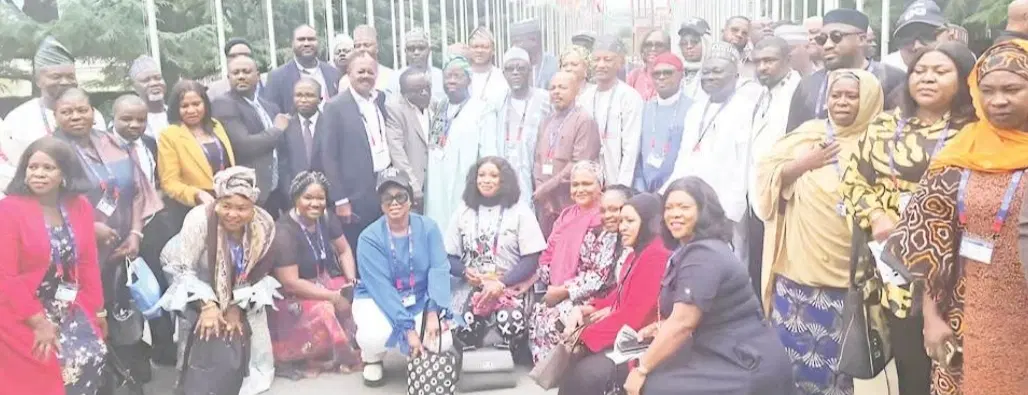
Nigeria’s participation in the 114th Session of the International Labour Conference, ILC, in Geneva, Switzerland, has once again brought into sharp focus a long-standing question surrounding the country’s international engagements: when does representation become excess, and when does participation become performance?
Read Also: Nigeria raises AI concerns at ILC
With an estimated delegation of more than 200 participants, Nigeria fielded one of the largest contingents at the global labour summit held from June 1 to 12, 2026.
Beyond the optics of numbers and visibility, however, the composition of the delegation raises deeper concerns about duplication, administrative bloat, and the effectiveness of what critics increasingly describe as “jamboree diplomacy.”
On paper, Nigeria’s delegation reflects the International Labour Organization’s, ILO, tripartite structure, bringing together government, employers, and workers. In practice, however, the list reveals a far more complex-and arguably bloated-arrangement.
Government delegation
The government side, led by the Minister of Labour and Employment, Muhammad Dingyadi, included participants drawn from multiple ministries, agencies, parastatals, and state governments, extending far beyond the Federal Ministry of Labour and Employment.
Officials from agencies such as the Nigeria Social Insurance Trust Fund, NSITF, Michael Imoudu National Institute of Labour Studies, MINILS, National Productivity Centre (NPC), National Directorate of Employment, NDE, Industrial Training Fund, ITF, Nigerian Maritime Administration and Safety Agency, NIMASA, and the National Salaries, Incomes and Wages Commission, NSIWC, featured prominently.
In addition, officials from Lagos, Rivers, Delta, Kano, Jigawa, Edo, Imo, and Adamawa states were included, often in roles that appeared to duplicate existing federal representation.
While proponents argue that such inclusion promotes federal character and strengthens intergovernmental coordination, analysts question whether such breadth translates into meaningful engagement at the conference.
Employers’ delegation
The employers’ delegation, led by the Director-General of the Nigeria Employers’ Consultative Association, NECA, Adewale-Smatt Oyerinde, also reflected broad industrial representation-from oil giants such as Chevron, Shell, TotalEnergies, Seplat, and NLNG, to manufacturing firms, banks, hospitality groups, and digital platforms such as Bolt and Glovo.
However, the presence of multiple representatives from individual companies, alongside overlapping human resources and public policy personnel, raises questions about functional necessity versus representational inflation.
In several cases, large corporations fielded multiple participants performing similar labour-relations functions, prompting concerns about redundancy.
Workers’ delegation
The workers’ bloc was the largest component of the Nigerian delegation, led by Nigeria Labour Congress, NLC, President Joe Ajaero and the leadership of the Trade Union Congress of Nigeria, TUC.
It included dozens of national union leaders, state council executives, and affiliate representatives from NASU, NUEE, MWUN, RATTAWU, PENGASSAN, NAAT, ATSSSAN, and other unions.
While labour solidarity at international forums is often considered important, the scale of participation-well over 100 individuals-raises questions about efficiency and purpose.
Some labour analysts argue that the sheer number of delegates risks diluting influence rather than strengthening it, particularly when only a limited number actively participate in ILO negotiations and committee work.
Participation without proportional output
Nigeria’s large delegations to international conferences are not new. Similar patterns have been observed at previous labour conferences and other global summits.
What is increasingly coming under scrutiny, however, is whether such large delegations generate measurable diplomatic, policy, or institutional returns.
Critics point to overlapping roles among advisers, observers, substitutes, and accompanying officers; repeated representation by the same agencies; limited post-conference reporting on outcomes; and high logistical and financial costs with unclear performance metrics.
A recurring concern is that international engagements often function more as status exercises than outcome-driven policy missions.
‘Jamboree diplomacy’
At the heart of the debate lies a familiar tension: visibility versus value.
Supporters of Nigeria’s broad representation argue that labour issues are multidimensional and require diverse expertise. They also maintain that exposure to international labour standards contributes to institutional learning.
Critics, however, contend that participation on the scale witnessed at events such as the ILC risks turning structured multilateral engagement into what they describe as a “delegation tourism culture,” where attendance becomes an end in itself.
One observer familiar with Nigeria’s participation patterns described the situation as “a system where presence is confused with productivity and numbers are mistaken for influence.”
It is also commonly alleged that some delegates use the opportunity presented by such conferences to shop extensively or visit relatives and friends across Schengen countries. Others reportedly extend their trips to destinations such as the United Kingdom, the United States, or Canada for personal visits and holidays.
Cost may have exceeded N2.4 billion
Conservative estimates suggest that Nigeria’s participation in the 114th ILC may have cost between N2.1 billion and N2.4 billion.
Based on a review of delegation lists from government, employers, and workers’ groups, Nigeria reportedly fielded between 280 and 325 participants.
Although no official expenditure breakdown has been released, an investigative cost model based on conservative international travel benchmarks raises questions about the financial efficiency of such large-scale participation.
Data compiled from official delegation records indicate significant expansion beyond the core requirement:
* Government delegation: 85-100 participants
* Employers’ delegation: 75-85 participants
* Workers’ delegation: 120-140 participants
In total, the delegation comprised more than 200 named officials, advisers, union leaders, corporate executives, and accompanying personnel, with additional observers and institutional staff pushing the overall figure even higher.
Government representation
The government contingent alone included officials from the Federal Ministry of Labour and Employment, the National Productivity Centre, NSITF, ITF, NDE, NIMASA, NSIWC, and IAP, as well as representatives from the Ministries of Health and Marine and Blue Economy, National Assembly administrative offices, and the governments of Lagos, Rivers, Kano, Edo, Delta, Imo, and Jigawa states.
The N2.4 billion estimate
While official figures have not been made public, an investigative cost model based on a seven-day attendance period provides a benchmark for estimating total expenditure.
Estimated cost per delegate (seven days):
* Airfare (economy/business class mix): N2.2 million
* Accommodation: N2.9 million
* Per diem (day-by-day)and logistics: N1.9 million
* Local transportation and miscellaneous expenses: N0.5 million
Estimated total cost per delegate: approximately N7.5 million.
Applying this estimate:
* 280 delegates × N7.5 million = approximately N2.1 billion
* 325 delegates × N7.5 million = approximately N2.4 billion
Estimated total expenditure: N2.1 billion to N2.4 billion.
Cost breakdown
Estimated expenditure distribution:
* Air travel: 29%
* Accommodation: 38%
* Per diem and logistics: 25%
* Local transportation and miscellaneous expenses: 8%
Accommodation accounted for the largest share of expenditure, followed by air travel and subsistence allowances.
What did Nigeria gain?
Perhaps the most important question emerging from Geneva is not how many attended, but what was achieved.
There is limited publicly available information on key interventions made by Nigeria’s delegation, policy positions advanced or defended, negotiations influenced, or domestic labour policy feedback generated by the conference.
Without such information, the size of the delegation risks overshadowing its substance.
Speaking on the key takeaways from the 114th ILC, NLC President Joe Ajaero said: “I believe the defining issues are the platform economy and artificial intelligence. The discussions in Geneva have underscored the profound challenges posed by technological disruption.
“The world has moved through the agrarian revolution, industrialisation, globalisation, and is now entering the era of artificial intelligence.
“Unfortunately, Africa-and Nigeria in particular-has not fully benefited from the earlier phases of this transformation.
“We have yet to complete our agrarian transition and still struggle with food sufficiency. We have not fully integrated into the global economy, yet the world is already accelerating into the AI age.”
Risks are clear
“If artificial intelligence advances rapidly without adequate preparation in Nigeria, workers could bear the consequences. Employers may increasingly deploy technology to reduce labour costs and maximise efficiency, much as previous waves of technological change displaced workers and altered employment patterns. That is why preparation is essential.
“On the issue of organising informal workers, the Nigeria Labour Congress recognised years ago that the informal economy is now the largest source of employment in the country. The sector employs more people than the organised private sector and the public service combined.
“For that reason, we have expanded our organising efforts to include app-based workers, commercial motorcycle riders, traders, artisans, cosmetologists, cattle dealers, market associations, and many other groups operating outside traditional employment structures.
“However, organising informal workers remains a significant challenge because informality itself makes collective organisation difficult.
“The critical question before us is this: how do we formalise informality That remains one of the most important challenges facing the labour movement today,” Ajaero added.
Nigeria’s presence at the 114th ILC demonstrates a clear commitment to international labour engagement. However, it also exposes a persistent structural challenge: the absence of a clear framework linking delegation size to measurable diplomatic or policy outcomes.
Until such a framework is established, observers warn that Nigeria risks repeating a familiar pattern-large delegations, high visibility, and limited traceable impact.
As one observer put it, the question is no longer whether Nigeria should participate in Geneva, but what purpose that participation serves.