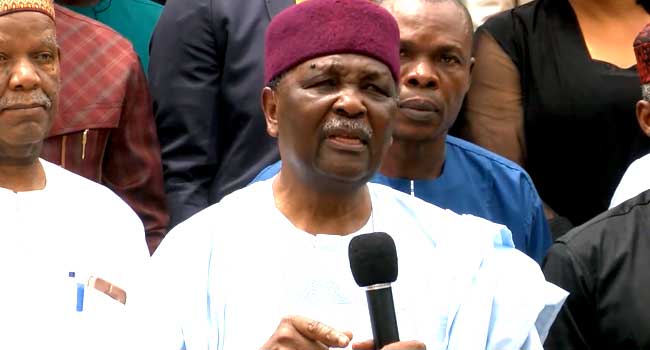
Former Head of State Yakubu Gowon has disclosed that the refusal of the United States and Britain to supply arms to Nigeria during the civil war forced his administration to seek military assistance from the Soviet Union and a Lebanese black-market businessman.
Gowon said the intervention from both sources eventually helped Nigeria turn the tide during the three-year civil war, which lasted from July 1967 to January 1970.
The revelations are contained in Chapter 15 of his 859-page autobiography published by the Havilah Group, Lagos, and titled “My Life of Duty and Allegiance,” unveiled in Abuja on Tuesday. President Bola Tinubu was represented at the launch by Vice President Kashim Shettima.
The autobiography, spanning 36 chapters, chronicles Gowon’s life from his upbringing in Plateau State to his military career, the Nigerian civil war, his removal from office in 1975, and his years in exile and academic pursuits.
In the chapter titled “If The Devil’s Ready To Help,” Gowon detailed the severe ammunition shortages faced by the Nigerian Army in late 1968, revealing that the military’s stockpile had dropped to about half a million rounds.
He explained that the dwindling supplies were worsened by restrictions placed on international arms sales to Nigeria by Western countries.
“As the weeks of fighting wore on, our stock of ammunition was steadily depleted by these wastes, and we could not replenish them because international sales restrictions prevented suppliers from selling military hardware to Nigeria.
“Left with no choice, I ordered the Federal troops to hold their position after the capture of Enugu up to Okigwe and Umuahia because I could not, in clear conscience, commit them to further advance knowing that the ammunition to sustain the effort was in short supply,” he wrote.
Gowon said he was disappointed by the attitude of the United States and Britain, especially as both countries were simultaneously intensifying military operations in Vietnam and Cambodia.
The former head of state recalled summoning the British and American ambassadors for what he described as one of the most critical meetings of the war.
About the meeting, he said, “If I say I’m not disappointed, it will be an understatement.
“I, however, left them in no doubt that I had a duty and responsibility to keep Nigeria united and safe for all Nigerians and other nationals resident in Nigeria.
“As they were about to enter their cars, preparatory to leaving the State House, I said, if I say I’m not disappointed, it will be an understatement, so I will go to any devil to get what I need to deal with the problem, to do my duty to my country, and when that happens, I hope I will not be accused of doing something wrong.”
According to Gowon, the ambassadors left without making any commitments.
He subsequently directed his principal secretary, Hamza Ahmadu, to establish contact with the Soviet Ambassador, Aleksandr Romanov, at Dodan Barracks.