Nigeria’s 4.43 percent economic growth in the second quarter of 2026 (Q2’26) is masking a deepening industrial crisis, with manufacturing and the broader industrial sector losing ground as services increasingly dominate economic activity, the Manufacturers Association of Nigeria, MAN, has warned.
This came as the senator representing Ogun East, Otunba Gbenga Daniel, said the true measure of Nigeria’s economic progress should be the lived experiences of citizens rather than growth in Gross Domestic Product, GDP, alone, saying that Nigeria cannot have a strong economy without security.
Reacting to the National Bureau of Statistics, NBS, Q2 2026 GDP, report, yesterday, MAN Director-General, Segun Ajayi-Kadir, said the 4.43 per cent year-on-year real GDP growth recorded in the quarter, up from 3.89 per cent in Q1 2026 and 4.23 percent in Q2 2025, masks deep-seated weaknesses in the real economy.
He noted that services accounted for 56.62 per cent of GDP in Q2, while the broader industrial sector contributed only 17.23 per cent and suffered a dramatic slowdown in growth.
“The growth trajectory remains disproportionately service-driven (56.62 per cent of GDP), while the broader industrial sector (17.23 per cent of GDP) is visibly suffocating under severe structural headwinds,” Ajayi-Kadir said.
He described the near-halving of industrial growth as particularly alarming, noting that it fell from 7.46 pe rcent in Q2 2025 to 3.96 per cent in Q2 2026.
According to him, the sharp deterioration was driven largely by the electricity, gas, steam and air-conditioning supply segment, which contracted by 10.63 per cent during the quarter.
MAN also noted that manufacturing’s share of real GDP plunged from 9.57 per cent in Q1 2026 to 7.72 per cent in Q2, while real manufacturing growth eased marginally from 3.29 per cent to 3.24 per cent.
Ajayi-Kadir attributed the weakening performance to the combination of high production costs, exchange-rate pressures, prohibitive interest rates and soaring electricity tariffs confronting manufacturers.
He warned that continued dependence on services and extraction would leave Nigeria vulnerable to external shocks while doing little to expand productive capacity.
“Ultimately, headline GDP growth driven by non-tradable service activities will fail to strengthen foreign exchange reserves, reduce structural inflation, or create sustainable mass industrial jobs. A nation that trades and consumes what it does not produce builds prosperity on quicksand.”
MAN said the trend portends employment fragility, an inflationary spiral, greater FX vulnerability, and erosion of industrial capacity and technological capability.
To reverse the slide, MAN called for urgent intervention in power, industrial finance, FX allocation and local procurement.
It recommended direct power purchase agreements for industrial clusters, matching grants for manufacturers investing in solar and battery systems, credit guarantees to force down lending rates, and a dedicated FX clearance window for raw materials and capital machinery, amongst others.
MAN also demanded stronger enforcement of local procurement, incentives for vehicle assembly, tax relief for domestic supply chains and legally binding implementation of the Nigeria Industrial Policy.
Ajayi-Kadir said Nigeria must urgently move from consumption-led growth to production-led growth, warning that without a stronger manufacturing base, impressive GDP numbers would remain largely disconnected from improvements in living standards and economic prosperity.
Nigerians’ experience, not GDP, measures economy -Daniel
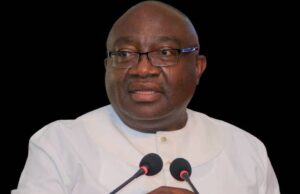
On his part, Daniel spoke, separately, yesterday at the 7th Annual Lecture of Freedom Online in Lagos, and argued that economic growth and security are inseparable.
His comments came days after the NBS reported that Nigeria’s GDP grew by 4.43 per cent year-on-year in the second quarter of 2026, up from 4.23 per cent recorded in the corresponding period of 2025.
According to the senator, although the latest GDP figures and improvements in agriculture and services are encouraging, they did not fully reflect the economic realities confronting Nigerians.
“Nigeria cannot have a strong economy without security, and it cannot have lasting security without a strong economy, which effectively means that both of them are inseparable,” he said.
Daniel said the real test of economic progress is whether Nigerians could secure decent jobs, access their farms safely, operate businesses profitably and attract investment.
He asked: “In our country today, can a young person find decent work? Can a farmer safely reach the farm? Can a manufacturer produce competitively?
“Can a small business survive the cost of power and transport? Can investors commit their resources with confidence?”
The former Ogun State governor described security as an essential component of economic infrastructure, rather than an issue exclusively for the military, police and other security agencies.
He said insecurity has direct economic consequences, noting that farmers who could not safely access their land will be unable to produce enough food, while insecurity along major roads will increase the cost of transporting goods.
Daniel further argued that excessive expenditure on security measures could undermine business competitiveness, while insecurity in communities could discourage both domestic and foreign investment.
He called for an approach that treats security and economic development as mutually reinforcing priorities.