The federal government on Tuesday acknowledged that inflation and insecurity remain major challenges facing Nigerians, even as it defended the economic reforms introduced by President Bola Tinubu’s administration over the past three years.
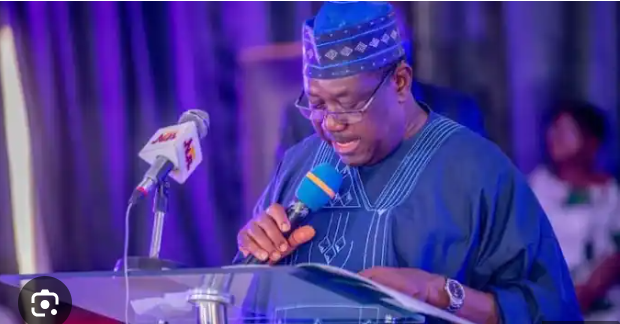
Speaking at a press conference to mark the 2026 Democracy Day celebration in Abuja, Secretary to the Government of the Federation, George Akume, said the government was aware of the hardship caused by its policies but argued that recent economic indicators suggested improvements in key sectors.
Akume stated, “The government, though with all hands on deck, would never claim that every challenge has been solved. While we pursue various reforms diligently, with purpose and with compassion, the government recognises that inflation has been painful, though it is on a downward trend. Government is similarly conscious of the fact that insecurity still threatens lives and livelihoods.”
The briefing, attended by members of the Federal Executive Council, formed part of activities marking 27 years of uninterrupted democratic rule and served as what the SGF described as an accountability exercise by the administration midway into its first term.
While acknowledging public concerns over the cost of living and security, the SGF insisted that government reforms were beginning to yield results.
“Evidence shows that the country is moving in the right direction,” he said.
Akume cited economic figures which he said reflected improvements in output and investment, noting that Nigeria’s Gross Domestic Product grew by 4.07 per cent in the fourth quarter of 2025 and 3.89 per cent in the first quarter of 2026.
The government also used the occasion to highlight the impact of its social intervention programs, including cash transfers, student loans, and consumer credit initiatives introduced since 2023.
According to him, more than one million students have benefited from the Nigerian Education Loan Fund, with over N184bn disbursed for tuition and upkeep.
He also said millions of households had been reached through the Renewed Hope Conditional Cash Transfer program, while government-backed credit schemes had expanded access to formal financing.
The administration further defended its fiscal reforms, including tax measures signed into law in 2025, arguing that the policies were aimed at improving revenue generation and strengthening accountability in public finance.
On anti-corruption efforts, Akume said anti-graft agencies had continued to recover proceeds of crime and prosecute offenders, adding that recovered funds had contributed to financing the student loan scheme.
He also linked Nigeria’s removal from the Financial Action Task Force grey list in October 2025 to reforms in anti-money laundering and counter-terrorism financing frameworks.
“Accountability in this administration is sacrosanct,” he said.
Despite the government’s claims of progress, security featured prominently in the SGF’s remarks, with Akume conceding that the challenge remained unresolved.
“We continue to confront internal security challenges. Government will not pretend that insecurity will disappear today without the active support of all Nigerians,” the SGF stated.
He said the administration was expanding the capacity of the armed forces and other security agencies through increased recruitment and funding, while also strengthening cooperation with neighbouring countries and international partners.
Akume appealed to citizens to support security agencies through intelligence sharing and vigilance, describing security as a collective responsibility.
The SGF also used the Democracy Day platform to call for national unity amid ethnic and religious divisions.
“In a country as diverse and plural as ours, development is strongest when trust is stronger than division,” he said.
He noted that the government continued to support interfaith dialogue through the Nigeria Inter-Religious Council and recently approved a National Values Charter aimed at promoting citizenship, tolerance and national cohesion.