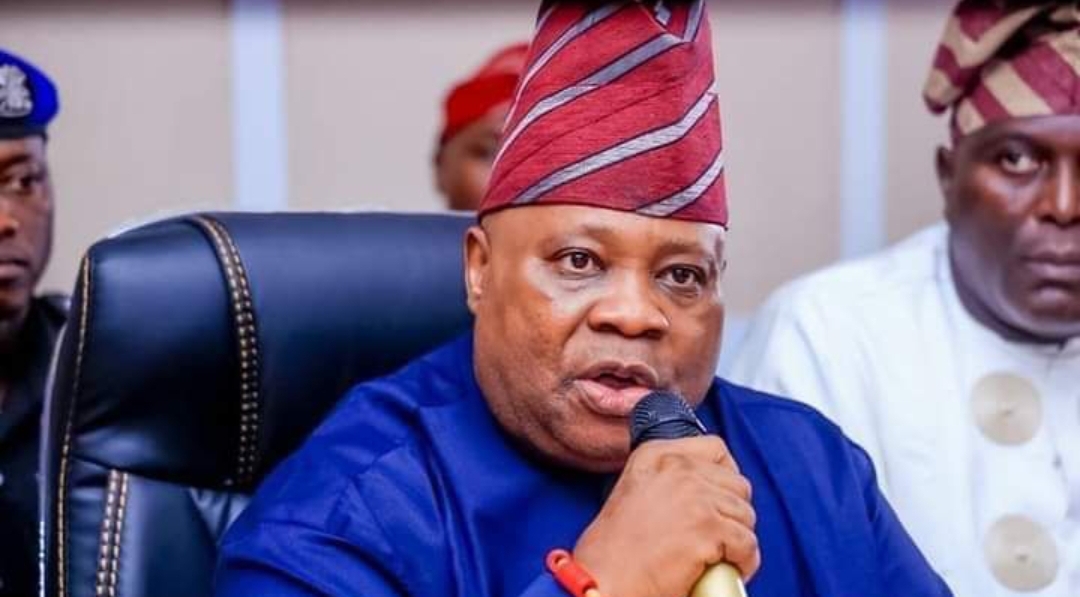
Osun State Governor, Ademola Adeleke, has urged the Federal Government and state governments to prioritise policies that promote production, support businesses and create jobs to ease the rising cost of living.
Adeleke said this on Tuesday in Ilesa at the second Distinguished Public Lecture Series of the University of Ilesa, delivered by the President of the Institute of Chartered Accountants of Nigeria, Queensley Seghosime.
Represented by the Commissioner for Finance, Olusola Ogungbile, the governor said governments must ensure that public funds were spent responsibly, adding that borrowing, when necessary, should support development and improve citizens’ welfare.
He also stressed the importance of security to economic recovery, noting that insecurity on farms, roads and in markets could undermine production and investment.
“Governments at all levels must therefore remain focused on policies that encourage production, support enterprise, create jobs and improve the welfare of the people.
“Security is not merely a matter of protecting lives and property, it is also essential to economic growth and national stability,” Adeleke said.
The governor added that the country’s challenges had reinforced the need for good governance, urging public institutions to remain transparent, accountable and responsive to citizens’ needs.
In her lecture, titled ‘Accounting for Economic Resilience: Addressing Inflation, Fiscal Sustainability, Insecurity and Governance Challenges in Nigeria’, Seghosime said economic reforms would only be successful when Nigerians felt their impact in their homes and businesses.
Represented by the First Deputy Vice President of ICAN, Dr Oye Akinsulire, she said Nigeria had reached a critical point where the difficult reforms introduced in recent years had sought to restore macroeconomic stability.
She, however, cautioned against treating economic stabilisation as the ultimate goal, saying its benefits must translate into improved living standards.
According to her, the success of reforms should be measured by whether households experience relief and businesses gain greater confidence to plan and operate.
“Economic stability becomes meaningful when citizens experience greater purchasing power, businesses can plan with greater confidence and households can begin to rebuild their standard of living,” she said.
Seghosime said Nigeria needed to address the structural factors driving inflation by improving agricultural productivity, energy supply, transportation and storage, while strengthening domestic production and maintaining credible monetary and fiscal policies.
She also noted that the country’s recurring challenges with inflation, fiscal pressure and exchange-rate volatility underscored the need to build economic resilience during favourable periods.
Earlier, the Vice-Chancellor of the University of Ilesa, Prof. Taiwo Asaolu, said the lecture series was established to commemorate the institution’s Founders Day.
The PUNCH had earlier reported that the Executive Chairman of the Federal Inland Revenue Service, Dr Zacch Adedeji, offered to partner with Nigerian tertiary institutions to develop them into innovation incubators capable of providing solutions to real-world problems.
Adedeji made the offer while delivering the university’s 2025 Distinguished Lecture on ‘Economic Resilience in an Era of Dwindling Revenue’.
He discussed Nigeria’s economic challenges and outlined measures adopted by the tax agency under his leadership, including automation and digitisation, expansion and modernisation of the tax base, collaboration with states on tax harmonisation and institutional reforms to build public trust.