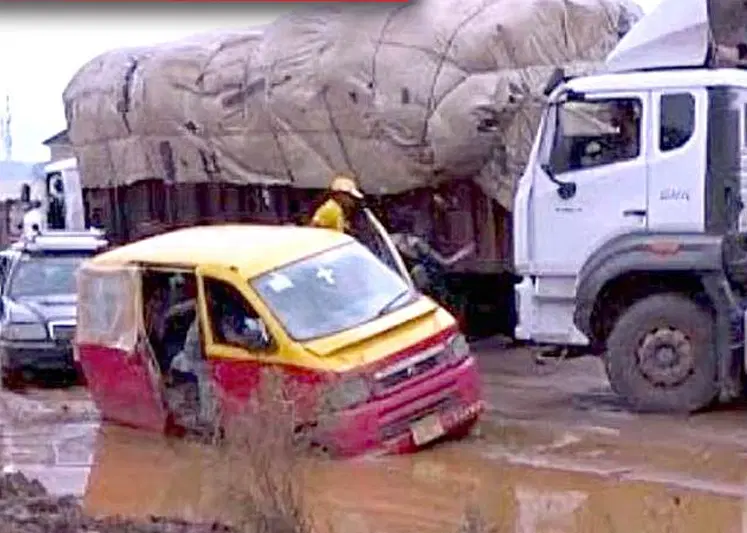
An activist and Publisher of Common Good Letter, Rev. David Ugolor, has called on the Federal Government to fully disclose the details of its emergency intervention on the Benin-Asaba Road.
Ugolor said while the intervention by the Federal Ministry of Works was necessary to ease the hardship faced by motorists and other road users, Nigerians deserved transparency on the scope, cost and legal basis of the exercise.
He said the deployment of more than 50 pieces of equipment for emergency works on the road was a necessary response to the severe hardship suffered by motorists, transporters, businesses and communities along the strategic corridor.
“For too long, road users have endured gridlock, damaged vehicles, increased transport costs, lost working hours and serious safety risks. We therefore welcome President Bola Tinubu’s decision to authorise the Federal Ministry of Works to intervene in the overriding public interest,” he said.
Ugolor also acknowledged the roles of the Minister of Works, Senator David Umahi; Edo State Governor, Senator Monday Okpebholo; Delta State Governor, Rt. Hon. Sheriff Oborevwori; members of the National Assembly and communities whose advocacy, he said, helped draw national attention to the condition of the road.
However, he said the emergency intervention should be regarded as a rescue operation rather than a resolution of what he described as the underlying concession issues.
“The intervention confirms that the concession has failed to deliver,” he said.
According to Ugolor, the Benin-Asaba corridor was concessioned to the Benin-Asaba Expressway Concession Company under a 25-year public-private partnership, under which the concessionaire was expected to mobilise private financing, reconstruct the highway and recover its investment over the concession period.
He said the Federal Government had acknowledged that the pace and manner of execution fell short of the concession agreement.
Ugolor said the Works Minister had also disclosed that the concessionaire failed to accept the government’s proposed intervention options; that the government was contractually required to seek the concessionaire’s permission before intervening; that asphalt had been removed from some sections of the road, leaving the base exposed; and that equipment previously deployed by the concessionaire had been substantially reduced.
He added that the Federal Government would bear the immediate cost of the emergency intervention, while the entire highway would be redesigned for reinforced concrete pavement.
“These disclosures raise fundamental questions about how the concessionaire was selected, whether it possessed the required technical and financial capacity, what safeguards were included in the agreement and how the project was supervised,” he said.
Ugolor argued that the emergency intervention should not replace an accountability process.
“A rescue operation cannot replace an accountability process. The emergency intervention may make the road passable, but it does not explain how a major federal highway concession reached this point,” he said.
He urged the government to establish responsibility and a lawful cost-recovery mechanism before public funds are used to address obligations assigned to a private concessionaire.
“Otherwise, Nigerians may pay twice: first through the concession arrangement and again through emergency public expenditure,” he said.
Ugolor called on the government to disclose the cost and duration of the emergency intervention, the companies supplying equipment and carrying out works on each of the three sections, as well as the legal and procurement authority under which the equipment and contractors were engaged.
He also demanded disclosure of the applicable rates for equipment hire, materials, labour and supervision; the road sections, quantities and specifications covered by the intervention; the source of funding and whether the expenditure was appropriated; and the quality-control, traffic-management and completion arrangements.
He further asked the government to clarify whether the cost would be recovered from the concessionaire, its performance bond, insurers or guarantors.
Ugolor said the Minister’s clarification that no new contract was awarded to Hitech or another company was helpful but did not remove the need for procurement transparency.
“Equipment hire and emergency works still involve public expenditure and must be documented, competitively priced where possible, audited and publicly reported,” he said.
He also questioned the reported requirement for government to obtain the concessionaire’s permission before intervening on the road.
“The claim that the concession agreement required the government to obtain the concessionaire’s permission before intervening deserves urgent scrutiny,” he said.
According to him, a properly structured public-private partnership should contain emergency-intervention and government step-in provisions to protect public safety and essential services.
He called on the Federal Government and the Infrastructure Concession Regulatory Commission (ICRC) to publish the relevant provisions of the concession agreement and explain who drafted and approved them, the government’s step-in rights, what constituted concessionaire default, the performance guarantees required and penalties applicable to delayed delivery.
He also asked them to clarify whether termination rights were adequately protected and why the agreement apparently prevented timely emergency intervention.
“If the concession agreement failed to protect the public interest, those institutional and procurement failures must be identified and corrected, not hidden behind the description of the project as an inherited problem,” Ugolor said.