The Abia State Nigeria Climate Adaptation–Erosion and Watershed Project (NEWMAP-EIB), in partnership with the University of St Andrews, United Kingdom, has called for deeper collaboration among governments, host communities, civil society organisations and international development partners to strengthen environmental governance and promote the sustainable management of natural resources across the Niger Delta.
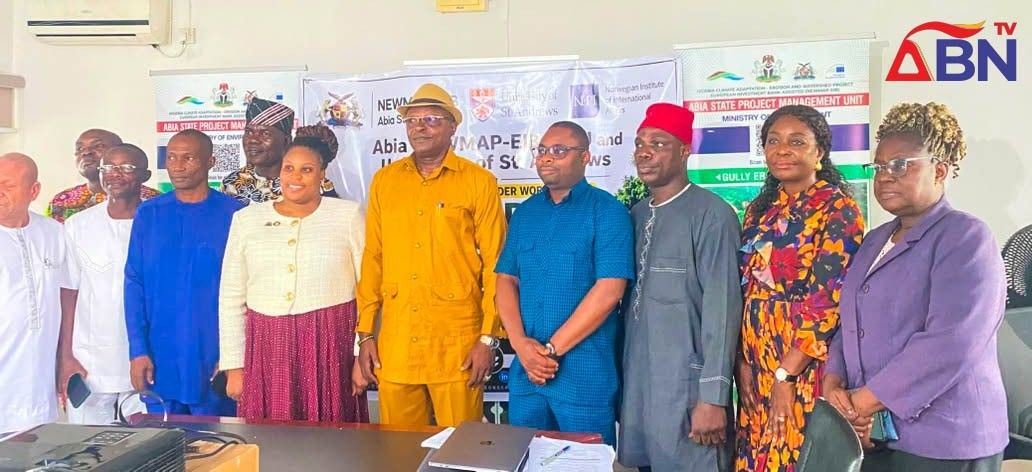
The call was made during a one-day stakeholder workshop held in Umuahia with the theme, “Rebundling Sovereignty over Local Nature in Global Governance (RESOLVING).” The workshop brought together directors from relevant ministries in the nine Niger Delta states, environmental experts, policymakers and development partners to examine emerging challenges and opportunities in environmental governance.
Welcoming participants, the Project Coordinator of Abia NEWMAP-EIB, Dr. Nkiruka Chidia Maduekwe, described the workshop as a strategic platform designed to facilitate meaningful dialogue, exchange practical experiences and identify sustainable solutions to the environmental challenges confronting the region.
She expressed appreciation to the Abia State Ministry of Environment, the supervisory ministry of the project, and the University of St Andrews for their partnership in organising the workshop.
According to Dr. Maduekwe, while NEWMAP is widely recognised for its erosion control and watershed management interventions, its greatest strength lies in fostering collaboration among government institutions, local communities and development partners to tackle environmental degradation.
She stressed that environmental challenges such as erosion, flooding and climate change go beyond engineering concerns, describing them as social and institutional issues that require inclusive governance, effective leadership and collective action.
The Project Coordinator recalled a recent visit by officials of the Ministry of Environment and the NEWMAP team to an erosion-ravaged community following a distress call, saying the experience underscored the devastating impact of environmental degradation on affected communities.
She encouraged participants to engage openly during the discussions, assuring them that their contributions would remain confidential to promote frank conversations capable of informing future environmental policies and interventions.
Speaking on behalf of the University of St Andrews, the Lead Facilitator, Dr. Cyril Effiong, explained that the workshop forms part of an international research project aimed at understanding how decisions affecting land, forests, coastlines, fisheries and other natural resources are made within local and global governance systems.
According to him, the research also seeks to examine the influence of international funding institutions and other external actors on environmental governance across the Gulf of Guinea.
“This is not a lecture session. We are here to learn from your experiences. We want to understand what is working, the challenges you face, and how together we can contribute to improving environmental governance locally and globally,” he said.
The workshop commenced with an opening prayer, followed by the rendition of the Nigerian National Anthem and the Abia State Anthem.
Delivering the keynote address on behalf of the Commissioner for Environment, the Permanent Secretary of the Abia State Ministry of Environment reaffirmed the commitment of Governor Dr. Alex Otti’s administration to environmental sustainability, climate resilience and responsible natural resource management.
He said the state government had institutionalised sustainable development through the Abia State Development Plan (2024–2050), which integrates environmental sustainability into critical sectors, including infrastructure, agriculture, urban planning and public health.
The Permanent Secretary disclosed that the state is implementing climate budget tagging to enhance accountability in climate-related spending while developing bankable projects capable of attracting climate finance and international investment.
He also highlighted the introduction of electric buses into Abia’s transportation system as part of the government’s efforts to promote cleaner mobility and reduce carbon emissions.
According to him, the Ministry of Environment has established a dedicated Climate Change Department to coordinate climate adaptation and mitigation policies, strengthen environmental regulation and improve stakeholder engagement.
He further noted that the NEWMAP-EIB project has continued to deliver critical erosion control and watershed management interventions aimed at protecting vulnerable communities, critical infrastructure, farmlands and ecosystems across the state.
Outlining the ministry’s policy priorities, the Permanent Secretary listed the expansion of climate adaptation projects, enhanced community participation in environmental governance, stricter enforcement of environmental regulations, improved environmental data systems, increased access to climate finance and stronger inter-agency collaboration.
He observed that although global climate agreements are negotiated at the international level, their implementation largely depends on sub-national governments, making states such as Abia central to Nigeria’s efforts to meet its climate and environmental commitments.
Declaring the workshop open, the Permanent Secretary expressed confidence that the engagement would generate practical recommendations capable of strengthening environmental governance and deepening collaboration among governments, communities, development partners and other stakeholders across the Niger Delta.
The opening ceremony concluded with a group photograph before participants proceeded to the technical sessions of the workshop.