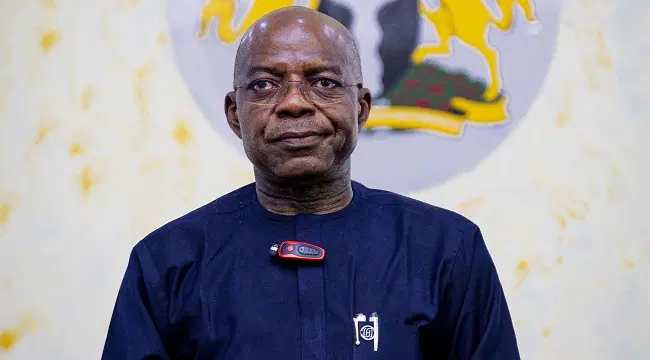
As political parties begin positioning ahead of the 2027 governorship election in Abia State, early political calculations appear to favour incumbent governor, Alex Otti.
With Otti emerging as the governorship candidate of the ruling Labour Party after winning the party’s primary on Saturday, he is set to commence his re-election campaign from a position many analysts consider advantageous.
Beyond the traditional benefits of incumbency, Otti’s growing political capital is largely attributed to what observers describe as visible achievements in governance across key sectors.
From infrastructure development and environmental reforms to urban renewal initiatives, the governor has projected the image of a reform-minded leader, earning support across party lines and broad acceptance among residents.
Political analysts argue that Otti’s greatest challenge may not come from any opposition candidate but from the high expectations of the electorate. His expanding support base, access to state resources, incumbency structure and reputation as a results-oriented administrator have combined to make his re-election bid appear strongly favoured at this stage.
Historically, no sitting governor in Abia State has failed to secure a second term, a trend that many believe further strengthens Otti’s prospects ahead of 2027.
Opiah, APC Face Uphill Task
Among the emerging challengers is Chief Eric Opiah of the All Progressives Congress.
A businessman who gained political prominence ahead of the 2023 election cycle, Opiah hails from the Ngwa axis of Abia Central Senatorial District, the same political bloc as Governor Otti. He is believed to possess substantial financial resources and could benefit from the influence of the ruling party at the federal level.
However, his ambition faces significant political and structural hurdles.
The Abia APC remains divided following controversies surrounding its internal processes and primaries. Prolonged factional disputes have continued to affect the party’s cohesion ahead of the election.
Further complicating matters, former Minister of State for Science and Technology, Henry Ikoh, has challenged Opiah’s emergence, alleging irregularities in the primary process.
Ikoh has petitioned the party’s national leadership, insisting that he was the authentic winner and consensus candidate.
Beyond the internal crisis, analysts argue that Opiah has yet to establish the level of grassroots appeal and emotional connection with voters currently enjoyed by Otti.
Despite the APC’s confidence and perceived federal advantage, the party continues to grapple with longstanding acceptance challenges in Abia, where its grassroots presence is widely considered weaker than that of its rivals.
Political observers also contend that Opiah lacks the statewide political network and mobilisation structure required to unseat an incumbent whose administration is widely viewed as having delivered visible developmental projects.
For many voters, the prevailing mood appears to favour continuity, particularly amid ongoing infrastructure and governance reforms.
Weak Opposition Landscape
Outside the Labour Party and APC, other political parties currently appear to have limited influence in the state’s political equation.
Most aspirants seeking office under smaller platforms are viewed by observers as pursuing political relevance, future bargaining opportunities or access to campaign structures rather than mounting serious challenges for power.
For now, the political landscape in Abia suggests that the 2027 governorship contest remains Otti’s race to lose.
Indeed, many political commentators argue that the governor’s toughest opponent in the election may well be his own record and the expectations it has created among the electorate.