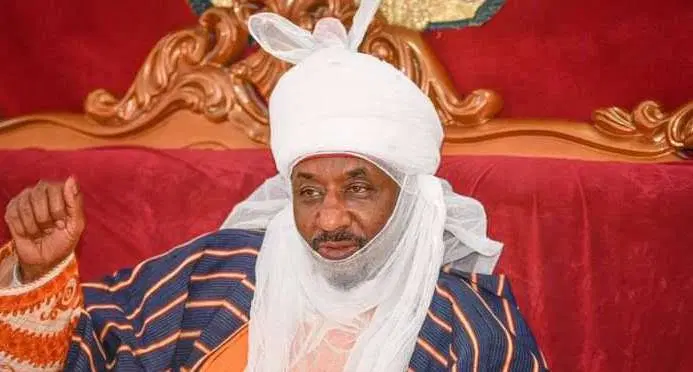
The National Chairman of the All Progressives Congress, APC, Prof. Nentawe Yilwatda, on Tuesday met with the Emir of Kano, Khalifa Muhammadu Sanusi II, in what is believed to be part of the party’s preparations for the 2027 general elections.
Yilwatda, accompanied by senior APC members and party leaders in Kano, visited Emir Sanusi at the Kofar Kudu Palace.
The meeting, which was held behind closed doors, lasted several hours, while details of the discussions were not made public.
However, a palace source said the meeting centred on the 2027 elections and the APC’s efforts to strengthen its support base in Kano.
“The national leadership of the APC was here to solicit the palace’s support and endorsement of all APC candidates in Kano. They have realised the dynamics of Kano politics,” the source said.
The source said the APC leadership recognised Emir Sanusi’s influence within the traditional institution and his reach among residents at the grassroots.
“The APC recognises the influence of Emir Sanusi within the traditional council and the authority he commands at the grassroots in terms of mobilisation and sensitisation on the rights and dignity of the people of Kano,” the source added.
According to the source, the visit also reflected the party’s recognition of the emir’s relevance in the state’s political landscape.
“I want to believe that the APC is aware of the strength and capacity of the Emir of Kano during the last election, even with a sitting governor. So, the APC National Chairman and the leadership in the state are doing their very best to consolidate their strength through the palace,” the source said.
Meanwhile, a public affairs analyst, Usman Usman, dismissed suggestions that Yilwatda’s decision to meet Emir Sanusi amounted to a political miscalculation because he did not visit the 15th Emir of Kano, Alhaji Aminu Ado Bayero.
Usman said the meeting should instead be viewed as part of the APC’s efforts to strengthen its political networks in Kano ahead of the 2027 elections.
He, however, questioned claims about the extent of Aminu Ado Bayero’s political influence and whether it could significantly affect electoral outcomes in the state.
“Political influence is not measured merely by claims of popularity. If an individual is said to command a decisive electoral following, such influence should be demonstrated through observable political outcomes,” Usman said.
He cited the 2023 Kano governorship election as an example, noting that Aminu Ado Bayero was widely associated with former Governor Abdullahi Umar Ganduje and the APC governorship candidate, Nasiru Gawuna.
Despite the association, Usman noted that the APC lost the governorship election in Kano, including at the polling unit linked to the emir’s palace, before losing at the local government and state levels.
“This raises a fundamental question: If Aminu Ado’s political following was as extensive and electorally consequential as the article suggests, where was the evidence of that influence at the ballot box?” he asked.
Usman further argued that Emir Sanusi had maintained significant public visibility, networks and influence despite his removal by the previous APC-led administration.