Home Blog Page 2854

Senate Probes FCC Over Alleged Secret Recruitments

0

The Senate on Thursday said it had asked the management of the Federal Character Commission to react in writing, to the secret recruitment being allegedly carried out by federal ministries, departments and agencies.

The Chairman, Senate Committee on Federal Character Commission and Inter-Governmental Affairs, Senator Danjuma La’ah, stated this in an exclusive interview with our correspondent in Abuja.

He said the FCC management was also expected to show documentary evidence that there was a circular from the Head of Service which placed an embargo on employment.

La’ah added that the FCC was asked by his committee to provide details of the recruitment exercise carried out so far since the supposed embargo and the criteria used in filling vacant positions.

He said the information from the FCC would enable his panel to take a decision on the way forward and how to ensure provision of jobs to the teeming unemployed graduates in the country.

The Senator said, “We have sent an official letter to the FCC and we are still expecting them to give us details of the information we requested from them.

“We have demanded details of the recruitment exercise they’ve carried out since the so-called embargo the MDAs claimed is on employment.

“We also want to know the criteria the MDAs are adopting to carry out the replacement of retired and dead staff.

“We are also aware that some people have left the service voluntarily. How were they replaced? Did the process follow federal character principles?

Read Also: Malami Behind EFCC Move Against Obiano – Anambra Govt

“When we get their response, we would be able to write our report and make necessary recommendations to the Senate for the required actions.”

La’ah had on Wednesday raised the alarm that some officials of the federal civil service were engaged in secret recruitment while claiming that there was an embargo on employment.

He, therefore, challenged heads of the various federal ministries and agencies to provide evidence that there was an official circular, placing an embargo on employment.

He stated this when he defended the 2022 budget report before the Appropriation panel of the red chamber.

Source

Malami Behind EFCC Move Against Obiano – Anambra Govt

0

The Anambra State Government has accused the Minister of Justice and Attorney-General of the Federation, Abubakar Malami (SAN), of allegedly being behind the recent move by the Economic and Financial Crimes Commission against the state governor, Willie Obiano.

The state Commissioner of Information and Public Enlightenment, Don Adinuba, alleged that the EFCC is supervised by the Office of the AGF, while Malami had made efforts to frustrate the recent governorship election in Anambra.

Adinuba, who spoke on Politics Today, a current affairs programme on Channels Television which our correspondent monitored from Abuja on Thursday, stated that EFCC’s action is politically motivated.

He said, “Nobody invited him (the governor) to interrogate him or hear his own side of the story. No petition was presented to him. He did not make any comments. But all of a sudden, the EFCC announced rather secretly…using the media as a third party…to announce that he is being watched. That is very surprising. There is absolutely no reason for that. And worse, the EFCC gave the impression that the governor wants to bolt away when he has a while four months to remain in office.

Read Also: CBN Bars BVN Violators From Opening New Bank Accounts

“It is unimaginable that a governor will abandon a state a whole four months to the end of his tenure. That is surprising. It just does not make sense to anyone simply because the whole exercise is politically motivated.”

When asked who he was referring to, the commissioner said, “I will repeat who these people are. The very people who did not want election to hold in Anambra State and had the audacity to tell the whole nation that the election was not going to hold for security reasons, without clearance with the President.

“Immediately the President got to know of this plot, he was alarmed and said ‘no, the election must hold in Anambra and it must be free and fair’. And the election actually became free, fair and transparent, and its outcome is in sync with the sentiments and expectations of the generality of not only Anambra people but all Nigerians.

“Consequently, Soludo’s victory became a national phenomenon. These people have tried everything possible to stop AGPA’s representative, Soludo, and consequently winning the election. They went as far as approving a Customary Court in Abuja to obtain summons – criminal summons – on Soludo. They went as far as arranging a kangaroo judgment from a High Court in Jigawa State over the chairmanship of APGA and more importantly the authentic candidate of APGA in the November 6 gubernatorial election in Anambra State.”

Source

Anambra Govt Spends N1.58b On Waste Disposal In 10 Months

0

Anambra Government on Friday says it has spent N1.58 billion on waste disposal between January and October, 2021.

Dr Emmanuel Okafor, Permanent Secretary, Ministry of Environment, made the disclosure during the 2021 budget assessment and 2022 budget defense, before the State House of Assembly Committee on Finance and Appropriation.

Okafor said in Awka that N3.8 million was also spent on erosion control across the state.

He said: “The ministry’s budget for year 2021 was N2.166 billion and so far we carried out two major projects, waste disposal, where we have spent N1.58 billion and in erosion control, we spent N 3.8 million.

“We also carried out routine monitoring of the five forest reserves in the state.

“We could not carry out all our proposed projects due to lack of funds. We only made do with the funds released to the ministry within the period.”

READ ALSO: Court Jails Secondary School Student Over Threat To Kill Teacher

The other agencies under the ministry lamented non-release of funds allocated to their agencies to carry out projects.

Mr Chido Obidiegwu, Managing Director, Clear Drainage and Forest Preservation Agency, said that no fund was released to the agency out of the N255 million allocated in 2021.

“We were supposed to carry out desilting of canals, clearing of drains to control flood, recruitment and equipping of more forest guards to protect our forest reserves.

“We wrote lots of proposals to get funds but nothing was released to the agency in 2021,” he said.

Also speaking, Mr Amaechi Akaora, Managing Director, Anambra State Waste Management Authority, said the agency was able to access N64.5 million out of N305 million allocated to it.

The Managing Director of the state’s Leisure Parks and Street Beautification Agency, Mrs Ify Atogu, also complained that the agency got N1.5 million out of N300 million budget allocation in 2021.

CBN Bars BVN Violators From Opening New Bank Accounts

0

The Apex Bank in Nigeria, Central Bank of Nigeria (CBN) has barred BVN Violators from from opening a new bank accounts going by its fresh rule.

The new policy is contained in a Revised Regulatory Framework for Bank Verification Number (BVN) operations and Watch-List for the banking industry released by the apex bank in its Update Report circular.

According to the apex bank, the new framework has been designed to enhance the effectiveness of customer due diligence and Know Your Customer (KYC) processes.

it therefore described the policy as part of its overall strategy for promoting a safe and efficient banking and payment system.

In the circular, the Director, Payments System Management Department, Musa Jimoh, explained that the watch-list is a database of customers identified by their BVNs, who have been involved in confirmed cases of breaches.

He explained that under the new framework, breaches on the part of customer could see the individual getting barred from entering a new relationship with any participant (banks).

Source

https://abntv.com.ng/2021/11/breaking-kaduna-lifts-telecoms-ban-after-three-month-shutdown/

BREAKING: Kaduna Lifts Telecoms Ban After Three Month Shutdown

0

The Kaduna State Government has lifted a three-month telecommunications shutdown it imposed in October due to recent attacks by bandits along the Kaduna-Abuja road.

The Kaduna State Government has lifted a three-month telecommunications shutdown it imposed in October due to recent attacks by bandits along the Kaduna-Abuja road.

The State Government through the Commissioner of Internal Security and Home Affairs, Samuel Aruwan, who announced this on Friday, said the relevant government agency in charge of telecommunication has been directed to lift the ban.

The state government had on the request of security agencies directed the National Telecommunication Commission (NCC) to shut down telecom service in selected local government areas of the state.

However, our correspondent reports that there was an upsurge in banditry, especially along the Kaduna-Abuja road, during the ban.

Aruwan said other measures like the ban on motorcycles, ban on weekly markets, selling of fuel in kegs remain in force.

Source

https://abntv.com.ng/2021/11/more-voters-in-nigeria-than-whole-of-west-africa-inec-chairman/

More Voters In Nigeria Than Whole Of West Africa – INEC Chairman

0

Prof. Mahmood Yakubu, Chairman of the Independent National Electoral Commission (INEC), in this interview with TEMIDAYO AKINSUYI, speaks on how the Commission successfully conducted the Anambra governorship election despite the numerous challenges it encountered. He also speaks on preparations for the 2023 general elections as well as the Direct Primary controversy. Excerpts:

Sir, let me begin by congratulating you on the successful conduct of the Anambra governorship election. Many had thought the election will not hold due to insecurity challenges but you insisted that the November 6 date remains sacrosanct and the election was held. How were you able to weather the storm?

Thank you for the commenda­tion. As you are aware, the Anam­bra Governorship election was held on 6th November 2021 un­der difficult circumstances. The Commission has declared a win­ner and the certificate of return has been issued. Like you rightly said, the election was peaceful and the outcome of the election has been universally adjudged to be credible.

However, the Commission is not unaware of the issues raised about the performance of the new technology deployed for vot­er accreditation. The deployment of the BVAS in the Anambra Gov­ernorship election was the sec­ond pilot test. It was intended to achieve two objectives. First is voter accreditation to replace the Smart Card Reader. The second is the uploading of polling unit re­sult on the IReV portal to replace the z-pad. The BVAS performed optimally in uploading results on the IReV but there were the usual challenges associated with the pilot of a new technology in a major election.

From our assessment so far, much of the glitches encoun­tered on Election Day in Anam­bra State had little to do with the machines but more with the oper­ators of the system. The extraor­dinarily difficult circumstances under which the election was held meant that some of the bet­ter trained ad hoc staff withdrew at the 11th hour. Similarly, some critical service providers such vehicle owners also withdrew thereby severely affecting our plans for rapid response by our technicians – the Registration Area Technical (RATECH) staff. Technical issues relating to the performance of the BVAS will be addressed in the presentation by our Director ICT at this import­ant meeting. Suffice it to say that in spite of the glitches, BVAS has justified our determination to deepen the deployment of tech­nology in the electoral process. Given the credible conclusion of the election, it has strengthened our belief that even the mini­mal introduction of technology in voter accreditation is better than the best manual process. We want to thank the voters in Anambra State for their patience and faith in the new technology. This has also justified the hope of citizens across the country that the deployment of more ap­propriate technology is essential to electoral integrity in Nigeria.

Our response to the glitches encountered started right from Anambra State. This explains there were no challenges report­ed during the supplementary election in Ihiala Local Govern­ment Area held on Tuesday 9th November 2022. I want to reassure Nigerians that we have learnt vital lessons from the Anambra pilot. There will be remarkable improvement in the next major election which is the end-of-ten­ure Area Council election in the Federal Capital Territory (FCT) schedule to hold in three months on 12th February 2022.

The COVID-19 pandemic is another major challenge that INEC under your leadership had to contend with. How has the commission been cop­ing and what steps are you taking since a national election is coming up in less than 600 days from now?

The world was confronted with the emergence of the deadly COVID-19 pandemic in November 2019. The first case was reported in Nigeria on 27th February 2020, forcing the federal and state gov­ernments to take series of actions to protect citizens. The pandemic caused extensive disruptions in the country’s electoral system, forcing the Commission to the postpone four bye-elections in Bayelsa, Imo and Plateau States. The highly contagious nature of the virus meant that the Com­mission cannot conduct these elections without considering how to protect election officials and other stakeholders from the risk of infection. In response, the Commission came up with the Policy on Conducting Elections in the Context of the COVID – 19 Pandemic in May 2020. The pol­icy, which was first of its kind in Africa outlined the measures to be put in place to ensure the safety of citizens that would par­ticipate as voters, candidates, or officials on election day. It was successfully applied during the Nasarawa Central State Constitu­ency bye-election, held on 8th Au­gust 2021 and in other elections thereafter, including the Edo and Ondo Governorship election in September and October this year.

With your experience and knowl­edge so far at the helm of affairs of INEC, what are the challenges in conducting elections in Nigeria?

Nigeria’s size and population make it one of the biggest democ­racies in the world. It is certain­ly the second largest presiden­tial democracy after the United States of America. The size of our voter population and elective institutions make elections in Ni­geria a huge undertaking. This fact is better appreciated within our regional context. There are 15 countries in West Africa today, including Nigeria. However, with the current voter population of over 84 million, Nigeria has about 11 million more registered voters than the other 14 countries put together which have 73.6 mil­lion registered voters. Conduct­ing a general election in Nigeria is like holding election in West Africa and beyond.

Furthermore, the statutory responsibilities of INEC make it both an Election Management Body and Electoral Commission. Section 53 (f) of Part 1 to the Third Schedule the Constitution of the Federal Republic of Nigeria 1999 (as amended) requires the Com­mission to organize, undertake and supervise all elections to the offices of the President and Vice-president, the Governor and Deputy Governor of a state, and to the membership of the Senate, the House of Representatives and the House of Assembly of each State of the Federation. In or­der to do so effectively, there are other extensive responsibilities undertaken by the Commission which include: registration and regulation of political parties, including the monitoring of par­ty and campaign finance as well as their primaries, congresses, meetings and conventions; Na­tionwide continuous registration of voters and the maintenance of the national register of vot­ers; Prosecution of electoral offenders; Creation of polling units; Delimitation of electoral constituencies; Voter education and publicity; Management of electoral logistics; Election se­curity in consultation with the security agencies; Strategic engagement with stakeholders; Formulation of regulations and guidelines for the conduct of elections and electoral activities to give clarity to the provisions of the Constitution and Elector­al Act; and maintenance of ex­tensive physical assets (offices, residential accommodation and other facilities) nationwide.

In addition, elections are held all-year round between one Gen­eral Election and another with no respite. There is no election season any longer in Nigeria. The Commission has to think literally on its feet as it reflects, strategises, and innovates and pilots the new innovations. For instance, since the 2019 General Election, the Commission has conducted 36 elections made up of 5 Governorship constituen­cies (Anambra, Bayelsa, Edo, Kogi and Ondo), six Senatorial Districts, seven Federal Constit­uencies (House of Representa­tives seats) and 18 state Assem­bly constituencies. Yet, there are more elections to be conducted in the next eight months. The Federal Capital Territory (FCT) Area Council elections made up of 68 constituencies (6 Council Chairmen and 62 Councillors) is scheduled to hold on 12th February 2022, followed by the Ekiti and Osun State Governor­ship elections holding on 18th June 2022 and 16th July 2022 respectively. There are also 3 pending Federal constituency bye-elections (Jos North/Bassa in Plateau State, Akure North/ Akure South in Ondo State and Ogoja/Yala in Cross River State) and 3 State constituencies (Ekiti East I in Ekiti State, Shinkafi in Zamfara State and Akpabuyo in Cross River State). While the off-season Governorship elec­tions are known in advance, the bye-elections, mainly caused by the deaths of serving members of the National and State As­sembly, are unpredictable.

What is the latest information on the issue of Continuous Voter Registration (CVR) and Launch of Online Registration Portal by INEC?

You will recall that the Com­mission often undertakes a fresh registration of eligible voters with every general election un­til 2010 when the first reliable biometric register of voters was compiled. Thereafter, the prac­tice is to undertake intermittent registration of voters on the eve of major elections. However, in April 2017, this Commission for the first time began the imple­mentation of the registration of voters on a continuous ba­sis as provided in the Electoral Act. By the time the CVR was suspended in August 2018 to prepare for the 2019 General Election, a total of 14,283,734 new voters had been registered and added to the national reg­ister of voters, increasing the overall number to 84, 004 084. However, the CVR could not resume as planned after the general election due in part to the outbreak of the COVID-19 pandemic in the earlier part of 2020. In our determination to serve Nigerians better and in response to repeated calls by stakeholders, the Commission introduced a dedicated portal for online registration on 28th June 2021. This allows intend­ing registrants to commence the process online by filling the forms, upload their pictures and required documents, and then make an appointment on the web portal for a date and time to visit an INEC State or Local Government Area (LGA) office to give their fingerprints and complete the registration. In addition, those who are already registered as voters can carry out all the other activities such as transfers, correction of per­sonal details and replacement of damaged or defaced Permanent Voters’ Cards (PVCs) online. Ni­gerians have fully embraced and are taking full advantage of the services available on the portal. The Commission has also been updating Nigerians every week on new development since the CVR started. As of 22nd No­vember 2021, the CVR platform had recorded a total of 4,297,494 fresh registrants while 1,856,771 registrants have validated their application.

What is INEC’s position on the controversy trailing the Electoral Act Amendment Bill, especially the Direct primary clause?

Yes, a lot of people have been asking the Commission for its position on the Direct Primary clause which was included in the Electoral Act amendment Bill. But the issue is not about our position, but the process. In the exercise of its constitution­al power, the National Assem­bly has passed the Bill into law awaiting presidential assent. Once the process is concluded, the Bill becomes law and every person and authority in Nige­ria, including the Commission, must obey. The Commission will give expeditious consideration to the law, including the detailed regulations and guidelines for its implementation where nec­essary.

Source

I’ll Relocate To US After My Tenure – Obiano

0

Governor Willie Obiano has told the Economic and Financial Crimes Commission (EFCC) that he will be relocating to his United States base when he leaves office next March.

Reacting yesterday to Wednesday’s placement of the governor on a watch list by the anti-graft agency, Anambra State Commissioner for Information and Public Enlightenment, Don Adinuba, accused EFCC of acting a script.

He said his principal, currently out of the country, never disguised when he embarked on the foreign trip.

The commissioner said the governor has made it public that he would relocate to his U.S. residence at the end of his tenure.

Chief Obiano has never left any person(s) in doubt that he will relocate to his base in the United States once he finishes his tenure.

As early as August 31, 2020, he announced his decision to a meeting of the Anambra State Council of Elders, comprising such personages as the erstwhile Secretary General of the Commonwealth, Chief Emeka Anyaoku; the Obi of Onitsha, Igwe Nnaemeka Alfred Achebe who is also the chairman of both the Anambra State Council of Traditional Rulers and the Southeast Council of Traditional Rulers; a former Anambra State Governor, Dr Chukwuemeka Ezeife; an ex-Minister of Women Affairs, Iyom Josephine Anenih, mni; the founding Director-General of the National Orientation Agency (NOA), Professor Elochukwu Amucheazi; the Archbishop-Emeritus of the Anglican Church in Anambra State, The Most Reverend Dr Maxwell Samuel Chukwunweike Anikwenwa; and the Catholic Bishop of the Awka Diocese, Rev Dr Paulinus Ezeokafor.

Source

https://abntv.com.ng/2021/11/economic-diversification-with-focus-on-non-oil-exports-is-on-course-osinbajo/

Economic Diversification With Focus On Non-Oil Exports Is On Course – Osinbajo

0

The Vice President, Professor Yemi Osinbajo, believes Nigeria is on the right path to economic diversification focusing on non-oil exports, with the zero-oil plan actively promoted by the Nigerian Export Promotion Council (NEPC).

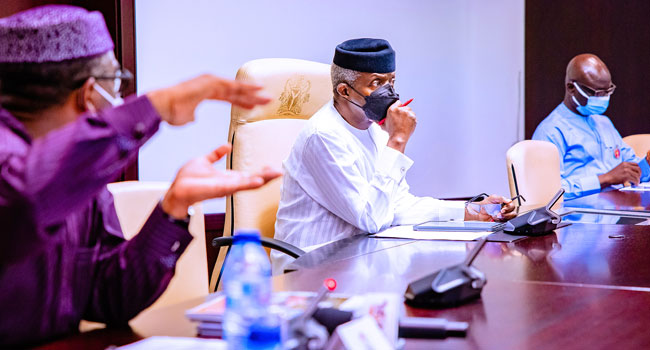
Professor Osinbajo stated this on Thursday when he received a delegation from the NEPC led by its outgoing Executive Director/CEO, Mr Segun Awolowo.

“We are set on the right path, and I like the fact that we are focused on non-oil exports, and we are facing the challenges and we are facing them head-on,” he was quoted as saying in a statement by his spokesman, Laolu Akande.

“In the next few years, those of us who are policymakers and looking at the future, must, today, have a plan. In fact, we have set ourselves on an inevitable course of a zero-oil plan.”

The Vice President commended the outgoing NEPC chief for his foresight, and for putting in place a well-structured and detailed plan.

According to him, it is important to note that Nigeria is certainly getting away from the oil and gas era.

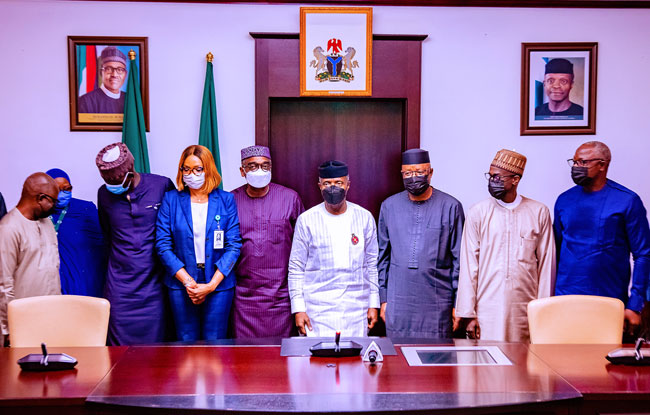
The Vice President, Professor Yemi Osinbajo, with Mr Segun Awolowo and others at the meeting held at the State House in Abuja on November 25, 2021.

Read Also: Court Proscribes Bandit Groups

“In the past, we used to think that it will still take a while but today, with the circumstances and all of the various factors around the world (less dependence on oil, climate change, and COP), it is inevitable,” Professor Osinbajo stated. “Public investments from the EU, from the multilateral organisations for oil and gas, are fizzling out.”

“The Export Expansion Facility Programme (EEFP) is a natural progression for the Zero-Oil Plan,” he said of the efforts put in place by the NEPC to realise the government’s objectives. “If you say you have a zero-oil plan, then you must have a way of improving exports in particular because oil is our major foreign exchange earnings.

“So, if you are going to replace it, then you must have a robust plan, and I think that the EEFP is an incredibly wide door for exports in our country.”

The Vice President tasked stakeholders in the sector to brace up for the challenges ahead, saying “the years to come will test our resolve even more because we are going to be challenging ourselves the more.”

In his remarks, Awolowo gave an overview of the EEFP which he said has been crucial to the economic diversification agenda of the government.

He also highlighted the significant increase in non-oil revenues which he said was at over N1 trillion – representing 15 per cent above the target set.

The outgoing NEPC chief commended the support the council enjoyed from the President and the Vice President in the discharge of its mandates, saying it enabled the council to significantly re-energise the country’s non-oil exports.

“For instance, the Export Development Fund of the NEPC has been activated for the first time under the Buhari administration through the Economic Sustainability Plan,” he said.

Awolowo said through the activities promoted by the council, Nigeria was on track in growing its non-oil sector and urged all stakeholders not to relent in their efforts.

He was accompanied on the visit by the management and some staff members of the council.

Source

Appeal Court Upholds Forfeiture Of Diezani’s $40m Worth Of Jewellery

0

The Court of Appeal sitting in Lagos has upheld the final forfeiture order on the $40 million worth of jewellery seized from the premises of the former Minister for Petroleum, Diezani Allison-Madueke.

Justice Festus Obande, who read the judgment on Friday, held that there was no substance in Alison-Madueke’s bid to overturn the lower court’s order and subsequently dismissed the move by the former Minister to challenge the forfeiture order.

Barring any appeal by the former minister to the Supreme Court, the jewellery are to be forfeited to the Federal Government.

In July 2019 the Economic and Financial Crimes Commission (EFCC), had secured an order from Justice Nicholas Oweibo of the Federal High Court to temporarily forfeit the expensive items to the Federal Government.

According to the schedule attached to the forfeiture application, the jewellery, categorised into 33 sets, includes “419 expensive bangles; 315 expensive rings; 304 expensive earrings; 267 expensive necklaces; 189 expensive wristwatches; 174 expensive necklaces and earrings; 78 expensive bracelets; 77 expensive brooches; and 74 expensive pendants.”

In his application for the final forfeiture order, EFCC counsel Mr Rotimi Oyedepo had told the judge that the items were reasonably suspected to have been acquired with the proceeds of unlawful activities of the former minister.

An investigator with the Commission, Rufai Zaki, in an affidavit before the court insisted that the jewelleries were beyond the former minister’s “known and provable lawful income.”

The investigator further said that findings by the EFCC showed that she started acquiring them in 2012, two years after she was appointed Minister.

The investigator also said that the EFCC was in possession of the details of the bank account through which Mrs Alison-Madueke received her salary as a minister.

Read Also: Court Proscribes Bandit Groups

“The respondent did not utilise her salary or any part of her legitimate income to acquire the assets sought to be forfeited to the Federal Government of Nigeria,” Zaki said.

He said a “damning intelligence report” received by the Commission led to the search of former minister’s house at No. 10 Fredrick Chiluba Close, Asokoro, Abuja.

The former Minister on her part had challenged the seizure of the jewelleries from her premises by the EFCC.

An affidavit filed on her behalf by her counsel, Prof Awa Kalu (SAN), Diezani, who is currently in the United Kingdom, alleged that the EFCC violated her fundamental “right to own property and to appropriate them at her discretion,” under sections 43 and 44 of the constitution.

She also accused the anti-graft agency of entering her apartment illegally and taking the items without any court order.

Source

BREAKING! Court Proscribes Bandit Groups

0

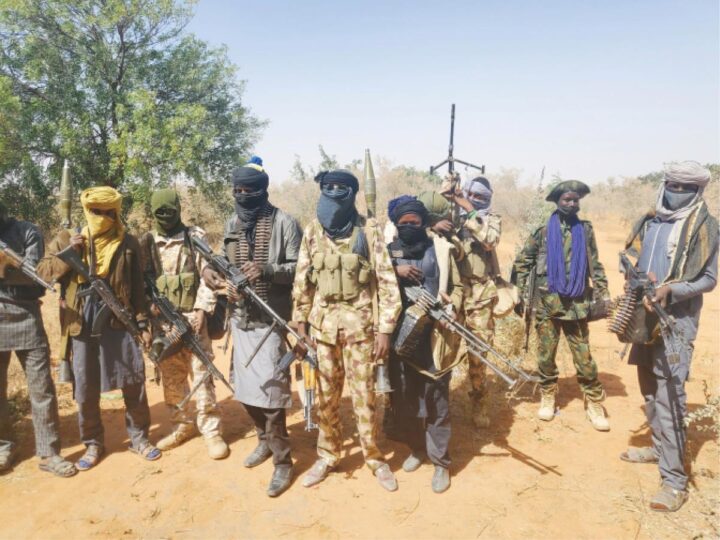
A federal high court in Abuja has declared the activities of Yan Bindiga and Yan Ta’adda bandit groups as acts of terrorism.

Taiwo Taiwo, the presiding judge, gave the order on an ex parte motion filed by the federal government.

Mohammed Abubakar, director of public prosecution (DPP) at the federal ministry of justice, who filed the motion ex-parte, said President Muhammadu Buhari gave approval for his action, of which objective is the proscription of Yan Bindiga and Yan Ta’adda groups and other terrorist groups in the country.

In its supporting affidavits, the federal government said security reports have confirmed that the bandit groups were responsible for the killings, abductions, rapes, kidnappings and related acts of criminality in the northeast, north-central and other parts of the country.

It alleged that the group is responsible for the growing cases of “banditry, incessant kidnappings for ransom, kidnapping for marriage, mass abductions of school children and other citizens, cattle rustling, enslavement, imprisonment, severe deprivation of physical liberty, torture, rape, sexual slavery, enforced prostitution, forced pregnancy, other forms of sexual violence, attacks and killings in communities and commuters and wanton destruction of lives and properties in Nigeria, particularly in the Northwest and Northcentral states in Nigeria are being carried out by Yan Bindiga and Yan Ta’adda groups and other groups associated with or engaged in the same or similar activities as Yan Bindiga and Yan Ta’adda groups in Nigeria.”

Read Also: Kidnapping: Buhari Orders Increased Surveillance, Patrol on Abuja-Kaduna Road

“The activities of Yan Bindiga and Yan Ta’adda groups and other similar groups constitute acts of terrorism that can lead to a breakdown of public order and safety and is a threat to national security and the corporate existence of Nigeria,” the government added.

Delivering ruling on Thursday, the court specifically declared the activities of the “Yan Bindiga group” and the “Yan Ta’adda group” and other similar groups in any part of the country, especially in the north-west and the north-central as “acts of terrorism and illegality”.

The court proscribed the activities of the group as well as other similar groups in any part of Nigeria, “either in groups or as individuals by whatever names they are called”.

The judge also made an order restraining “any person or group of persons from participating in any manner whatsoever, in any form of activities involving or concerning the prosecution of the collective intention or otherwise of the Yan Bindiga group and the Yan Ta’adda group under any other name or platform however called or described”.

The court asked the federal government to publish the proscription order in the official gazette and two national dailies.

Source

Latest News

Popular News Now