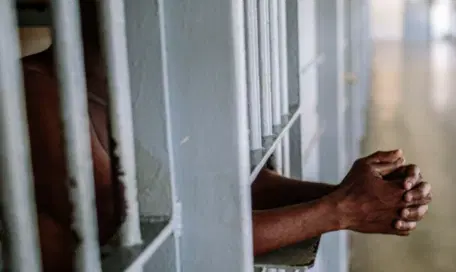
As of February 9, 2026, Nigeria’s total inmate population stood at 80,812.
The Nigeria Correctional Service (NCoS) reported that of this number, 51,955 inmates were awaiting trial, 24,913 had been convicted, and 3,850 were held under other categories.
The Controller-General, Mr. Sylvester Nwakuche, disclosed these figures while appearing before the House of Representatives Committee on Reformatory Institutions in Abuja to present the Service’s 2025 budget performance and 2026 budget estimates.
At that engagement, the CG, Nwakuche, observed that awaiting-trial detainees constitute 64% of the total custodial population nationwide.
Unfortunately, with the nation’s next general election drawing near, this group of citizens stands at risk of disenfranchisement.
This is notwithstanding a court judgment handed down 12 years ago that established prisoners’ eligibility to vote.
In a landmark judgment delivered on December 16, 2014, the Federal High Court sitting in Benin, Edo State, pronounced on the right of prisoners in Nigeria to vote.
Justice Mohammed Liman held that the disenfranchisement of five inmates by the Independent National Electoral Commission (INEC) was illegal and ultra vires.
He found that their fundamental rights were violated when they were sidelined from participating in the selection of their representatives in government.
According to the court, voting rights in Nigeria inure to anybody who has attained the age of 18 and is residing in the country at the time of voter registration for the purpose of an election, and who is not under any legal incapacity to vote under any law or regulation in force in Nigeria.
The court held that being an inmate was not an incapacity that could impede the registration and voting rights of inmates under section 24 of the 2010 Electoral Act of Nigeria.
The judgment followed a legal action instituted by five inmates — Victor Emenuwe, Onome Inaye, Kabiru Abu, Osagie Iyekepolor and Modugu Orion — on behalf of inmates in Nigerian prisons.
Aside from INEC, the Comptroller-General of Prisons was also listed as a defendant in the originating summons dated February 18, 2014.
The plaintiffs urged the court to determine whether, having regard to the provisions of section 25 of the 1999 Constitution, as amended, and section 12(1) of the Electoral Act 2010, they were entitled to be registered as voters by INEC.
They also asked the court to determine whether, in view of provisions of section 77(2) of the Constitution and section 12(1) of the Electoral Act 2010, they were entitled to cast their votes at any election in the country.
They further asked whether INEC’s failure to make registration and voting provisions for inmates in Nigerian prisons constituted an infringement of their rights as citizens of Nigeria, as enshrined in sections 14(1)(2)(a)(b), 17(2)(a), 24(b)(c), 39 of the 1999 Constitution, and Article 13(1) and Article 20 of the African Charter on Human and Peoples’ Rights.
Even though the court upheld the case, it limited its decision by safeguarding only the voting rights of the plaintiffs, stressing that under the Federal High Court Civil Procedure Rules 2009, they ought to have obtained leave of court to file the action in a representative capacity.
It therefore declined to extend the voting right to all other inmates by not directing INEC to update its national register to reflect the names of prisoners in the country.
The court also held that the prison authority was not bound to create registration centres and polling units for inmates within prison yards.
It noted that since alternative arrangements could be made for inmates to exercise their voting rights, there was no need to mandate the respondents to set up registration and polling units within the prison walls.
Rather, the court held that qualified inmates could be taken to the closest voting centres established by INEC to enable them to exercise their franchise.
Dissatisfied with aspects of the judgment, the plaintiffs took their case before the Benin Division of the Court of Appeal.
The appellants, among other things, queried the lower court’s decision that other inmates in the country could not benefit from the outcome of the litigation.
They also faulted the trial court for suggesting that they could be moved to voting points outside the precincts of the prison.
The appellants contended that allowing inmates to go outside the prison walls to register and vote could amount to an invitation to anarchy, terrorism and disaster.
They requested that polling units be established in various prisons across the federation to guarantee inmates’ right to vote during elections.
In its judgment on December 7, 2018, the appellate court affirmed the decision of the high court.
The appellate court, while upholding that prisoners should be taken to the nearest voting points, described the right to vote as a choice and not a duty.
It held that such a right could be exercised at the instance and volition of the citizen, adding that a prisoner asserts the right when he or she indicates to the prison authority a desire to register or vote.
It was the position of the appellate court that upon such indication, the prison authority should notify INEC, which must take necessary steps to ensure that the prisoner is allowed to register or vote.
Failure to guarantee the right, the court held, would amount to an illegal violation of the prisoner’s right to vote.
Unlike the lower court, the appellate court established that the right to vote was not limited to only the appellants but was guaranteed for all eligible prisoners in the country.
However, about 12 years after the judgment was handed down, and eight years after it was affirmed, no prisoner has been allowed near a registration centre or polling unit.
Hope flickered for the inmates when INEC, through its former chairman, Prof. Mahmood Yakubu, stated that plans were afoot to work out modalities for the participation of inmates in elections.
He said the modalities would include access to facilities, concerns by political parties, as well as clarifications on the category of inmates the judgment favoured.
The INEC chairman re-echoed the need to seek the intervention of the National Assembly on the matter.
“We are aware that the right to vote is a human right that cannot be taken away from a citizen on account of time being served in a correctional facility. In many parts of the world, including some African countries such as Ghana, Kenya and South Africa, where our officials observed elections, inmates exercised the right to vote.
“As you are aware, an election is a process governed by law. Working together, we can seize the opportunity of the ongoing electoral reform for a clear legal provision that will specifically cover citizens serving time in our correctional facilities,” the former INEC boss added.
Prof. Yakubu disclosed some of the challenges that hampered the implementation of the judgment.
He said: “For our part, we raised the issue of access to the correctional facilities for voter registration, creation of polling units, and voter education. On behalf of stakeholders and for transparency, we also brought to your attention concerns about access to your facilities for observers and the media.
“Political parties also want to know if they will be allowed to campaign in correctional facilities and appoint polling agents on election day. We believe that working together with you and the stakeholders, we can address these concerns.
“Doing so will also clarify the provision of Section 12(1)[e] of the Electoral Act 2022 on voter registration, a precondition for voting in elections, which restricts the exercise to a Nigerian citizen who ‘is not subject to any legal incapacity to vote under any law, rule or regulation in force in Nigeria’.
“There are various interpretations as to whether this provision relates to inmates on death row, those serving life sentences, or those convicted of treason.
“Our immediate task is to engage with the National Assembly for a clear legal provision on inmate voting. Thereafter, we can address the specific issues that may arise in the course of implementation,” he added.
Weighing in on the matter, lawyer and human rights activist, Mr. Deji Adeyanju said it was important for prison inmates in the country, particularly those not convicted of capital offences or whose convictions are under appeal, to have the right to vote.
“Denying inmates this right would amount to an additional punishment and would undermine the principle that sovereignty belongs to the people, not just to the free citizens outside prison walls. In other democracies around the world, inmates vote because citizenship and the obligations and rights it entails are not extinguished by incarceration.
“Granting voting rights to inmates would signal that Nigeria’s democracy is maturing and moving away from punitive exclusion towards rehabilitative inclusion. However, public perception would definitely be mixed; some might see it as rewarding lawbreakers.
“However, if the process is implemented transparently and fairly, it could help reduce political disenfranchisement, build trust in electoral institutions, and encourage a more civic-minded prison population,” Adeyanju argued.
Nigeria is not navigating uncharted territory.
Across Africa and beyond, the question of inmate voting has already been asked — and answered.
Ghana held prison elections in 2020. Kenya’s High Court ruled in 2012 that prisoners hold a constitutional right to vote under Articles 38 and 83 of the constitution.
Zambia’s Constitutional Court affirmed the same in 2017, and by 2021 had achieved nearly 100 per cent voter registration among its prison population.
Malawi ruled prisoners eligible to vote in 1999. Namibia allowed inmates to cast ballots in 2021.
South Africa’s Constitutional Court upheld inmate voting rights for national and provincial elections.
Globally, the picture is even starker. A survey conducted across 66 countries found that roughly 55 percent of jurisdictions allow prisoners to vote in some form.
Among the most permissive are the Scandinavian countries, Ireland, Spain and Canada — which constitutionally protects inmate suffrage following its Supreme Court’s ruling in Sauvé v. Canada — and even Japan and Israel.
In Germany and Portugal, the vote is withheld only for crimes specifically directed against the democratic order.
In France and Luxembourg, a court must explicitly order disenfranchisement as an additional penalty.
Even in Europe, where debates about prisoner voting are fiercest, the European Court of Human Rights held that states may decide their own rules, but they cannot impose an automatic, blanket ban on all prisoners.
The United Kingdom has defied that ruling for two decades by denying serving prisoners the right to vote.
But as Canada’s Supreme Court held in the Sauvé case, stripping prisoners of the vote is more likely to undermine respect for law and democracy than to reinforce it.
As the nation heads toward its national election, its incarcerated population appears set to be excluded once again.