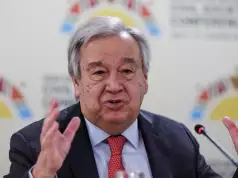
The United Nations is grappling with significant financial difficulties amid escalating global challenges, Secretary-General António Guterres said on Monday.
During a briefing to member states in New York, Guterres stressed the urgent need for broad structural reforms aimed at reducing costs and improving the organization’s overall effectiveness.
According to figures shared by the UN Controller with the General Assembly’s Fifth Committee (Administrative and Budgetary), the organization had only received $1.8 billion of the $3.5 billion regular budget assessments for 2025—representing a nearly 50 percent shortfall.
As of April 30, unpaid assessments totalled $2.4 billion. The United States owed approximately $1.5 billion, followed by China ($597 million), Russia ($72 million), Saudi Arabia ($42 million), Mexico ($38 million), and Venezuela ($38 million). An additional $137 million was outstanding from other member states.
The peacekeeping budget, which follows a July-to-June fiscal cycle and includes arrears from previous periods, faced unpaid contributions totalling $2.7 billion. The international tribunals also had $79 million in outstanding contributions as of April 30.
“These are times of peril,” Guterres lamented, adding, “but they are also times of profound opportunity and obligation. The mission of the United Nations is more urgent than ever.”
The Secretary-General laid out comprehensive reform plans to transform UN operations, including measures to cut spending, streamline processes, and modernize approaches to peace and security, development, and human rights.
He noted that some of the proposed changes would be reflected in the revised 2026 budget estimates, expected in September 2025, while more in-depth reforms would be presented in 2027.
The anticipated changes are expected to result in “meaningful reductions” in the overall budget. Guterres indicated that the departments dealing with political and peacekeeping affairs could face a 20 percent reduction in staff, primarily by eliminating duplicative roles.
He explained that this scale of reduction could serve as a benchmark throughout the UN system, although adjustments would be made for the specific needs of each department.
“There might be immediate, one-off costs involved in relocating staff and providing potential termination packages,” Guterres said. “But by moving posts from high-cost locations, we can reduce our commercial footprint in those cities and reduce our post and non-post costs.”
Departments based in New York and Geneva have been instructed to evaluate whether some teams could be relocated to more cost-effective duty stations, downsized, or disbanded altogether.
A preliminary review revealed over 3,600 unique mandates assigned to the Secretariat alone, with a more thorough assessment currently underway.
Guterres underscored that the sheer volume of mandates—and the bureaucracy needed to support them—placed an undue burden on smaller member states with limited capacity.
“Based on this work, Member States may wish to consider the opportunity to conduct themselves a review of the mandates,” he added.
Close to 50 initial submissions have been received from senior UN officials, which Guterres said reflected “a high level of ambition and creativity”. Key areas identified for review include peace and security, development, human rights, humanitarian operations, training and research, and specialized agencies.
Guterres also addressed the UN’s ongoing liquidity crisis, noting that while the reform initiative would not resolve the prolonged cashflow issues, greater cost efficiency could help mitigate their effects.
“The liquidity crisis is caused by one simple fact—the arrears,” he said, emphasizing that structural reform alone could not resolve the core issue of some member states failing to pay their dues on time.
He assured member states that he would maintain close and regular consultations with them regarding the financial crisis and necessary reforms, seeking their guidance and presenting actionable proposals.
UN staff and their representatives are also being engaged in the process, Guterres said, stressing, “Our concern is to be humane and professional in dealing with any aspect of the required restructuring.”
In conclusion, he highlighted the UN80 Initiative—a programme launched in March—as a “significant opportunity” to fortify the UN system and better serve the global population.
The initiative is centered around three core priorities: improving operational efficiency, reviewing how member state mandates are implemented, and exploring systemic structural reforms.
“Let us seize this momentum with urgency and determination and work together to build the strongest and most effective United Nations for today and tomorrow,” Guterres urged.
(NAN)