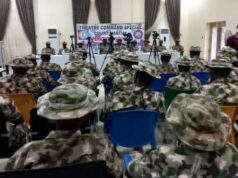
The United States of America, USA, military has designed plans for intervention in Nigeria. This is coming after President Donald Trump alleged that “Christian genocide” was happening in Nigeria, and the US would invade to take care of the terrorists.
In Trump’s words: “Christianity is facing an existential threat in Nigeria. Thousands of Christians are being killed. Radical Islamists are responsible for this mass slaughter.”
He then ordered the military to prepare a plan.
The Defense Secretary, Pete Hegseth, quickly responded, “Yes, Sir,” and then directed the Africa Command to send plans for possible strikes.
Officials at the command, which is based in Stuttgart, Germany, sent options to Washington. The new AFRICOM commander, Gen. Dagvin R.M. Anderson, has a previously scheduled trip to Nigeria next month.
Three defense officials said the plans from the command had three options — light, medium and heavy — and were intended to be escalatory.
Option 1
The light option, the officials said, included what the military called partner-enabled operations.
Under that option, the U.S. military and the State Department would support government forces in Nigeria to target Boko Haram and other Islamic insurgents who have attacked, kidnapped and murdered civilians, mostly in northern Nigeria, where sectarian and ethnic violence has raged for almost 20 years.
The United States would have to conduct these operations without the expertise of the U.S. Agency for International Development, whose office in Abuja, the capital, officially closed in July, after the Trump administration shuttered the agency.
But that action would come with a host of issues, the thorniest being that the violence in the northern Nigerian Sahel falls along linguistic, cultural and religious lines.
Much of it is based on land use and tenure and is fomented in some cases by corruption in the Nigerian government
Farmers and herders in the region have battled one another over land use for decades, and militant Islamic groups have taken advantage of the distrust to push their own agenda.
Option 2
The medium option being put forward by Africa Command, officials said, includes drone strikes on militant camps, bases, convoys and vehicles in northern Nigeria.
American Predator and Reaper drones can loiter for hours before striking, and other U.S. intelligence can gather information on specific targets’ pattern of life.
But that option comes with its own issues, not least being that the U.S. military in August vacated its two nearest drone bases, in Agadez and Niamey, both in neighboring Niger. Russian forces now occupy those bases.
Drones launched from Niamey or Agadez could reach Nigeria in an hour, one military official said. But now, the closest known places from which the United States could launch drones are southern Europe and perhaps Djibouti, in East Africa, where the U.S. military has a large base.
U.S. troops at an air base in Agadez, Niger, in 2018. The United States vacated its drone base in the city in August.
One official suggested that West African countries seeking favor with the Trump administration might allow their territories to be used, but that is less clear. Doing so would also go against the wishes of the Nigerian government, which is hugely influential on the continent, and could open up another set of problems for neighboring countries.
The Nigerian government has said it welcomes U.S. assistance in targeting Islamist insurgents but added the caveat that any action must respect Nigeria’s sovereignty and its territorial integrity.
Option 3
The heavy option, military officials said, would be to move an aircraft carrier group into the Gulf of Guinea and to deploy fighters and perhaps long-range bombers to conduct strikes deep in northern Nigeria.
However, the United States is already in the process of moving one of its aircraft carriers, the Gerald R. Ford, from its deployment in Europe to the southern Caribbean, where Mr. Trump has declared war on drug cartels. Other aircraft carriers are currently deployed in the Pacific or in the Middle East or are undergoing maintenance.
Deploying an American aircraft carrier to the Gulf of Guinea to take on Islamic insurgents in Nigeria was not deemed to be a 2025 national security priority as recently as Friday, several military officials said.
The American military cannot do much to quell the violence unless it is willing to start an Iraq- or Afghanistan-style campaign, the officials said, something that no one appears to be seriously contemplating.
But they said there were some steps available to American war planners that could have limited impact on the militants