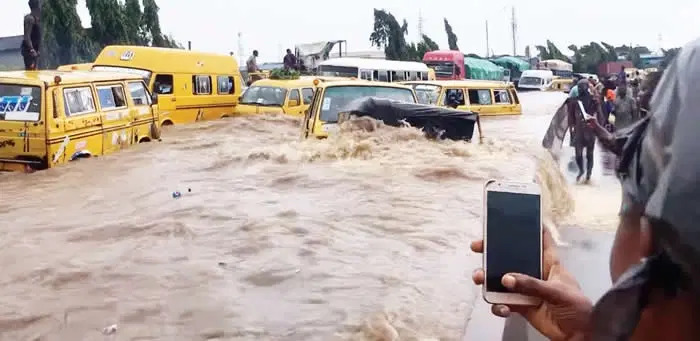
Residents and motorists in Lagos are currently struggling with the aftermath of heavy rainfall early Monday morning, which caused widespread flash flooding, leading to severe traffic congestion and the submersion of homes across the city.
The Nigerian Meteorological Agency (NiMet) had earlier predicted thundery and rainy weather nationwide from Monday through Wednesday, warning of potential flash floods in some areas.
In a weather outlook released on Sunday in Abuja, NiMet forecasted morning thunderstorms and moderate rains over northern states including Adamawa, Taraba, Sokoto, Kebbi, Zamfara, Jigawa, Kano, and Katsina, as well as Lagos in the southwest.
The agency also anticipated cloudy skies and light rain over parts of southern states such as Ebonyi, Enugu, Imo, Anambra, Abia, Ogun, Edo, Delta, Rivers, Cross River, Akwa Ibom, and Bayelsa during the morning hours.
Later in the day, light rains were expected over Abia, Imo, Ebonyi, Anambra, Osun, Ogun, Oyo, Ondo, Ekiti, Edo, Delta, Bayelsa, Rivers, Lagos, Cross River, and Akwa Ibom.
NiMet warned of a high possibility of flooding in Oyo, Ogun, Edo, and Delta States during this forecast period.
For Tuesday, morning thunderstorms were expected over northern states such as Taraba, Katsina, Kebbi, Sokoto, Kaduna, and Zamfara.
The agency urged the public to take safety precautions: “Ensure warm clothing for the vulnerable persons due to low night-time temperatures, and ensure that loose objects are fastened to avoid collisions.
“Disconnect electrical appliances from electrical sockets, and stay away from tall trees to avoid impact from falling branches and broken trees.
Airline operators get airport-specific weather reports (flight documentation) from NiMet for effective planning in their operations,” it added.
NiMet also advised residents to stay informed through updates available on its website, www.nimet.gov.ng.
On Monday, Vanguard’s checks revealed many key Lagos roads, including Lagos-Abeokuta Motorway, Ikorodu Road, Apapa, Alimosho, Lekki axis, Agege, Oworosonki, Ikotun, and the Long Bridge along Lagos-Ibadan Motorway, were submerged, causing heavy traffic jams and stranding vehicles, with houses and shops flooded.
Commuters who ventured out were stranded for hours due to the flooding. Although the rain began around midnight and continued into the early morning, by 8 a.m. some parts of the state were still experiencing rainfall.
The Lagos State government, through the Ministry of Environment and Water Resources, issued an advisory urging residents and motorists “not to panic but to stay safe”, assuring them that the flash floods would soon recede.
Flooding affected roads on both the island and mainland sides of Lagos. Traffic came to a standstill in many areas during the downpour, while some roads saw slow-moving traffic as motorists tried to navigate flooded sections.
A motorist identified only as Alhaji Abu described the ordeal at Odo Iya Alaro Bridge in Ikorodu around 5 a.m., saying it was “heavily flooded”.
Around Alakuko, the Lagos-Abeokuta Motorway was almost at a standstill. John, another motorist, noted, “Since the flood had covered all the potholes on the road, motorists had to be cautious in order not to be stranded inside the flood.”
Residents of Gberigbe in Ikorodu also lamented the heavy flooding of homes, with many trying to bail out rainwater.
Broken-down vehicles were seen stranded in the floodwaters, and gridlock extended to Ikotun, Igando Roads, and Oworosonki. Motorists kept to the lane closest to the median to avoid deeper water on service lanes.
Even after the rain stopped around 9 a.m., commuters remained stuck, many waiting at bus stops while residents stayed indoors.
Several residents called on the state government for immediate intervention to address the recurring flood issues during the rainy season.
Modupe Akinbiyi, a resident of Gberigbe, said, “We do experience heavy floods each time it rains, particularly during rainy season. We are worried over this flood. We have sent several complaints to the government and the Ministry of the Environment and Water Resources without positive results.”
Anthony Azubuike from Lagos Island urged better drainage maintenance, stating, “The relevant authorities in the state should ensure the process of clearing the drainage channels is effectively monitored. Most of the refuse being pulled out from the drainage channels is often left beside it, and in a matter of days, they make their way back into it, blocking the channels.”
Motorist Kunle Oyebode added, “The roads have been taken over following this torrential rainfall. You can see vehicles broken down while others who are conversant with the road waded through the better part of the flood.”
Despite the challenges, the Commissioner for Environment and Water Resources, Mr. Tokunbo Wahab, reassured Lagosians there is no need for alarm.
During the Year 2025 Seasonal Climate Predictions (SCP) and Socio-Economic Implications for Lagos State, Wahab stated the government is well-prepared but urged residents in low-lying wetland areas to relocate if necessary to avoid loss of life and property.
He explained, “It should be noted that the state has put in place its own network of weather stations as well as river gauge stations to monitor the weather and river levels in our state as well as increase preparedness for weather- and flood-related issues.
“The Ministry is collaborating with NiMet in the annual SCP, which has been valuable as a vital weather and early warning tool for farmers, planners, decision makers and operators of the various sectors and businesses that are likely to be impacted by the annual rainfall.
“Let me assure you that our state will continue to reap the benefits of careful and rigorous planning, as our flood control measures are being stepped up to contain any imminent rainfall.
“To ensure a flood-free and hygienic environment in the state, the ministry has embarked on an all-year-round drainage maintenance programme for effective and efficient flood control, in addition to an efficient and sustainable solid waste management system.
“To effectively contain flooding in our state, we are determined to continue the long-established synergy and partnership with the Ogun-Oshun River Basin Development Authority (OORBDA), which has ensured control and monitoring of the steady and systemic release of water from Oyan Dam to prevent flooding of the downstream reaches of the Ogun River. “This mutual relationship has been highly beneficial in the past, and we intend to sustain it.
“Therefore, the low-lying areas of Agiliti, Agboyi, Itowolo and Ajegunle communities in Lagos State are being closely monitored with respect to the likelihood of the Ogun River overflowing its banks as well as all other river basins in the state.
“The Lagos State Signage and Advertisement Agency, LASAA, will as usual be on standby to make sure advertising and communication agencies comply with regulations on the safety of billboards and telecommunication masts to prevent the incidences of telecommunication mast collapse caused by high wind speed, as it is expected during the onset and cessation of every rainfall season.
“This is to put all emergency response organisations, traffic management organisations, and other emergency-related organisations on high alert to help lessen the damaging effects of thunderstorms and associated heavy rainfalls in the state.
“I want to use this platform to make a plea to Lagosians, through the media, to help inform the public that, as is the case in several coastal cities across the world, it is occasionally normal to have flash floods when it rains, which will percolate or drain off rapidly a few hours after.
“It is only when such floods remain on the roads for several hours that we can report that a particular area is flooded. I therefore wish to plead with the media to avoid sensational headlines that cause panic.
“We all need to be wary of another contributory factor to flooding, which is the rise in lagoon level. Anytime there is high tidal movement, it may “lock up” the discharge points of drainage channels, and until it recedes, there will be no discharge.
“Such occurrences also cause backflow, resulting in flash flooding. But as soon as the lagoon water level recedes, all the generated stormwater will immediately be discharged, and our roads will be free.
“To our people, we sincerely appeal that they refrain from acts that can lead to flash flooding. They should stop indiscriminate dumping of refuse in unauthorised places, clogging drains with silt or construction materials, and erecting structures within and around drainage rights of way and setbacks.”