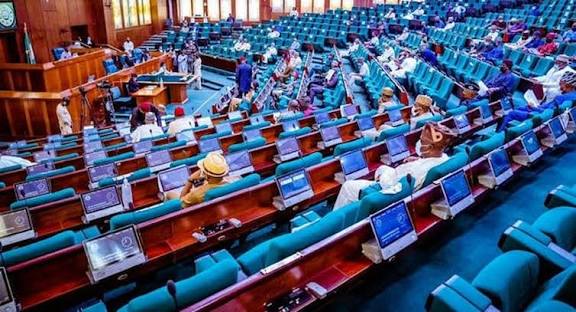
The House of Representatives on Wednesday passed an amendment to the Electoral Act 2026 that seeks to criminalise dual membership of political parties, proposing stiff penalties, including a fine of ₦10 million or a two-year prison term for offenders.
The amendment, adopted during a plenary presided over by Deputy Speaker Benjamin Kalu, introduces new provisions to Section 77 of the Electoral Act regarding political party membership.
The lawmakers said the measure is intended to curb political manipulation and strengthen the legal framework regulating party affiliation in Nigeria’s electoral system.
Under the proposed changes, three new subsections, Clauses (8), (9) and (10) are inserted into Section 77 of the Act.
Clause (8) states that no individual shall be registered as a member of more than one political party at the same time.
Clause (9) further provides that where it is established that a person is registered in more than one political party simultaneously, such membership shall be declared void. The individual will also cease to be recognised as a valid member of any political party until the situation is regularised in line with the Electoral Act and the constitution of the relevant political party.
Clause (10) criminalises the act outright, stipulating that anyone who knowingly registers or maintains membership in more than one political party commits an offence and is liable upon conviction to a fine of ₦10 million, imprisonment for two years, or both.
The lawmakers said the amendment would discourage what they described as political dishonesty and opportunistic behaviour among party members.
The proposal triggered debate among lawmakers, with some expressing concern that the amendment might conflict with constitutional provisions guaranteeing freedom of association.
Abubakar Fulata (APC, Jigawa) warned that denying a person membership of both political parties could run afoul of Section 40 of the Constitution, which guarantees citizens the right to freely associate.
“This Act seems to be in contravention of Section 40 of the Constitution of the Federal Republic of Nigeria, which guarantees freedom of association,” Mr Fulata said.
“If someone is found to be registered in two political parties, instead of denying membership in both parties, the law should limit the person to only one political party.”
He argued that stripping the individual of membership in both parties might amount to a denial of a constitutional right.
However, Jonathan Gaza (SDP, Nasarawa) strongly backed the amendment, describing dual party membership as dishonest.
“You cannot, as an adult, go and register in two political parties at the same time. It is wrong, totally wrong, an act of dishonesty,” Mr Gaza said.
“You should belong to one and follow that one through. You cannot put your legs in two different houses at the same time.”
Dennis Agbo (APC, Enugu) raised concerns about the possibility of political mischief.
He questioned whether someone could be fraudulently registered in another political party without their consent and later accused of maintaining dual membership.
“I would never want to belong to two political parties in my life,” he said.
“But if somebody goes to another political party without my permission and registers my name there, we might be creating a situation we may not be able to manage.”
Responding to the concerns, Mr Kalu said the amendment already addresses that risk through the use of biometrics.
“That is why the provision uses the word ‘knowingly,’ which means intentional and deliberate,” he said.
“One of the ways to establish that is through biometric verification.”
Lawan Ali (APC, Yobe) noted that Nigerians generally resign from one party before joining another, adding that the amendment mainly targets individuals who secretly maintain membership in multiple parties.
According to him, such individuals often act as informants or political spies.
Sada Soli (APC, Katsina), while supporting the amendment, said the draft should clearly outline how violations would be detected and handled.
He proposed that the Independent National Electoral Commission (INEC) should notify affected political parties when dual registration is discovered and allow the individual to choose which party to remain in within a specified period.
“We should not give lawyers the opportunity to feast on loopholes in this law,” he warned.
But Mr Kalu insisted that the amendment must discourage deliberate misrepresentation.
“To deliberately register in two political parties is deceit. You should identify with one political ideology and stand by it,” he said.
The amendment forms part of ongoing legislative efforts to strengthen Nigeria’s electoral legal framework ahead of future elections.
Recently, President Bola Tinubu signed amendments to the Electoral Act into law following their passage by both chambers of the National Assembly, a process that was not without controversy.
During deliberations on earlier electoral amendments in the House, lawmakers engaged in heated exchanges over provisions relating to electoral procedures and party processes.
If eventually signed into law by the president, the amendment would formally criminalise the practice and introduce severe penalties for offenders.