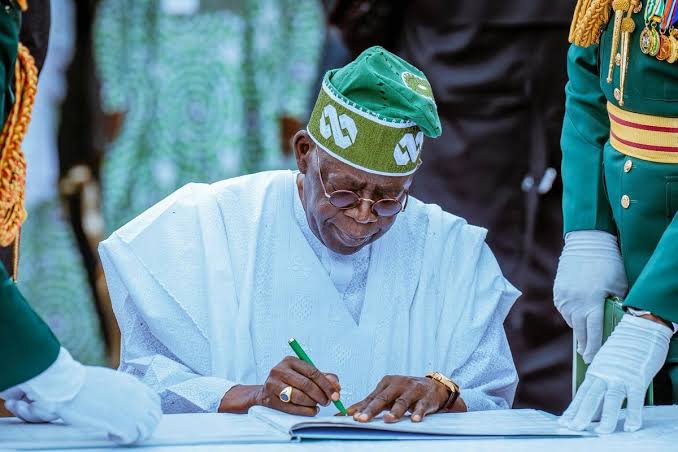
Opposition parties and civil society organizations have condemned President Bola Tinubu’s assent to the Electoral Act 2026 (Amendment), describing the move as a setback to Nigeria’s democratic progress and a legalization of electoral manipulation ahead of the 2027 general elections.
The Peoples Democratic Party, on Wednesday, alleged that the ruling All Progressives Congress’s fear of losing the upcoming elections drove what is called the rushed approval of the contentious legislation, which the party described as a threat to the country’s democratic process.
President Tinubu signed the Electoral Act 2026 (Amendment) into law around 5pm on Wednesday at the Aso Rock Presidential Villa, Abuja, with senior National Assembly officials in attendance.
It came barely 24 hours after the bill was passed by both chambers of the National Assembly.
During the ceremony, Tinubu raised concerns about Nigeria’s current broadband infrastructure and technical capacity to handle real-time electronic transmission of election results, even as he signed the Electoral Act 2026 (Amendment) into law.
But in a statement by its National Publicity Secretary, Ini Ememobong, the PDP called the development “a dark day for democracy.”
He stated, “The hurried grant of presidential assent to the contentious bill, as passed by both chambers of the National Assembly, despite widespread opposition from Nigerians, confirms that this was a well-choreographed drama by the APC.
“The party’s fear of inevitable defeat in a free and fair election is palpable, and they can no longer conceal it. This is indeed a sad day for democracy.
“The Nigerian people have been dealt a bad hand, one that existentially threatens democratic governance. The President has demonstrated an inability to rise above partisanship in the art of governance.”
The bill, which was approved by the National Assembly on Tuesday, has generated significant debate, especially over provisions for real-time electronic transmission of election results, a key demand by opposition parties, civil society groups, and election observers following widespread allegations of result manipulation during the 2023 general elections.
The signing occurred days after the Independent National Electoral Commission released the timetable for the 2027 general elections, intensifying concerns among opposition stakeholders that the amendment was designed to favour the ruling party.
The Executive Director of YIAGA Africa, Samson Itodo, described the bill as “a step backward rather than a reform.”
He said, “First, this bill that was passed, it is an absolute missed opportunity for transformative electoral reforms because it fails to address critical gaps. It signals a regression.
“So, it is a reform in name and a regression in substance. I wish that the President had rejected the bill and asked the legislators to go and fix some aspects of the bill.”
He also criticised provisions related to INEC’s independence and electronic transmission of results, saying, “When you look at electronic transmission of results, the provision adopted by the National Assembly is completely against what citizens demanded because what they have done is they have made the process more vulnerable to manipulation.
“So, I say that this particular bill signals a regression in substance. And we cannot call these reforms.”
Meanwhile, the Country Director of Accountability Lab, Friday Odeh, described the amendments as a potential threat to election integrity.
Odeh stated, “There is a huge danger of rigging. We know there has been progress made, but again, for me, it looks like a huge reversal of the progress that has been made. And this is legalising rigging in a very formal way.”
However, the Executive Director of the Civil Society Legislative Advocacy Centre, Auwal Musa, offered a more measured perspective, acknowledging that while the law was not perfect, it provided a framework for future improvement.
“Well, as it is now, since the National Assembly and the President did not yield to the call by Nigerians to ensure that we have electoral law that is acceptable by us, improve the electoral transparency and boost confidence of Nigerians to even participate in the election, I think whatever it is, we just have to manage with what we have now.
“We just have to accept this law and continue to advocate for an improved electoral law in Nigeria,” Musa explained.