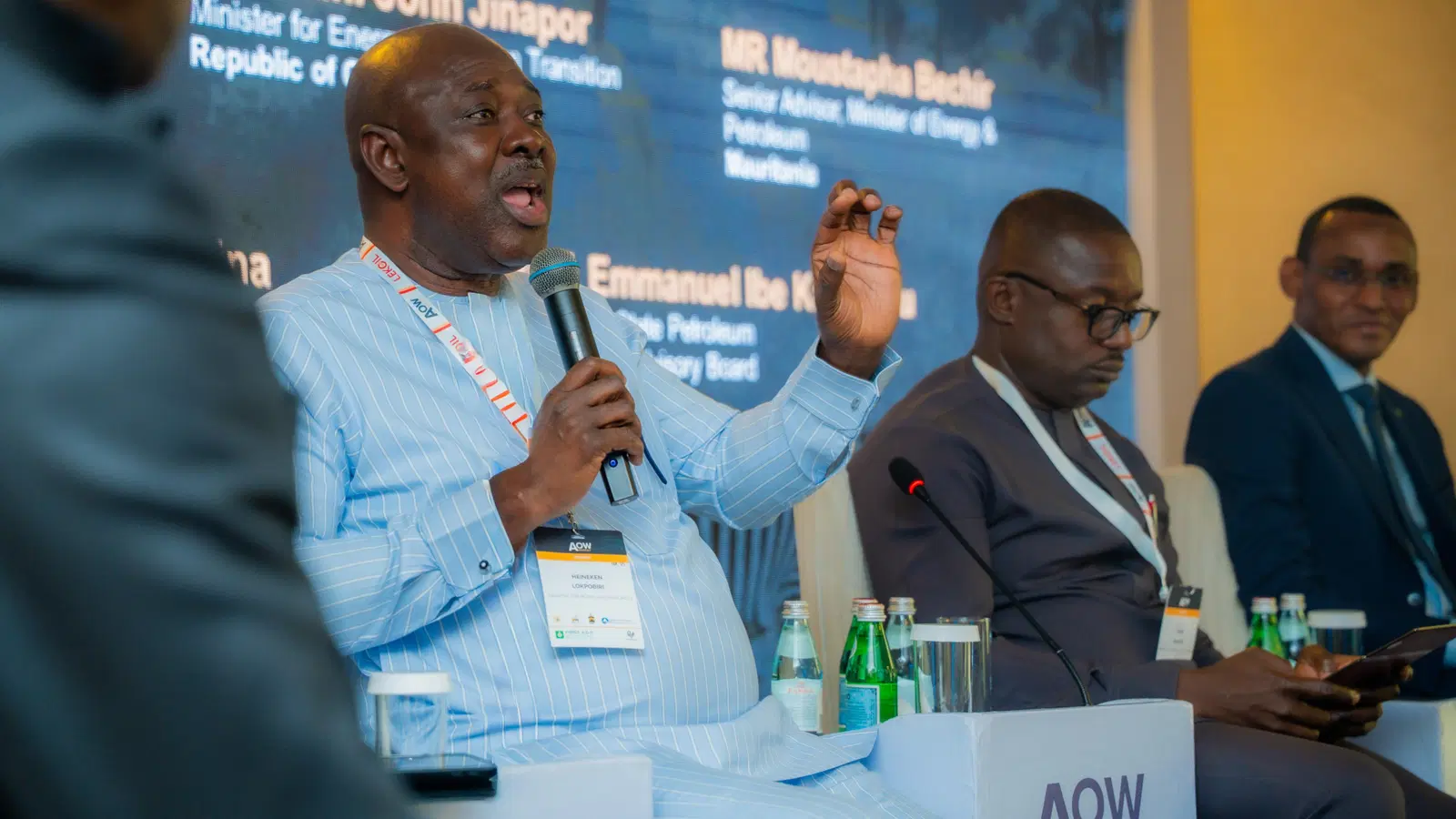
Nigeria’s Minister of State for Petroleum Resources (Oil), Sen. Heineken Lokpobiri, Ph.D, has reiterated Nigeria’s leading role in advancing Africa’s energy security, stressing the need for deeper regional cooperation at the Africa Oil Week (AOW) 2025 Ministerial and CEO Leadership Forum.
In a statement signed by his Special Adviser on Media and Communication, Nneamaka Okafor, Lokpobiri said regional integration offers the most effective pathway to ending energy poverty across Africa. He pointed out that shared infrastructure, harmonized standards, and technical expertise are vital to securing the continent’s energy future.
The Minister decried Africa’s dependence on imports, noting that the continent spends over $120 billion annually on hydrocarbon products. “This is capital flight. These funds should remain within Africa to fuel our development priorities,” he stated.
Lokpobiri further argued that the main obstacle to attracting investment is not capital scarcity but fragmented regulatory and fiscal regimes. “Investors make long-term decisions based on stability and predictability. Africa must harmonize its policies to attract and retain investment,” he emphasized.
As part of Nigeria’s regional leadership drive, the Minister announced the establishment of a West African Reference Market (WARM), an initiative designed to leverage Nigeria’s expanding refining capacity to supply petroleum products across West Africa and beyond.
On the global push for energy transition, Lokpobiri clarified that the Paris Agreement calls for emission reductions rather than abandoning fossil fuels entirely. He stressed that Africa, which contributes only 3% of global CO₂ emissions, must focus on responsibly harnessing its abundant natural resources to power growth.
“We cannot lead an energy transition when we don’t even have energy. Our priority must be to use our resources responsibly to drive development,” he said.
The Minister concluded with a call for unity among African nations: “Africa has the market, the population, and the resources. What we need now is to keep value within our continent and finance our own energy future.”