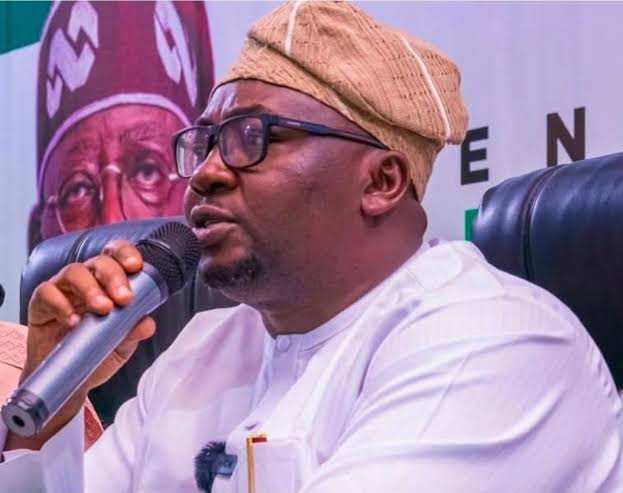
Two weeks after Minister of Power, Mr Adebayo Adelabu, assured citizens of imminent relief from persistent outages, a cross-country check suggests that for many households and businesses, the reality has barely changed.
This came as recent announcement by President Bola Tinubu of the approval of N3.3 trillion for the settlement of outstanding debt in the nation’s power sector has been received with mixed feelings.
While some experts believe the statement in its entirety, others question its authenticity, describing it as a recurring narrative that has become a trend.
Adelabu had, on March 24, while addressing the media in Abuja, publicly apologised for the wave of blackouts that swept across the country, admitting that the situation had worsened living conditions at a time of intense heat.
He acknowledged the strain on homes, schools and industries, attributing the disruption largely to gas supply constraints and technical issues beyond the government’s immediate control.
“I want to apologise to Nigerians… for this temporary issue that is leading to hardship being experienced,” the Minister said, while promising that “two weeks from now, we should start seeing improvements in supply.”
That deadline expired on Friday.
But from Abuja to Lagos, and across several states, many Nigerians say the promised improvement has yet to materialise.
In Utako, a district in Abuja, residents described a pattern of prolonged outages and brief, inconsistent supply.
Ekwa Mbuk, one of the affected residents, expressed frustration over what he called a worsening situation.
“So why are we at Utako District subjected to darkness for another night? The heat is sickening. This constant power outage is messing up the quality of life of your customers. Do you care? Please give us light,” he said, in a complaint directed at the Abuja Electricity Distribution Company.
He added that the power supply in the area had been erratic, with entire days passing without electricity, followed by only a short period of restoration.
“Since last night, no light… we’ve had only an hour of light. Are we getting what we’re paying for?” he asked.
Similar sentiments echoed in Lagos, where Iyke Oscar questioned the rationale behind tariff classifications that promised extended supply.
“Why are we still paying as Band A, if we can’t have light up to 24 hours?” he asked, pointing to the growing disconnect between billing structures and actual service delivery.
Across the states, the accounts follow a familiar pattern.
In Delta, Abednego Emonena dismissed the situation bluntly: “Electricity in Nigeria is still a joke.”
In Ondo, Akin Muyiwa said residents in Akure had all but given up on the expectation of stable supply. “We don’t know what’s called electricity,” he remarked.
From Imo, Mary Blossom reported that parts of Owerri had experienced a near-total blackout for weeks. “For the past four weeks, no light,” she said.
In Edo State, Diana Efe described outages stretching into days. “This is the fifth day we haven’t seen electricity since rain fell,” she noted, while another resident, Aino, said communities were left with barely two hours of supply daily.
Elsewhere, the frustration is tinged with resignation. In Ekiti, Mr. Awo Adekunle summed it up: “No light, we just dey pay bill.”
Cynthia in Ogun State pointed to a pattern tied to weather conditions. “Once rain falls, no light for the next 12 hours, sometimes 24 hours,” she said, suggesting that infrastructure fragility continues to worsen outages.
For some, the situation has become almost surreal.
Abolanle Ajirowo wondered aloud whether official assurances referred to a different reality. “Maybe there’s another Nigeria we don’t know about,” she said.
Behind these reactions lies a deeper structural problem. Nigeria’s electricity generation has continued to hover around 4,000 megawatts, far below what is required for a population of over 200 million. Per capita electricity consumption remains between 144 and 165 kilowatt-hours, according to data from the International Energy Agency, placing the country well below the African average of 617 kWh.
The implications are visible in daily life. With grid supply unreliable, households and businesses are forced to rely on alternatives such as generators, inverters and solar systems. These come at significant cost, effectively creating a parallel, self-funded energy system.
“Electricity remains unreliable, forcing people to depend on generators, inverters, or solar setups,” said Obinna Eze. “So you pay for electricity, even when it’s not consistent.”
In a sign of how deeply the crisis has reshaped everyday economics, new micro-businesses have emerged to fill the gap.
Power bank rentals, for instance, are now available in parts of Kaduna, Sokoto, Kano, Plateau, Niger, Nasarawa, Delta, Edo, Anambra, Imo and Lagos, offering temporary relief for phone charging and small devices at daily or weekly rates.
For now, the Federal Government maintains that improvements are on the way, tied to the repair of critical gas infrastructure and enforcement of supply obligations among producers.
Adelabu had expressed confidence that restored gas flow, particularly from facilities linked to major operators, would stabilise generation.
Yet, as the deadline he set passed without clear nationwide improvement, public patience appears to be thinning.
What remains is a familiar cycle of promise and delay, with millions of Nigerians still waiting, often in the dark, for a power sector turnaround that has long been anticipated but remains elusive.
Experts speak on N3.3trillion for power sector
Meanwhile, the announcement by Tinubu of the approval of N3.3 trillion for the settlement of outstanding debt in the power sector has been received with mixed feelings.
While some experts believe the statement in its entirety, others question its authenticity, describing it as a recurring narrative that has become a trend.