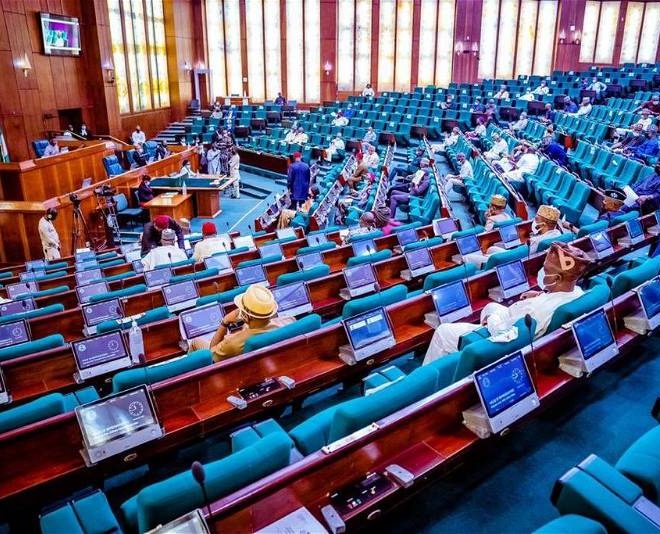
The bill, which passed second reading during Thursday’s plenary session presided over by Speaker Tajudeen Abbas, was jointly sponsored by the Speaker and Daniel Asama, a lawmaker from Plateau State.
The proposed legislation stipulates penalties for eligible voters who fail to vote without valid justification, including a fine of N100,000, a six-month jail term, or both.
When first introduced in mid-April, the bill sparked public outrage with the National Association of Nigerian Students threatening mass protests in opposition.
Leading debate on the general principles of the bill on Thursday, Asama argued that the heart of democracy lies in citizen participation.
According to him, democracy thrives when people are actively involved in choosing their leaders and shaping governance.
“Voting is not only a right but a civic responsibility, and in many democracies across the world, it is treated as such,” he said. “This bill proposes to introduce mandatory voting for all Nigerians of voting age in general elections, both at the national and state levels. It seeks to amend the relevant provisions of the Electoral Act, 2022, to reflect this obligation, while also allowing for limited and justified exemptions where necessary.”
Asama also raised concerns about the dual mandate of the Independent National Electoral Commission, which he said contributes to inefficiency and perceived bias.
“As it stands today, the Independent National Electoral Commission is charged with registration, monitoring, and regulation of political parties, in addition to its core constitutional mandate of organising, undertaking, and supervising elections. This dual role has increasingly proven to be a source of institutional overload, operational inefficiency, and in some instances, perceived partiality, especially during the pre-election period, when INEC is expected to make decisions that affect the status and operations of political parties that will also oversee elections.
“This challenge is not merely administrative, it is structural. When a single body is tasked with both organising elections and regulating the participants in those elections, questions arise about the independence, neutrality, and operational capacity of that institution.”
Highlighting low voter turnout as a critical issue, Asama noted, “Nigeria has consistently recorded alarmingly low voter turnout rates in recent elections. For instance, in the 2023 general elections, less than 30% of registered voters participated. This trend undermines the legitimacy of elected governments and weakens democratic institutions.”
He further argued that mandatory voting would foster civic engagement.
“By making voting a legal obligation, it will instil in citizens a sense of civic duty and shared responsibility in the governance process,” he said.
Citing international examples, Asama said, “Several democracies, including Australia, Belgium, and Brazil, have adopted mandatory voting with positive outcomes in terms of political participation and public accountability,” adding that the bill could reduce electoral apathy and vote-buying.
“Mandatory voting can significantly reduce the influence of vote-buying, as more citizens will be participating,” he added.
According to him, the bill seeks to amend the Electoral Act, 2022, to make voting in national and state elections compulsory for all citizens aged 18 and above.