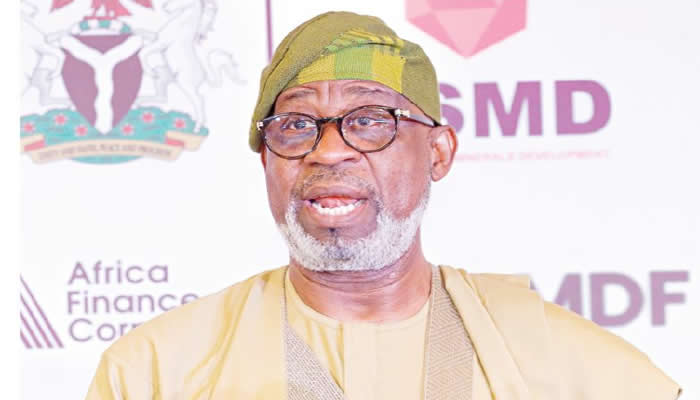
Minister of Solid Minerals Development, Dele Alake, revealed that that last year the nation received more than $800 million in processing investments in its solid minerals industry.
He said this surge is attributed to the Tinubu administration’s policy shift, favouring in-country value addition and stricter licensing requirements.
Alake also revealed that sector revenue climbed to more than ₦38 billion in 2024, up from ₦6 billion the previous year, despite the ministry receiving only 18 percent of its ₦29 billion budget allocation.
This was disclosed in a statement made available to journalists on Sunday by the Special Adviser to the President on Information and Media Strategy, Bayo Onanuga.
The minister made these remarks during a featured interview for an upcoming State House documentary marking President Tinubu’s second year in office.
Alake explained that the reforms have led to a marked increase in investor interest.
He pointed to several major projects now underway, including a $600 million lithium processing plant located near the Kaduna Niger border, scheduled for commissioning this quarter.
He noted that a $200 million lithium refinery near Abuja is nearing completion, and two more processing facilities in Nasarawa are expected to begin operations before the third quarter of 2025.
“These investments follow the administration’s insistence that no miner gets a licence without a clear local processing plant. The days of exporting raw minerals from pit to port are over.
“When we resumed, the entire sector generated ₦6 billion annually. By the end of 2024, we hit ₦38 billion. And this was with just 18 percent of our ₦29 billion budgetary allocation released. It shows how effective our policy framework has been,” said Dr Alake.
He further disclosed that in the first quarter of 2025 alone, the Mining Cadastral Office and the Mines Inspectorate recorded revenues of ₦6.9 billion and ₦7 billion respectively.
Looking ahead, the Minister projected that 2025 would be a landmark year for the industry. He said that ₦1 trillion has been allocated to mineral exploration, aimed at generating certified geological data that meets international standards.
“Exploration is key. When we came in, Nigeria had spent just $2 million on exploration, compared to $40 million in Sierra Leone, $148 million in Côte d’Ivoire, and over $300 million in South Africa. No serious investor will touch your sector without credible data,” he stated.
“We are now focused on turning our mineral wealth into domestic economic value, jobs, technology, and manufacturing,” he added.