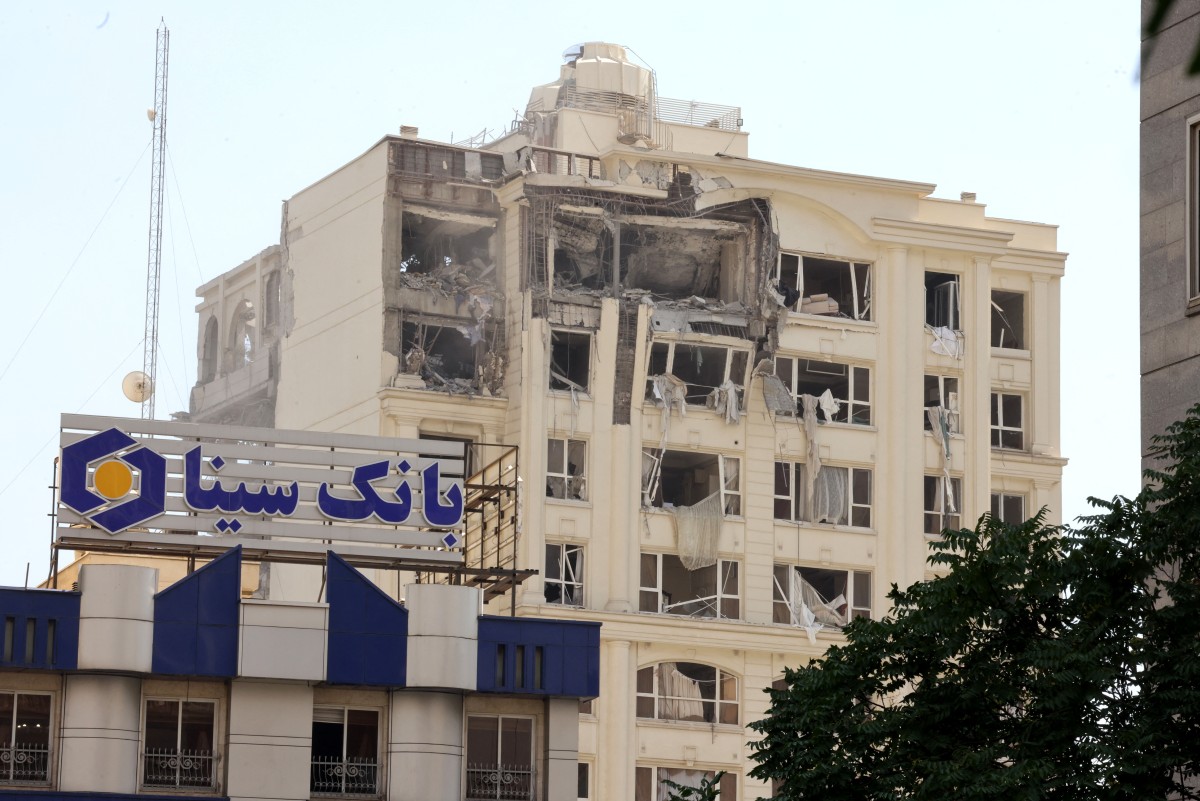
Israel targeted senior Iranian military leadership on Friday in a widespread and unprecedented series of airstrikes, hitting military and nuclear-related facilities across Iran.
Among those confirmed killed were two of the country’s most powerful military figures.
General Mohammad Bagheri—Armed Forces Chief of Staff
General Mohammad Bagheri was Iran’s highest-ranking military officer, overseeing the regular army, the Islamic Revolutionary Guard Corps (IRGC), and Iran’s ballistic missile program. Appointed in 2016, he worked directly under Supreme Leader Ayatollah Ali Khamenei, who serves as the country’s commander-in-chief.
As second in command of Iran’s military apparatus, Bagheri held extensive authority over all formations of the armed forces. He often appeared on state television in military uniform and was closely associated with the launch and oversight of underground military facilities.
Bagheri played a central role in building Iran’s long-range missile capabilities, developed initially during the Iran-Iraq War in the 1980s to offset Iran’s weaker air force. Over the decades, these systems became more precise and longer in range, leading Israel to identify them as a major strategic threat. In recent years, Iran has launched large-scale missile barrages at Israeli territory.
In public speeches, Bagheri adopted a hardline stance against Israel. “The Zionist enemy should know that it is nearing the end of its miserable life,” he once declared, referring to Israel as “a cancerous tumor.”
In 2022, he claimed that Iran had become “more than self-sufficient” in defense production, boasting that, if not for international sanctions, the country would be among the world’s leading arms exporters.
Bagheri was sanctioned by the United States during President Donald Trump’s administration and later by the European Union, particularly after Iranian drones were linked to Russia’s war in Ukraine. In response, he dismissed the sanctions and mocked the EU, suggesting it use Iran’s frozen assets to “buy coal” to heat itself during winter.
Born in June 1960, Bagheri succeeded General Hassan Firouzabadi, who led Iran’s armed forces from 1989 to 2016. Firouzabadi once famously alleged that Western spies had used lizards to detect Iran’s nuclear sites—an example of the conspiratorial rhetoric common among Iran’s security elite.
Major General Hossein Salami—Revolutionary Guards Commander
Hossein Salami, the commander of the Islamic Revolutionary Guard Corps, was also killed in the Israeli strikes. A long-serving officer known for his fiery rhetoric, Salami was considered a close confidant of Supreme Leader Khamenei.
In January 2025, while touring a secret underground missile base, he warned Israel and the United States, “If you make the slightest mistake, we will open the gates of hell for you.”
Born in 1960 in central Iran, Salami joined the IRGC in 1980 at the outbreak of the Iran-Iraq War. He spent most of his life in the Guards, an elite military force formed after the 1979 Islamic Revolution to protect its ideals. The IRGC now numbers an estimated 125,000 troops, although Iran has never published official figures.
Salami led the IRGC’s Aerospace Force before serving as deputy commander for nearly a decade. He was appointed as commander-in-chief of the IRGC in 2019, during a significant leadership reshuffle.
Salami often echoed the revolutionary leadership’s calls for the elimination of Israel. In a 2018 speech, he said Israeli Prime Minister Benjamin Netanyahu should “learn to swim in the Mediterranean Sea” in preparation for fleeing.
The IRGC under Salami played a major role in Iran’s regional strategy, supporting militant groups like Hamas in Gaza and Hezbollah in Lebanon. These groups have led armed confrontations against Israel, and the IRGC’s backing has helped fuel Iran’s broader confrontation with the West.
Friday’s massive Israeli airstrikes followed rising regional tensions and marked one of the most direct assaults on Iran’s military leadership in years. The deaths of Bagheri and Salami represent a major escalation in the shadow war between Israel and Iran, with potentially far-reaching consequences for regional stability.
— AFP