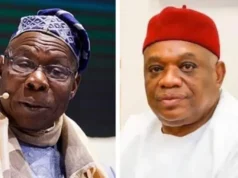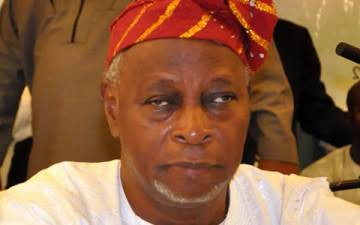
Former Secretary to the Government of the Federation and 1999 presidential candidate, Chief Olu Falae, has claimed that he, not Olusegun Obasanjo, won the election that marked Nigeria’s return to civilian rule after years of military governance.
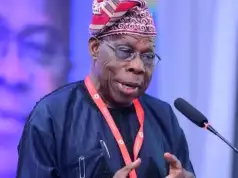
Speaking during an interview on Arise TV’s Morning Show on Thursday, as part of Democracy Day programming, Falae alleged that the results of the 1999 presidential election were manipulated in Obasanjo’s favour.
“I was told by my lawyer, the late Chief J.O.K. Ajayi, that I won the election by over a million votes after a meticulous assessment of the figures declared,” Falae stated.
According to the elder statesman, a legal review of the vote tallies—conducted by his late legal counsel—showed that he had secured victory over Obasanjo, who ran on the platform of the Peoples Democratic Party (PDP). Falae, on the other hand, was the joint candidate of a coalition between the Alliance for Democracy (AD) and the All Peoples Party (APP).
Despite the reported findings, Falae said his team chose not to challenge the election results in court, prioritising national stability over personal political ambition.
“But we decided not to go to court. We were more concerned about the country returning to democracy peacefully after years of military rule,” he explained.
His comments have reignited debates around Nigeria’s 1999 transition from military rule—a political shift overseen by then-Head of State, General Abdulsalami Abubakar, following the sudden death of General Sani Abacha.
The 1999 election was widely seen as a political compromise, particularly intended to appease the South-West region, in the aftermath of the annulled June 12, 1993, presidential election, widely believed to have been won by MKO Abiola, also a Yoruba man.
Both Falae and Obasanjo hailed from the South-West, with Obasanjo, a former military head of state, enjoying considerable backing from Nigeria’s military and political establishment.
“There was so much pressure not to rock the boat. We made sacrifices for democracy to return. I accepted it in good faith then, but the truth must be told: I won that election,” Falae declared.
“It’s not about me. It’s about the truth. Nigeria deserves to know the real story behind its so-called democratic rebirth.”
Reflecting on Nigeria’s democratic journey since 1999, Falae lamented the ongoing lack of electoral credibility, saying that despite remaining under civilian rule, free and fair elections have remained elusive.
“Since 1993, we have struggled to conduct truly credible elections,” he added.