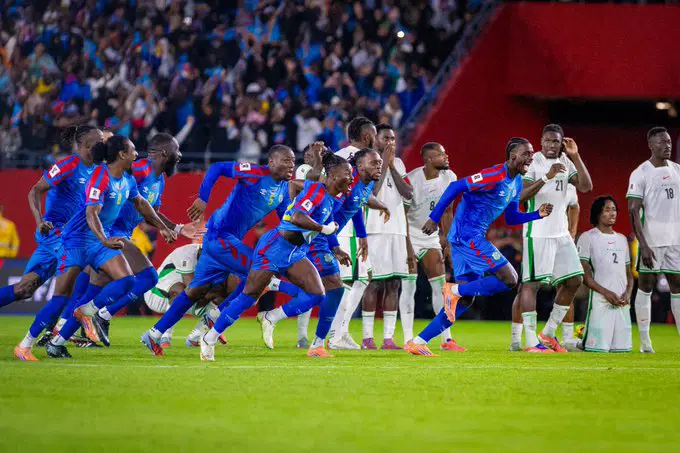
The Democratic Republic of Congo has named a 26-man squad for the tournament playoff scheduled for later this month despite the Nigeria Football Federation’s (NFF) appeal to FIFA regarding Congo DR’s eligibility to feature at the World Cup’s intercontinental playoffs.
Head coach Sébastien Desabre confirmed the squad list on Wednesday as the Leopards begin their final build-up for the decisive match scheduled to take place in Mexico. The fixture represents a crucial opportunity for the Central African side to secure a ticket to the global tournament.
However, notable omissions are Michel-Ange Balikwisha and Mario Stroeykens, two of the players Nigeria specifically named in its formal complaint to FIFA over alleged eligibility violations; only Matheu Epolo, the third player prominently mentioned in Nigeria’s petition, has been included in the squad.
Nigeria lodged the complaint after losing the African play-off tie to DR Congo 4–3 on penalties, alleging that the Congolese football federation misled FIFA in securing nationality switches for several overseas-born players.
The petition, made public on December 15, 2025, urged FIFA to investigate the matter and consider disqualifying DR Congo from the qualification process.
In the complaint, which was made public by journalist Osasu Obayiuwana, Nigeria argued that several players received clearance to represent DR Congo only days before the decisive play-off match, despite having been invited to the squad earlier.
The petition questioned how the Congolese football federation could call up the players before FIFA had granted final approval for their nationality switch.
It partly reads: ““It should be added for context that at least three of these players with unrenounced Belgian nationality (Michel-Ange Balikwisha, Mario Stroeykens, and Matheu Epolo) received their final clearance to play for DRC between November 11 and 12, 2025, just before the play-off match against Nigeria on November 16, 2025.
“Notably, Balikwisha played his debut match for DRC in this game against Nigeria.”
The document further suggested that the timeline surrounding the call-ups raised serious concerns about procedural compliance.