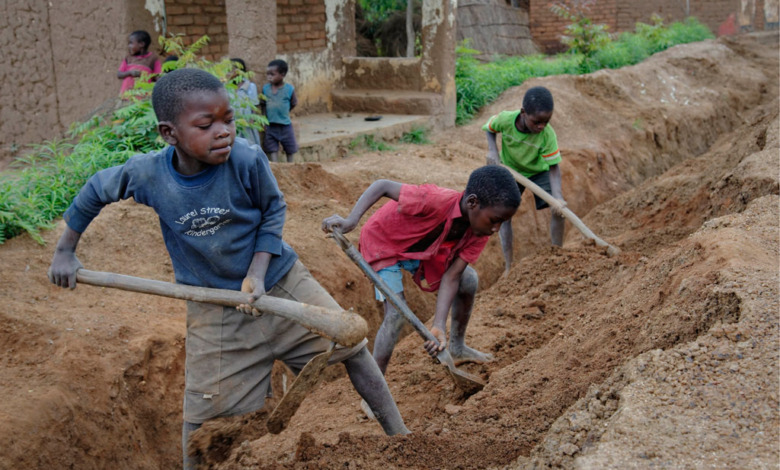
As the world marks World Day Against Child Labour, the International Labour Organization (ILO) has revealed that nearly 138 million children were engaged in child labour globally in 2024.
This was disclosed by Mr. Gilbert Houngbo, ILO Director-General, during a message delivered at the 113th Session of the International Labour Conference (ILC) held on Thursday in Geneva, Switzerland.
According to Houngbo, the total figure includes approximately 54 million children involved in hazardous work—jobs likely to endanger their health, safety, or development.
Despite some positive trends, Houngbo acknowledged that the global community has failed to meet the target of eliminating child labour by 2025.
“This is according to new estimates released today by the ILO and UNICEF, and the latest data show a total reduction of over 22 million children since 2020, reversing an alarming spike between 2016 and 2020,” he said.
“The findings of the report offer hope and show that progress is possible, but parents must themselves be supported and have access to decent work.
“This is so that they can afford to ensure that their children are in classrooms and not selling things in markets or working on family farms to help support their family.”
UNICEF Executive Director Catherine Russell echoed similar sentiments, emphasizing that sustained progress is achievable through targeted interventions.
“This is by applying legal safeguards, expanded social protection, investment in free, quality education, and better access to decent work for adults.”
Russell highlighted that agriculture remains the largest sector for child labour, accounting for 61% of all cases. This is followed by services (27%), such as domestic work and street vending, and industry (13%), including sectors like mining and manufacturing.
She stressed the need for stronger commitments from governments: “To accelerate progress, the UNICEF and ILO called on governments to invest in social protection systems, especially for vulnerable households, including universal child benefits so that families do not resort to child labour.
“It is imperative to strengthen child protection systems to identify, prevent, and respond to children at risk, especially those facing the worst forms of child labour, among others.”
In Nigeria, Alhaji Mohammad Dingyadi, Minister of Labour and Employment, affirmed the country’s ongoing efforts to combat child labour.
“Nigeria was a Pathfinder Country, and it was intensifying efforts to eradicate child and forced labour.
“We are reviewing national legislations, building capacities, strengthening capacities and implementing community best programmes, as well as rescuing and rehabilitating vulnerable children,” he said.
Also lending his voice, Mr. Adewale-Smatt Oyerinde, Director-General of the Nigeria Employers’ Consultative Association (NECA), called for urgent action to end child labour across Africa.
“Millions of Nigerian children continue to engage in dangerous work, sacrificing their health, education, and future potential,” he said.