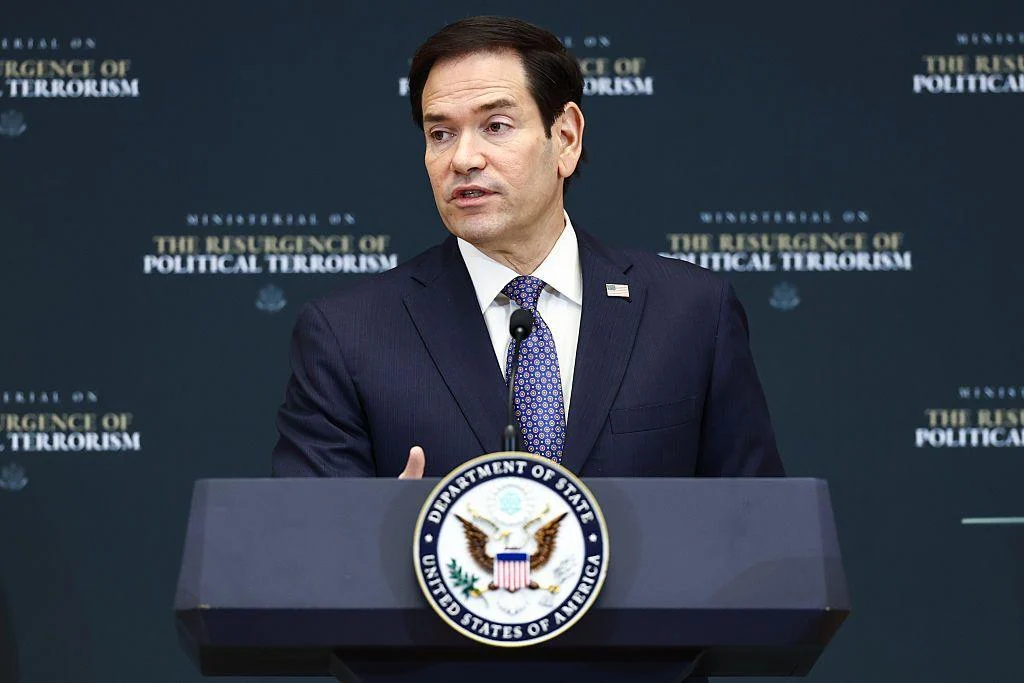
United States Secretary of State Marco Rubio has dismissed fears that the country is under a coordinated cyberattack following a series of technology disruptions affecting government agencies, banks, airlines and major technology companies.
Rubio said there was no evidence linking the incidents or suggesting that they were orchestrated by hackers, criminals, foreign governments or other hostile actors.
“We are not under systemic attack,” Rubio told reporters in Manila, Philippines, on Tuesday, November 17, while travelling with President Donald Trump.
According to Reuters, Rubio acknowledged that the disruptions were unsettling but insisted that they were unrelated and had different technical causes.
“We have zero evidence or any reason to believe that any of these isolated or individual instances have anything to do with nefarious actors, with cyberhackers, with criminals, with another nation state, with a malign actor of any kind,” he said.
He added, “Each of them are distinct, and they’re different in their causation.”
The remarks followed a series of disruptions affecting Microsoft’s email services, United States air traffic control, major banks, United Airlines, Apple services and the National Security Agency’s internal communications network.
The Federal Aviation Administration had ordered a nationwide ground stop on Friday, November 13, which lasted approximately four and a half hours, disrupting air travel across the country.
The disruption followed a Microsoft outage affecting services including Outlook and Teams, while JPMorgan Chase experienced a software problem that affected some banking services on Monday.
United Airlines also reported a technology failure that delayed approximately 150 flights.
On Tuesday, the NSA disclosed that its network had experienced a temporary disruption during scheduled maintenance, although it maintained that its mission-critical capabilities remained operational.
The agency said its ability to defend national security had continued despite the technical problems.
Intelligence chief backs Rubio
Director of National Intelligence Jay Clayton also dismissed suggestions that the disruptions were the result of a cyberattack or state-sponsored activity.
Speaking during an interview with CNBC on Tuesday, Clayton said, “This is not a cyberattack, and this is not a coordinated effort by a nation-state.”
He added, “We’ve looked very closely. Anytime we see something like this, those are the first questions that we ask on behalf of the American people.”
Clayton attributed some of the problems to technology upgrades and security patches introduced to address vulnerabilities in computer systems.
“As you patch and upgrade your systems, taking them down and bringing them back up, there are things like this that happen,” he said.
He also explained that artificial intelligence was enabling organisations to identify vulnerabilities more quickly, creating pressure to upgrade and secure their systems.
Concerns persist over repeated outages
Despite the administration’s assurances, the frequency of the disruptions has prompted questions from lawmakers and some supporters of Trump.
Republican Senator Josh Hawley expressed reservations about the incidents occurring within a short period.
“If this is all a coincidence, it’s like the greatest coincidence in the history of the world,” he told reporters.
Democratic Senator Mark Warner, vice-chairman of the Senate Select Committee on Intelligence, also said there was no indication that the incidents were the result of a coordinated attack.
However, he called attention to the pressure artificial intelligence was placing on technology companies and government agencies to identify and fix vulnerabilities.
In a statement, Warner said, “I understand why Americans are concerned about the widespread outages we’ve seen in recent days, affecting everything from banks and major technology companies to critical government systems.”
He added, “At this point, there is no indication that these incidents are the result of a cyberattack, foreign interference, or some coordinated effort.”
Meanwhile, Trump also played down concerns over the disruptions, saying that technical problems could occur even in large and well-funded organisations.
“It’s like when you’re big and powerful, and you have all the money. Things like that happen. It’s fine,” he told reporters in Manila.
The incidents have renewed scrutiny of the reliability of critical technology infrastructure in the United States, particularly as government agencies and private companies increasingly depend on interconnected digital systems.