The proposed borrowing, which forms part of the Federal Government’s financing plan for the 2026 fiscal year, is expected to contribute to funding a budget deficit estimated at N31.4tn, further placing government borrowing and growing debt obligations under legislative and public scrutiny.
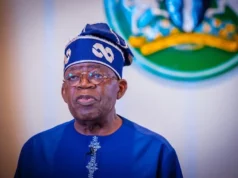
Tinubu’s request, contained in a letter dated October 26, 2026, and addressed to the President of the Senate, sought the National Assembly’s approval to raise N10,790,366,835,481, equivalent to $7,707,404,882.49, using the budget exchange rate of N1,400 to the dollar.
The letter was read during Wednesday’s plenary, following which the Senate President, Godswill Akpabio, referred the request to the Committee on Local and Foreign Debts and directed it to report back as soon as practicable.
The proposed $7.7bn external borrowing represents the foreign component of the N29.2tn new borrowing provision contained in the 2026 Appropriation Act.
According to the president, the approved borrowing plan comprises N18.4tn in domestic loans and N10.79tn in external financing to part-finance the country’s projected N31.4tn budget deficit.
“The 2026 Appropriation Act approved the sum of N29.2tn as new borrowings to part-finance the 2026 budget deficit of about N31.4tn,” the letter stated.
Explaining the rationale for the request, Tinubu said the proposed borrowing complied with Sections 21(1) and 27(1) of the Debt Management Office (Establishment, etc.) Act, 2003, which require external borrowing proposals to be submitted to and approved by the National Assembly.
The President disclosed that the Federal Government would explore several financing options simultaneously, taking into consideration borrowing costs, the benefits of each option and the time required to access the funds.
However, he indicated that Eurobond issuance would receive greater attention because of its relatively faster processing time and capacity to generate substantial funds.
“In view of this, emphasis will be on the issuance of Eurobonds, which is typically faster to conclude. Additionally, a larger amount can be raised through Eurobonds at a relatively lower cost in respect to the terms and conditions of the Eurobond,” he stated.
Other financing options identified in the letter included concessional and commercial loans from multilateral and bilateral institutions, facilities from the International Monetary Fund, bridge financing arrangements from book runners, loan syndications and direct borrowing from international financial institutions.
Tinubu, however, acknowledged that the final interest rates, repayment periods and other loan conditions would depend on prevailing market conditions when the financing arrangements are concluded.
He assured lawmakers that the Ministry of Finance and the Debt Management Office would work together to secure the most favourable terms for the country.