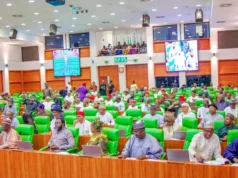
The Senate on Tuesday threatened to review Nigeria’s Bilateral Air Service Agreement with China unless Nigerian airlines were granted reciprocal rights to operate direct flights to the Asian country.
The upper chamber urged the Federal Government to renegotiate the agreement to protect the interests of Nigerian carriers and ensure that both countries enjoy equal opportunities in international air travel.
The resolution followed a motion sponsored by the Senate Chief Whip, Mohammed Monguno, representing Borno North, and seconded by Senator Abdul Ahmed Ningi, representing Bauchi Central.
The debate also saw Ningi raise concerns over alleged illegal mining activities by Chinese nationals in parts of the country, while lawmakers called for stronger indigenous airlines and the revival of a national carrier.
Leading the debate, Monguno recalled that Nigeria and China signed a Bilateral Air Service Agreement under the late President Muhammadu Buhari to establish direct commercial air links and regulate flight operations between the two countries.
He, however, expressed concern that the agreement had not delivered the expected reciprocal benefits for Nigerian airlines.
Monguno said bilateral trade between Nigeria and China reached $18bn in the first half of 2025, representing a 25 per cent increase year-on-year, compared with a total trade volume of $28bn in 2024.
He also highlighted the growing population and economic ties between both countries as reasons for improving direct air connectivity.
He said, “The population of Nigerians in China is more than 1 million people, while that of Chinese in Nigeria is more than 500,000. This has generated the interest of China in Nigeria because it is Africa’s most populous nation and largest economy, offering massive markets on the African continent.”
According to him, effective implementation of the agreement would position the Murtala Muhammed International Airport, Lagos, and the Nnamdi Azikiwe International Airport, Abuja, as major aviation gateways linking West and Central Africa to East Asia.
He listed reduced travel time, improved supply chains, increased airline revenues, foreign exchange retention and expanded opportunities for small and medium-scale enterprises among the benefits of direct flights.
Monguno added that improved air connectivity would support non-oil exports, particularly agricultural products, and strengthen Nigeria’s international trade.
He called on the Federal Ministry of Aviation and Aerospace Development, the Nigerian Civil Aviation Authority, the Central Bank of Nigeria and the Nigeria Customs Service to work towards effective implementation of the agreement.
Supporting the motion, Ningi described the proposal as patriotic but raised concerns about the activities of Chinese nationals in Nigeria’s solid minerals sector.
He alleged that some Chinese mining operations in parts of Bauchi State and other locations might be operating without complying with all relevant legal requirements.
The senator specifically cited mining activities in communities within his constituency bordering Kaduna and Plateau states, expressing concern over the scale of operations, equipment deployed and alleged exportation of raw minerals without sufficient local processing.
He called for stronger government oversight to ensure that Nigeria derives adequate economic benefits from its mineral resources.
On the aviation agreement, Ningi lamented that Nigerians travelling to China often had to connect through countries such as Morocco, the United Arab Emirates, Ethiopia and the United Kingdom because Nigerian airlines lacked direct flights to China.
He urged the Federal Government to support domestic carriers to operate international routes, naming Air Peace, United Nigeria Airlines, Azman Air and Ibom Air as airlines that could be encouraged to expand their operations to China, subject to regulatory and operational requirements.
Ningi argued that Nigeria should not continue granting Chinese airlines access to its aviation market without securing equivalent opportunities for Nigerian carriers.
He consequently called for a review of the agreement if China failed to guarantee reciprocal flight rights for Nigerian airlines.