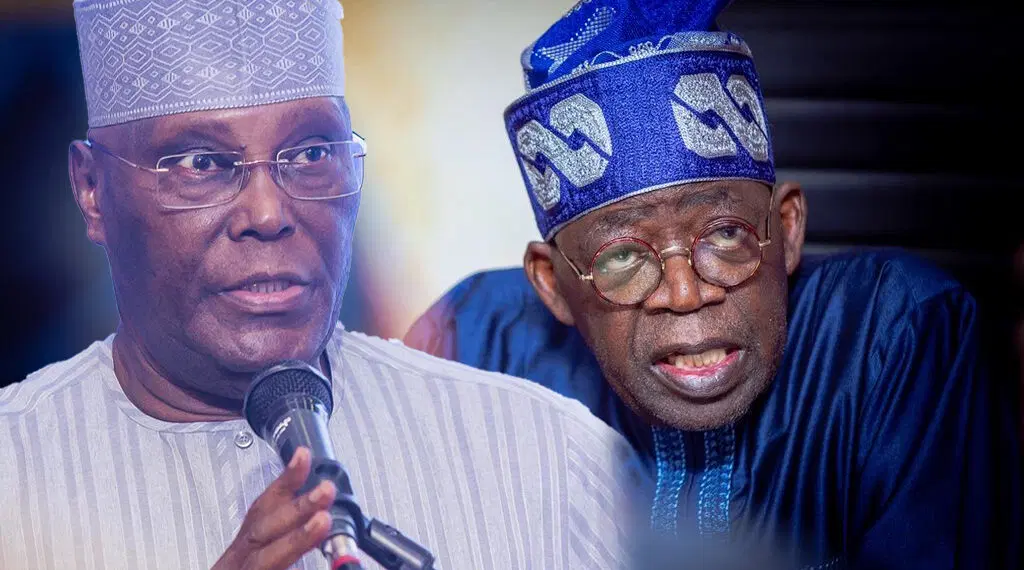
President Bola Tinubu on Tuesday defended his administration’s economic reforms as necessary steps towards building a $1tn economy by 2030, as former Vice President Atiku Abubakar challenged the policies, asking why Nigerians had to endure years of hardship before the government began promising relief.
Tinubu, represented by the National Chairman of the All Progressives Congress, Prof. Nentawe Yilwatda, at the second edition of the Asiwaju Scorecard Series and Policy Roundtable in Abuja, said the reforms had strengthened the foundation for economic stability and growth, citing improved foreign reserves, revenue mobilization, trade, and gross domestic product.
Atiku, however, said the administration’s recent promises of cheaper transportation, increased food production, and relief for vulnerable Nigerians amounted to a belated response to a cost-of-living crisis it had allowed to persist for more than three years.
Atiku, the presidential candidate of the African Democratic Congress, has continued to oppose the policies of the Tinubu administration as the 2027 general elections draw nearer, particularly its economic reforms and their impact on the cost of living.
Speaking at the event, Tinubu, represented by Yilwatda, said the economic reforms introduced by his administration had placed Nigeria on the path to achieving a $1tn economy by 2030.
He said the reforms had strengthened the foundation for economic stability, growth, and prosperity.
The president said the removal of fuel subsidy and reforms in the foreign exchange market, alongside increased revenue mobilization and investments in critical infrastructure, were necessary to move the country away from years of economic uncertainty and towards sustainable growth.
“When President Bola Ahmed Tinubu assumed office on 29 May 2023, Nigeria faced a difficult economic inheritance. We had fuel subsidy distortions, multiple exchange-rate windows, weak revenue mobilization, foreign-exchange shortages, rising debt-service pressures, and years of inadequate investment in critical infrastructure.
“The President understood that Nigeria could not continue on that trajectory and therefore took difficult decisions, including the removal of the fuel subsidy and the reform of the foreign-exchange market.
“The evidence increasingly shows that the foundation is strengthening. Nigeria’s gross external reserves have risen to about $52.7bn by August 2026.
“Consolidated non-oil revenue increased from approximately N13.63tn in 2023 to N16.4tn in the first two quarters of 2026, demonstrating the growing contribution of non-oil sources to government revenue.
“Our trade position has also improved dramatically: from a merchandise trade surplus of only about N44.8bn for the whole of 2023 to approximately N7.54tn in the first quarter of 2026 alone.
“Real GDP grew by 4.43 per cent in Q2 2026, while inflation has fallen significantly from its earlier peak to about 15.4 per cent.
“These figures do not mean that our economic challenges have disappeared, but they demonstrate that the direction of travel has changed.
“And let me emphasize: macroeconomic stability is not the destination; it is the foundation. The ultimate test is when stability translates into cheaper food, more jobs, affordable credit, reliable electricity, and greater purchasing power for Nigerians,” Yilwatda said on Tinubu’s behalf.
Speaking on the $1tn economy, Tinubu said, “It is not merely a number, but a national mission: a Nigeria that produces more, exports more, attracts more investment, creates more jobs, and gives its young people a greater stake in the future.”
He said Nigeria’s $1tn economy ambition requires adequate infrastructure, stressing that the Renewed Hope Agenda prioritizes roads, rail, ports, energy, and digital connectivity.
The president added, “Nigeria must now take full advantage of its enormous maritime opportunity by developing an integrated five-port maritime and logistics corridor.
“Our strategic ambition should be to develop and connect five major deep-sea ports at Lagos, Ondo, Ibom, Port Harcourt, and Calabar, linking them by modern rail and road infrastructure, with the Lagos-Calabar Coastal Super Highway serving as the principal coastal road spine. But the vision does not stop at the coastline.
“The Western Corridor will connect the maritime gateways to the interior through the Lagos–Abuja–Kaduna–Kano rail corridor, complemented by the Sokoto–Badagry Super Highway, thereby opening a direct trade route from the Atlantic coast to the markets of the Northwest and the Sahel.
“The Eastern Corridor will similarly connect the eastern maritime gateways through the Port Harcourt–Abuja–Kaduna–Kano rail corridor, complemented by the proposed Calabar–Maiduguri Trans-Sahara Super Highway, creating a second major east-to-north trade route.