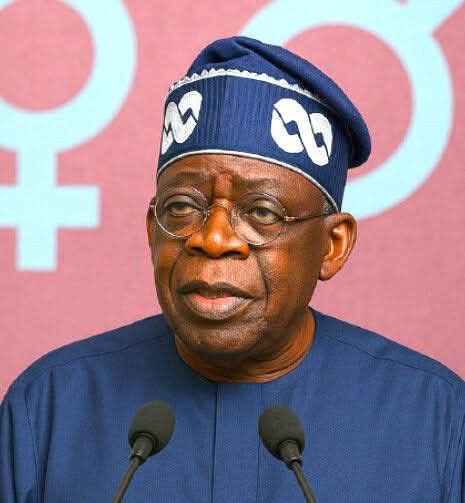
President Bola Tinubu has disagreed with former President Olusegun Obasanjo over claims that the state-owned Port Harcourt, Warri, and Kaduna refineries may never work.
In what appeared to be Tinubu’s first clear position on the viability of the three refineries, which have remained moribund despite billions spent on turnaround maintenance, the president insisted that the facilities will return to operation.
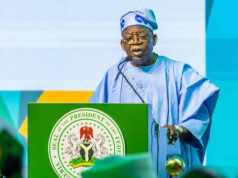
The PUNCH reports that Tinubu made his position known on Thursday when he received the Executive President of the Nigeria Union of Petroleum and Natural Gas Workers, Salimon Oladiti, and members of the union at the Presidential Villa, Abuja.
The President’s declaration is coming against the backdrop of repeated doubts expressed by Obasanjo about the ability of the Port Harcourt, Warri and Kaduna refineries to operate successfully, despite the huge sums that have been committed to their rehabilitation over the years.
“The refineries you mentioned are going to come back to work. We’re just building a very firm research and structural reworking of the economy of it. Ordinary flame and smoke of a refinery doesn’t mean it’s working until it’s profitable and yields the value for which it is built,” Tinubu stated.
He said he would not bother to look back into what has happened in the past about the failed rehabilitation of the refineries, saying, “I am not a man who looks back because I have accepted the asset and liability of my predecessor, no matter what has happened in the years past. It is my responsibility now to fix it and make it work for the largest common value of our population. I take responsibility for that, and I’m going to do it.”
Tinubu’s position is different from Obasanjo’s long-standing argument that the Nigerian National Petroleum Company Limited cannot successfully operate the government-owned refineries.
Obasanjo recently reiterated his position in an interview aired on television by Sony Irabor Live, arguing that public-private partnerships offered a better model for running major government assets.
“One of the lessons that I learnt is that PPP works. Look, one project that has not been destroyed by the government in Nigeria is the NLNG, where the private sector has 51 per cent, and the Nigerian government has 49 per cent. See what we did with Nigerian railways.
“See what we did with the national shipping company. See what we are doing now even with the NNPC. The NNPC has refineries, and I said to people that it will never work. And a man had the audacity to say, ‘Am I a chemical engineer?” he said.
Obasanjo’s position was based partly on his experience as President between 1999 and 2007, when his administration attempted to transfer the management and ownership of the refineries to private investors.
According to him, he approached Shell to take a 10 per cent equity stake and run the refineries, but the oil major declined. He subsequently asked the company to operate the facilities without taking equity, but it also rejected that proposal.
“When I was there, I called Shell. I said, ‘Look, please, I beg you, come and take 10 per cent equity and run the refinery for us.’ They said no. I said, ‘Okay, if you don’t want to take equity, don’t take equity. Come and run the refineries’. They said no,” he stated.
Obasanjo said he later invited a top Shell official to explain why the company had rejected his proposals. He said the official told him that Shell’s major profits came from upstream operations and that the downstream business was more of a service than a major profit-making venture.