…As foreign firms dig gold, other mineral resources
ABUJA: For years, residents of some parts of Abuja, the nation’s capital, have had to contend with some quarry operators whose activities are adversely affecting their health, safety, environment and livelihood.
Indeed, while the continuous excavation of the land for its ‘gold’ intensifies, the natives are gradually being pushed away from their comfort zone as the ‘invaders’ take over and establish their footprints, with no intention to give way, even in the near future.
From Mpape, the ‘traditional headquarters’ of quarry operators, to Bmuko, Kubwa, Karshi and Pyakasa, it has been the same story of pollution – air and noise.
For Olatide Yusuf, a youth corps member in Bmuko, a fast-growing community off the Dutse-Bwari road, although her house is not close to any of the quarry sites, she is concerned about the air quality in the area.
She said: “I deliberately didn’t take a house close to the quarry. However, we still hear the sounds, even here. If you didn’t know, sometimes you would think there has been a truck accident.
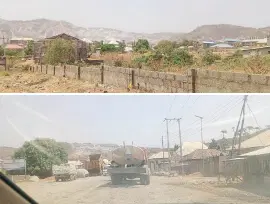
“Then the road not being fixed is another pollution, dust. If you put on black, it will turn to white, because the remains of the rocks they break, that is like sand, they will use it to fill the road and it will be raising dust. If you are going out without nose masks, then you will surely have catarrh. And it is worse when the company’s trucks are moving.”
Venus Mining Company and Istanbul Concrete Limited are very active in the area and their operations continue into night time.
Another resident, Ibrahim Auwal, urged the companies to put the road in order. He said even though the companies sometimes wet the road, the weather condition and volume of vehicular traffic on the route is such that it dries off in less than an hour.
“They will only pour water on the road at some specific time. It is only during rainy season that the situation is manageable for the residents because the rains will force the companies to reduce their operations and that automatically reduces the level of dust generated from the quarry. As a result, the road will remain wet for some time. But dry season like now is very challenging for everyone living around the quarry site because the dust generated is unbearable,” he said.
On one of the weekends that Vanguard visited the area, a water tanker from the Venus Quarry was seen spraying water on the dusty road around 11am.
Another corps member, who gave her name simply as Mercy, lamented the ordeal she faces in Jikoko, a community in Mpape.
“Whenever I have to go for my CDS, I have to wear another cloth on top of my NYSC vest. I also put my white sneakers inside a bag. The first time I went for CDS, I got there looking so unkempt because of the dusty terrain from Jikoko to Berger Quarry junction. You have to use face or nose masks and also cover your hair, otherwise you will have respiratory issues and develop what I can refer to as temporary artificial grey hairs,” she said.
Simply put, quarrying is the blasting, extraction, breaking, crushing, cutting, grading, and washing of rocks for use in the built sector.
In the process, experts say some of the gases emitted include Sulphur dioxide, Nitrogen dioxide, Chlorine, Carbon monoxide and others, which most times go beyond the limit approved by the National Environmental Standards Regulatory and Enforcement Agency NESREA.
Aside that, there could be cases of visual assault occasioned by dust and smokes, heavy traffic, noise pollution and sometimes, deterioration in water quality.
Tremors
Following series of earth tremors in Mpape, which is home to no fewer than nine quarry sites, a few of which are no longer active, the Federal Capital Territory Administration FCTA had in 2018 placed a temporary ban on quarrying in the area.
The Administration had said preliminary reports indicated that rock blasting by quarry operators, other mining activities and proliferation of borehole drilling were the immediate causes of the tremor.
The latest earth tremor in the area occurred from Friday, September 13, to Monday, September 16, 2024, a development that forced some residents to relocate.
Aisha Mohammed, who had lived in the Ajegunle area of Mpape since 2006, said she had to leave the area when her rent expired in November 2024.
“There have been series of earth tremors in the past but what we experienced in 2018, 2020 and the latest one in September 2024 were something else. So, since they do not want to put a stop to quarrying, some of us have decided to relocate,” she said.
A heavy-duty machine operator in one of the companies in Mpape, Hassan Mohammed (not his real names), however, exonerated most of the companies.
According to him, since 2001, people have been encroaching on the immediate perimeters of quarry sites. The National Environmental (quarrying and blasting operations) Regulations, 2013 states that: “A person shall not locate a quarry or engage in blasting within three kilometres of any existing residential, commercial, or industrial area.”
Mohammed said most of the companies in Mpape had been operating the sites before people started living in those areas.
“We started quarrying before people came here. It is not as if people were already living here or started building houses before we came. They know the risks but some unscrupulous developers will build houses close to our sites and rent same out. But even if the developers are money mongers, should the prospective tenants not do their own due diligence?”, he queried.
In Kubwa where Zeberced holds sway, there is no love lost between the company and residents of its immediate surroundings.
Some of the residents accuse the company of not contributing to the well-being of the area despite deriving enormous benefits.
Despite rumoured claims of building cracks occasioned by vibrations from the blasts, Vanguard could not find any of such buildings around the Zeberced Quarry on Arab Road, Kubwa, or around the Venus and Istanbul Quarry sites in Bmuko.
The major complaints of residents centre around emissions from the quarries and their lack of Corporate Social Responsibility CSR to their immediate, host communities.
One of the landlords around the Zeberced Quarry site in Kubwa, Alhaji Seidu Sulaimon said school children are often delayed when going and coming back from schools because the company’s trucks sometimes block the road.
Noting that he has taken the company to court and obtained an interlocutory injunction against it, he said the company still carries out its operations despite not obtaining a stay of execution.
He recalled that in 2019, another resident, Moses Anyaoha, had instituted a case against the company and that Justice Charles Agbaza of the Federal Capital Territory FCT High Court in Jabi had restrained the firm from continuing to constitute “nuisance” with its extraction, blasting, drilling, cutting and mining activities.
He said: “You know I got one court injunction stopping them from blasting but they went on appeal and I still followed them to the appeal.
“They have not paid any compensation. Also, when there isn’t injunction, they were supposed to stop work but they continued”.
He said the pictures of the damage to his property were with his lawyer and he would get them across to Vanguard. It was however not possible to get the pictures before going to press.
Chairman of the Kubwa Extension II Relocation Residents Association, Mr. Goodluck Agbo, corroborated the position of Alhaji Seidu. He urged the company to employ modern techniques of quarrying in order to reduce the negative effects on residents.
He said: “They (company) should reduce the blasting; they should use modern techniques of rock blasting that they said they have and which won’t affect houses. But I think they are digging into it and the government is not even saying anything”.
Asked whether there have been positive changes in spite of the two court injunctions against the company, he answered in the negative.
“The community still has the same complaints and nothing has changed. It was individuals who sued and not the community but nothing has changed actually in respect of whether the blasting have reduced, or if they have done anything for the community. We are just on our own.”
On whether he has taken up the issues with the company, he said when he was elected, he approached the company to see what they could do for the community.
However, he added that information available to him indicated that Zeberced had approached the relevant authorities for permission to construct the road but that the situation is complex.
Section 81 of the Nigerian Mineral and Mining Act 2007 provides: “No person shall, in the course of exploration or carrying out mining operations, under this Act construct a road, tramway or railway over, on or under any state land, other than, that comprised within the area of the mining lease, without the consent of the Mining Cadastral Office after consultations with the officer in charge of lands in the Federal Capital Territory, Abuja, or in the state as the case may be; any customary lands, other-than those comprised within the area of the mining tease, without the approval of the Mining Cadastral Office after consultations with the Chairman of the Local Government Council or Area Council as the case may be without first giving notice in writing to the lessee or holder or applicant; and obtaining the consent of the Mining Cadastral Office”.
Agbo said: “When we were elected, we went to discuss with them. One of the executives of the company called some of their executives and management staff and we told them some of the things we wanted. We asked them to fix the road and provide electricity for us.
Agbo said the residents had tried sponsoring a motion at the National Assembly before but that the two people from the community who had worked at the National Assembly before and who were working on the motion, suddenly became incommunicado.
“We tried using motion through the National Assembly. The people who were working there, two of the community persons who were working there suddenly stopped picking our calls and we became frustrated. The government has been very quiet on this disturbing issue and we are really worried.
Wike steps in to salvage situation; awards Gbazango road contract
Meanwhile, relief is on the way for motorists and the long-suffering residents of the area as Zeberced is currently working on the Bazango dual carriageway road project in Kubwa, which was recently awarded on an emergency basis.
The FCT minister, Nyesom Wike, had inspected the project at least three times since last November and decided to put an end to the perennial suffering of the road users.
This came after he had promised in the early days of his administration to liaise with the company on how to develop the road. His promise has now translated into concrete action to give succour to the people of the community and the roadusers.
What the law says
Section 23, Sub-section 6 of the National Environmental (Quarrying and Blasting Operations) Regulations 2013 states that “Adjoining community shall be initially informed at least 48 hours prior to any type of blasting operation through mass media and augmented with local sirens, letters, warning signs, and other means deemed appropriate to convey an impending operation.”
However, Vanguard observed that there were no such warnings in the areas visited.
How residents take in poisonous substances
An Ear, Nose and Throat, ENT, specialist in private practice, Dr. Wahab Bamidele, said hazardous airborne effluents emitted from quarry sites had various ways of entering into the human body.
According to him, there is inhalation, which is usually through the nose and mouth, along the respiratory tract to the lungs.
“The lungs are so exposed that they easily absorb these gaseous emissions, particulate matter and dust,” he said.
According to him, there is also ingestion, which is through the mouth by way of eating or drinking in the contaminated environment.
“It can also be through absorption. In this way, such agents enter into one’s system through the skin pores, eyes or via clothes that are contaminated
Impact on residents, environment
The Executive Director, Africa Network for Environment and Economic Justice, ANEEJ, Rev. David Ugolor, said in areas such as Ewekoro, Ogun State, teachers report that the constant detonation of explosives disrupts classroom activities, leaving students struggling to maintain focus.
He stated: “For children growing up near quarry sites, the learning environment is severely compromised. Schools situated in close proximity to these operations are subjected to persistent noise pollution from heavy machinery and explosive blasts, making it difficult for students to concentrate.
“In areas such as Ewekoro, Ogun State, teachers report that the constant detonation of explosives disrupts classroom activities, leaving students struggling to maintain focus. The high-decibel noise pollution also has long-term effects, including hearing impairments, which can hinder cognitive development.
“Additionally, quarry activities generate significant air pollution. In Ewekoro, for instance, schools are exposed to airborne particulate matter from quarry dust, which creates an unhygienic learning environment. Fine dust particles, including microscopic solids and liquid droplets emitted from industrial plants, have been linked to increased cases of respiratory illnesses among pupils. This results in higher absenteeism rates and reduced school participation, exacerbating educational disparities in these communities.’’
Ugolor added that dust and particles released from quarry operations could be a major contributor to respiratory infections and other health problems in local communities, especially for those who lived or schooled in the area.
According to him, dust particles generated during the extraction and transportation of quarry materials contain harmful substances such as silica and particulate matter.
He says these tiny particles, when inhaled over time, could lead to serious respiratory conditions such as asthma, bronchitis, Chronic Obstructive Pulmonary Disease COPD, and even lung cancer.
Ugolor noted that the long-term health consequences of dust inhalation could persist, even after the quarry operations cease, as respiratory conditions often develop or worsen over time.
“Over time, quarry operations can lead to severe environmental degradation. Large-scale excavation of land can result in the destruction of ecosystems, loss of vegetation, and soil erosion, which further disrupts local agriculture. This has a lasting impact on the livelihoods of residents who rely on farming for survival. Quarry activities can also lead to the contamination of local water sources. Dust and chemicals used in the quarrying process may run off into rivers or groundwater supplies, making the water unsafe for drinking and irrigation, which further exacerbates the health risks,’’ he maintained.
Way forward
President, Geological Society of Africa GSA and Head of Department, Geology, at the University of Ibadan, Prof. Olugbenga Okunlola, has said government had to sanction regulators who issued permits either for quarries or for residential apartments when they ought not to.
The former president of the Nigeria Mining and Geoscience Society, NMGS, said where quarries were already in operation, those who issued building permits ought to be dealt with.
Conversely, he said those who issued quarry licenses for residential areas also ought to be sanctioned.
“Usually, you should not have residential houses close to mining sites, no. In fact, I will give an example. There was one around Ibadan, and the road that is constructed now between Ibadan and Oyo really happened to be so close to the quarry, but the quarry had to be closed down and they moved further inwards, inside, right inside, more inside the bush, where there are no houses.
“So, there is no way you will have blasting and it will not affect houses. There has to be a specific distance and the law has stated that clearly. What should be happening is that, who are those who are really giving out those permits, either to build houses or for quarries? Did the quarries come there before the buildings or did the buildings come there before the quarry?
‘’That has to be established. If the houses were built after the quarry and all the licenses that have been given and all the operations, then they are also liable. So, who gave them permission around all those areas? There are laws, but people compromise the monitoring of these laws.
“The Mpape people will complain, of course, when there is blasting because the vibrations will, and it can even affect plantations and all that. So, I think the regulatory agencies-Ministry of Mines and Solid Minerals, the National Environmental Standards and Regulatory Enforcement Agency, NESREA, and those who are in charge of explosives and mining should see to it that there is no threat to human lives arising from blasting.
‘’No house should be close at least 200 metres to any mining site. It is not even just the vibrations. Even the splinters from the rocks and the stones that have been blasted can travel as far as 200 metres and they can cause injuries.
“So, what I know is that most of those quarries in Mpape had been there before residential houses came close to them. Those who gave the permits should also be held responsible. Why did you give permits and all that? And it can be resolved.
‘’It is either those quarries move away or they look for those who gave the permits. Usually, in any country that is involved in environmental standards and safety, no building should be close to quarry operations,” he said.
As to whether his association had been able to make any interventions on the issues between communities and quarry operators, Okunlola said it was the job of the relevant ministry.
“That is the ministry’s responsibility. That is the ministry’s assignment. We don’t have a taskforce as an association. It is the inspector, the mines inspector you have in the ministry. By law, no organisation has any right to monitor.
‘’What we do at the Council of Mines Engineers and Geosciences is to see that we have no quacks. However, what is happening with the quarries is another thing. Most quarries, they will have a quarry license. So, the monitoring of how they operate should be with the Mines Inspectorate Office, Mines Officers in each of those states. So, that is it. But I know most of them have some quarry licenses.’’
As a way out, Prof. Okunlola said there was no need to review any extant laws as the current laws were sufficient to regulate the industry.
Inactive FCT dept
In 2022, the Federal Capital Territory Administration FCTA created a ‘Department of Solid Minerals and Allied Matters in the FCT’.
The department is supposed to tackle illegal mining and ensure that all mining activities in the FCT were properly coordinated for improved Internally Generated Revenue IGR.
However, the department has not been very active as its supposed functions are still being performed by the Ministry of Mines and Solid Minerals Development.
A source in the Administration said there was an “FCT Desk” in the Ministry of Mines and Solid Minerals Development, saying the functions of that department ought to be ceded to the FCT Administration which operates like a state.
Efforts to get the reaction of the Head of Department, Mines Inspectorate, at the Ministry of Solid Minerals Development, Imam Ganiyu, were unsuccessful as of press time.
Head of Press and Public Relations at the Ministry of Mines and Solid Minerals Development, Mrs. Kania Maliki did not also respond to media enquiries.
The Nigeria Mining Cadastre Office NMCO was established in 2007 with the responsibility for the Administration and Management of Mineral Titles in Nigeria in accordance with Section 5 (1) of the Nigerian Minerals and Mining Act, 2007 (the Act).
While the phone number on its website was “not assigned” according to the network operator, its official email kept bouncing back mails.
Director General of NESREA, Innocent Barikor, told Vanguard that while there were illegal operators in the system, the mandate of his agency only covered the environmental aspect.
He disclosed that the agency had received complaints from residents and facilities close to quarry sites, adding that the complaints were treated on a case-by-case basis.
“We have a good number of active quarrying and mining facilities within the FCT monitored both by both MMSD and NESREA.
“There are illegal operators in the sector and that falls within the purview of the Mining Cadastral Office. NESREA deals only with the environmental aspect.
“NESREA has gazetted statutory instruments called the National Environmental (Quarrying and Blasting Operations) Regulations, S.I. No. 33, 2013 and the Environmental Impact Assessment Act of 1992 CAP E12.
“Yes, there are public complaints emanating from both adjoining residents/facilities and are treated case by case,” he stated.
Of all the quarry operators listed, only Zeberced indicated its readiness to respond to allegations by some of the community members.
It, however, asked for more time to prepare a detailed response. The company had reached our correspondent through a third party (a communication consultant), promising a detailed response and a guided tour of its operations. Over a year later, that visit has not happened.
Three scholars from the Department of Geography, Faculty of Environmental Sciences, Nasarawa State University, Keffi, – LM Omeiza, DU Sangari and AT Ogah in their research, “Effects of Quarry on the air quality in Mpape, Bwari Area Council, FCT Abuja”, had recommended: “All activities that lead to the release of air pollutants should be liable to environmental tax laws; the quarry companies should upgrade their plants to more efficient technologies and switch to lower carbon content fuels which will reduce emission of pollutants”.
The result of their study is contained in the International Journal of Environmental Research and Earth Science published by Cambridge Research and Publications in March 2022.
While the orchestrated blasting in the Abuja communities continues and generates fortune for the foreign companies, the locals continue to wallow in poverty, environmental degradation and health challenges. But it appears no one is actively listening and proferring the needed solutions.