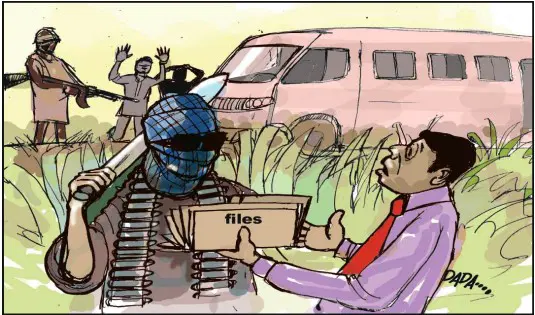
For federal civil servants across Nigeria, the path to promotion is paved with long, costly, and sometimes dangerous journeys. Officers from Ministries, Departments, and Agencies (MDAs) outside Abuja are often required to travel to the Federal Capital Territory for mandatory promotion examinations.
What should be a routine step in their careers has become an ordeal fraught with exhausting travel, security risks, and mounting expenses, shedding light on a persistent challenge in the country’s public service system.
The long-standing practice is compulsory for officers on Grade Level 14 and above in many MDAs and parastatals. However, due to funding constraints affecting several federal offices-and in a bid to cut travel costs-the exercise has, in some cases, been restricted to officers seeking promotion to the Director cadre on Grade Level 17.
In most federal organisations, management has, in recent years, mobilised interview panels to conduct promotion examinations in various operational zones to reduce costs. However, officers seeking elevation to the Director cadre on Grade Level 17 are still required to travel to Abuja.
The policy has attracted criticism, particularly in light of increasing cases of kidnapping and armed robbery along major highways. Civil servants complain that the travel allowances provided for the exercise are grossly inadequate, often failing to cover transportation costs. In some instances, the allowances are paid long after the examinations.
Investigations indicate that several civil servants have lost their lives or suffered injuries in road accidents, robberies, or abductions while travelling to Abuja for promotion exams. Many such incidents, families say, go largely unreported, leaving victims and their relatives to suffer in silence.
One widely reported case involved six directors in the Federal Ministry of Defence who were kidnapped on Monday, 10 November 2025, along Kaba-Lokoja road while travelling to Abuja for promotion exams into the Directorate cadre across MDAs.
The kidnapped officers-Mrs. Ngozi Ibeziakor, Mrs. Emeribe C. A., Mrs. Helen Ezeakor C., Mrs. Ladoye C. A., Mrs. Onwuzurike J. A., and Mrs. Essien Catherine O.-were staff of Command Day Secondary School (CDSS), Ojo, Lagos, and were travelling from Lagos to Abuja at the time of the incident.
After spending several days in captivity and reportedly paying millions of naira in ransom, Mrs. Helen Ezeakor C., Mrs. Ladoye C. A., Mrs. Ngozi Ibeziakor, and Mrs. Essien Catherine O. were released. However, as of the time of this report, the fate of Mrs. Emeribe C. A. and Mrs. Onwuzurike J. A. remains unknown.
Two of the released victims reportedly died a few hours after regaining their freedom.
Following the abduction in November 2025, the Association of Senior Civil Servants of Nigeria (ASCSN),among others said: “We have consistently advised that promotion examinations be conducted in the states to avoid exposing public servants to security risks and the dangers posed by poor road conditions”.
Labour raises red flag
Reacting to the development, Organised Labour, through the Joint National Public Service Negotiating Council (JNPSNC), raised serious concerns over the safety of public servants across Nigeria, citing a string of kidnappings and deadly attacks targeting federal workers. Labour called on the FG to decentralise the conduct of promotion exams across the six geo-political zones to reduce security risks and ensure workers’ safety.
According to Labour, federal public servants travelling to Abuja for promotion exams have been exposed to life-threatening dangers, and the current centralised system has heightened these risks.
Speaking to Vanguard, the General Secretary of the Nigeria Civil Service Union (NCSU) and National Secretary of the JNPSNC (Trade Union Side), Olowoyo Gbenga, among others, said:
“It is no longer news that numerous accidents involving public servants have been recorded, vividly illustrating the urgency of this proposal: Six Directors from the South-West Zone traveling to Abuja were kidnapped recently along the Kabba-Abuja road.
In the North-East, several incidents involving local government workers, teachers, and civil servants have resulted not only in kidnappings for ransom but also in deaths.
These devastating incidents have been reported across Kwara, Kebbi, Zamfara, Borno, Ondo, Edo, Sokoto, and other states. No state in Nigeria has been exempted; workers and their dependants continue to be direct victims of these deadly occurrences.
In our view, the Federal Civil Service Commission has not digitised the promotion examination process due to a lack of political will on the part of the commission.
Furthermore, the ongoing national budget impasse, where statutory funds were not released, has created unprecedented situations.
For the first time, statutory meetings addressing issues critical to the growth of the Public Service could not hold due to lack of funds.
At this juncture, it is expedient to state that the Office of the Head of the Civil Service of the Federation should enter into a technical partnership to develop a workable template for conducting promotion examinations. This framework should take into consideration all federal public servants, especially those serving in states and zonal offices of Federal Ministries, Departments, and Agencies (MDAs), enabling them to take their promotion examinations at the nearest designated locations.
The Federal Government, through the Office of the Head of the Civil Service of the Federation, should treat human capital as living assets deserving appropriate consideration.”
He called on “the Office of the Head of the Civil Service of the Federation to convene a joint meeting of Management and the JNPSNC (Trade Union Side) to develop workable arrangements that safeguard the lives of federal workers. Management must adopt proactive measures to ensure that workers are not unnecessarily exposed to danger.
“The government should address the financial hardships faced by workers, including: payment of three months’ arrears of the Wage Award; proper implementation of the 40% Peculiar Allowance approved by the Buhari administration, which has not been fully paid by the present administration; and settlement of promotion arrears for federal public servants spanning three to four years.
“In essence, our leaders should adopt a proactive approach to policy issues rather than being reactive.
The level of engagement with stakeholders on matters affecting the public service is currently at its lowest ebb, which is deeply concerning.”