Five African countries including Ghana, Nigeria, Kenya, Zimbabwe and Tanzania have emerged as the top countries in the world for youth mental health, even as 41 per cent of the world’s young adults grapple with serious psychological distress.
The 2025 Global Mind Health Report released by Sapien Labs showed that 41 percent of internet-enabled young adults aged 18 to 34 across 84 countries are experiencing what researchers described as a “mind health crisis.”
The study released on Wednesday draws from data collected from nearly one million respondents through the Global Mind Project, one of the largest ongoing global assessments of mental well-being.
According to the report, Ghana ranked first globally in youth mind health, followed by Nigeria, Kenya, Zimbabwe and Tanzania. The top five positions were occupied entirely by sub-Saharan African nations, while high-income countries including the United States, Canada, several European nations, Japan and Australia ranked near the bottom.
The rankings were derived from the Mind Health Quotient, a composite score measuring 47 dimensions of emotional, social, cognitive and physical functioning required to navigate work, relationships and daily life effectively.
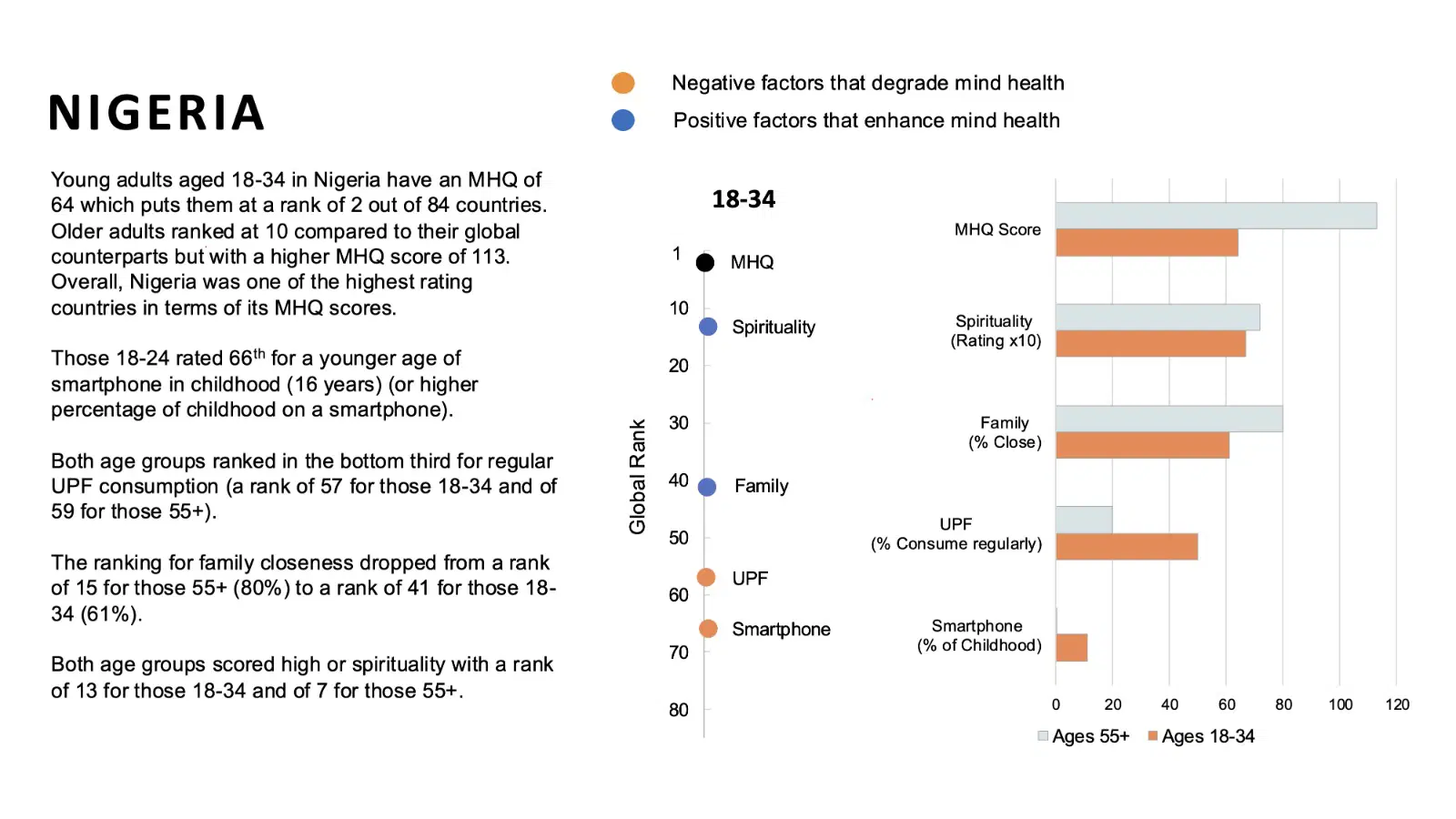
In the case of Nigeria, young adults aged 18-34 in Nigeria have an Mind Health Quotient, MHQ, of 64 which puts them at a rank of 2 out of 84 countries. Also older adults ranked at 10 compared to their global counterparts but with a higher MHQ score of 113.
Overall, Nigeria was one of the highest rating countries in terms of its MHQ scores. Those 18-24 rated 66th for a younger age of smartphone in childhood (16 years) (or higher percentage of childhood on a smartphone). Both age groups ranked in the bottom third for regular Ultra-Processed Foods, UPF, consumption (a rank of 57 for those 18-34 and of 59 for those 55+).
The ranking for family closeness dropped from a rank of 15 for those 55+ (80 per cent) to a rank of 41 for those 18-34 (61 per cent). Both age groups scored high or spirituality with a rank of 13 for those 18-34 and of 7 for those 55 and above.
Researchers said the findings revealed a sharp generational reversal. In the early 2000s, young adults were considered the healthiest age group mentally. Today, they are four times more likely than adults over 55 to experience clinical-level mental health challenges that significantly impair productivity and quality of life.
According to the founder and chief scientist of Sapien Labs and lead author of the report, Tara Thiagarajan said: “The mind health crisis appears to be a progressive slide from generation to generation and goes far beyond rising rates of depression and anxiety. Alongside depression and anxiety, many young adults are struggling with emotional control, relationships and focus.”
The report identified four primary drivers behind the global decline: early smartphone adoption in childhood, increased consumption of ultra-processed foods, weakened family bonds and diminished spirituality.
Among 18- to 24-year-olds, the younger the age at which they received their first smartphone, the greater their likelihood of experiencing adult mental health struggles. Ultra-processed foods were estimated to account for between 15 and 30 percent of the mental health burden after controlling for other factors. Individuals with poor family relationships were almost four times more likely to fall into distressed or struggling categories compared to those with strong family ties.
Spirituality emerged as a powerful protective factor. Young adults who reported a strong sense of connection to a higher power scored at least 20 points higher on the Mind Health Quotient than those with low spirituality ratings. Tanzania ranked highest globally on measures of spirituality and also recorded one of the oldest average ages for smartphone adoption.
The study also suggests a possible inverse relationship between national wealth and youth mental health outcomes, with sub-Saharan African countries outperforming many wealthier economies across key indicators. However, researchers cautioned that despite their strong global ranking, African youth still scored lower than older generations within their own countries, reflecting a universal generational gap.
The widening divide between young and older adults began before 2020 and intensified during the COVID-19 pandemic, when youth mental health declined sharply while older populations experienced only modest drops. Over the past five years, the gap has remained largely unchanged.
“In the U.S., spending on mental health research and care has risen dramatically, by billions of dollars, as it has across western countries. And while important, it’s not moving the needle,” Thiagarajan said. “We need to begin tackling the broader problems that erode the productivity and well-being of young adults around the world.”
A professor of economics at Dartmouth College, David Blanchflower warned that the scale of distress among young adults poses a direct economic threat.
“When almost half of the core workforce globally is struggling with an array of mental health challenges, we are facing a crisis that can undermine entire economies and societies,” he said.
The report called for policy interventions including restricting smartphone use during school hours, establishing minimum age requirements for social media access, and increasing regulation and research into the additives found in ultra-processed foods.
For Ghana, Nigeria, Kenya, Zimbabwe and Tanzania, researchers stated the challenge now is to preserve the cultural and social strengths driving their high rankings while preventing the generational erosion of mind health seen elsewhere.