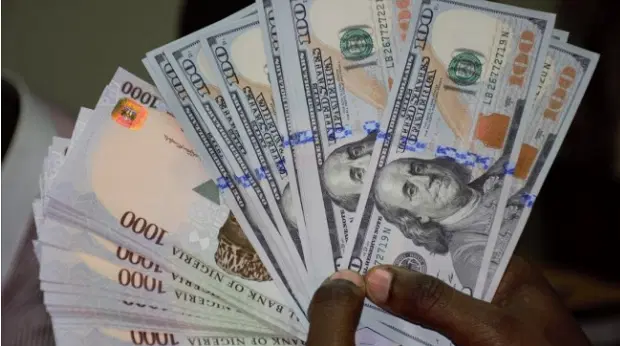
The Nigerian Naira maintained a stable stance against the US Dollar in the early hours of Tuesday, February 24, 2026, as the Nigerian Foreign Exchange Market (NFEM) reflected the impact of sustained Central Bank interventions.
Real-time data shows the local currency navigating a tight range, bolstered by a significant narrowing of the spread between official and informal market rates.
Official Market Performance (NFEM)
In the official window, the Naira opened at 1,344.65 per dollar, holding firm following a close of 1,343.81 at the end of Monday’s session. Intraday activity has seen the currency fluctuate between a high of 1,342.50 and a low of 1,346.87.
Market liquidity remains a key driver of this stability. Trading volumes have been supported by the Central Bank of Nigeria’s (CBN) recent framework allowing licensed Bureau De Change (BDC) operators to purchase up to 150,000 dollars weekly. This policy has successfully decentralized dollar access, easing the concentrated demand that previously spiked rates in the official window.
Parallel Market Trends
The parallel market continues to show signs of rate convergence, with the dollar trading at approximately 1,335 to 1,345 per dollar in various regional hubs. Interestingly, in some segments of the informal market, the Naira has traded slightly stronger than the official rate, a rare phenomenon attributed to improved price discovery and the mopping up of excess retail demand.
Traders in Lagos and Abuja note that the “panic buying” witnessed in previous years has largely dissipated. The current alignment of rates suggests that the central bank’s efforts to harmonize the market are gaining significant traction, providing a more predictable environment for businesses and individual travelers.
Macroeconomic Drivers
Several factors are providing a supportive backdrop for the Naira this Tuesday:
Easing Inflation: Headline inflation slowed for the tenth consecutive month, reaching 15.10% in January 2026. This disinflationary trend, particularly in the food and energy sectors, has reduced the domestic pressure on the exchange rate.
Foreign Reserve Accretion: Nigeria’s external reserves have strengthened to approximately 47.81 billion dollars, providing the CBN with a robust buffer to manage market volatility.
Oil Production Recovery: Increases in domestic crude oil production, recently recorded at 1.46 million barrels per day, have improved foreign exchange inflows, further stabilizing the balance of payments.
As the trading day continues, analysts expect the exchange rate to remain within the 1,340 to 1,350 range. The market’s attention is now turning toward the upcoming Monetary Policy Committee (MPC) meeting, where stakeholders anticipate further guidance on interest rate trajectories.