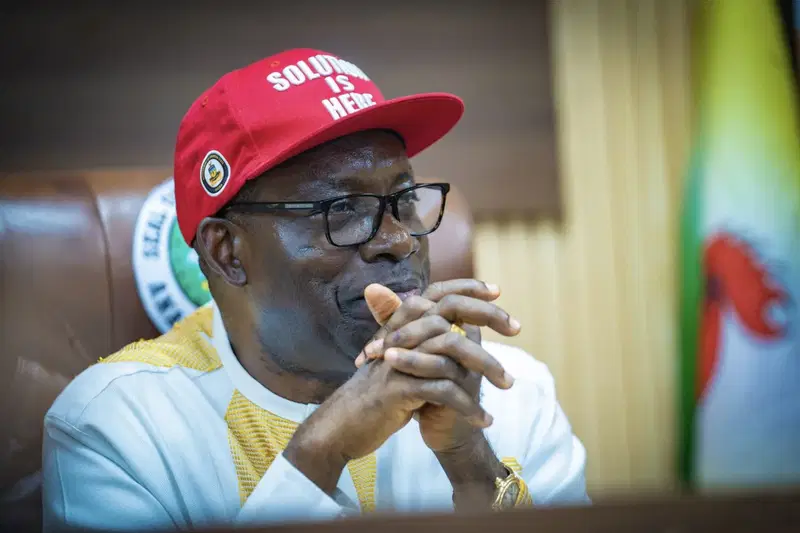
Tension heightened in Onitsha, Anambra State, yesterday, as traders protested the continued closure of the Onitsha Main Market and its adjoining commercial centres, following Governor Chukwuma Soludo’s directive compelling markets in the state to open on Mondays.
As early as 6:30 a.m., heavily armed security personnel — including soldiers, police officers, and operatives of Operation Udo-Ga-Achi (Agunechemba) — blocked all entry and exit points to the market, preventing traders from gaining access to their shops.
The lockdown also crippled business activities in Marine Market, Biafra Market, Kano Street Market, Sokoto Road Market, William Street Market, and Bida Road Market, which depend on the Main Market for their daily operations.
Governor Soludo’s move forms part of the state government’s enforcement strategy to end the weekly sit-at-home order imposed by separatist agitators across the South-East, which the administration has repeatedly described as economic sabotage.
However, the development sparked anger and resistance among traders who tried to defy the order but were dispersed by security operatives stationed around the markets.
During visits by journalists, groups of traders were seen chanting protest songs and appealing to the governor to lift the market closure, while others loitered nearby, hoping for a last-minute reprieve. By midday, most traders had returned home in frustration after realising the enforcement would continue.
Many traders accused the government of misplaced priorities, arguing that such a massive security deployment had never been used to protect them when gunmen enforcing the sit-at-home order attacked in past years.
“This is executive rascality,” said trader Tobechukwu Ezeh. “In 2024 and 2025, many traders were kidnapped or killed on Mondays for trying to open their shops, yet no security was provided. Now that we want to work, they’ve locked us out.”
Ezeh recalled that a market leader from the Old Motor Spare Parts Market, Obosi, abducted last year, remains missing, with no meaningful government response.
A 70-year-old trader, Eugen, also blamed the crisis on government interference in market leadership, saying successive administrations weakened traders’ unions by imposing loyalists as market leaders.
“Since after Mbadinuju’s time, traders lost their voice. Government meddling has divided us and left us powerless against anti-people policies,” he lamented.
Igbo Group Appeals for Reopening
Amid the rising tension, the Igbo Community Association (ICA), Abuja, has called on Governor Soludo to reopen the Onitsha Main Market immediately to prevent further unrest.
In a statement jointly signed by its President General, Engr. Ikenna Ellis-Ezenekwe, and Secretary General, Mazi Emmanuel Onah, the group warned that continued closure could trigger violence, injuries, and destruction of property if not urgently addressed.
“The markets are central to our economic and social life. Their prolonged closure is deepening hardship for both traders and consumers,” the statement read.
While commending Soludo’s achievements in infrastructure and economic reform, the association urged him to embrace dialogue rather than force.
“We recognise the governor’s commitment to development, but governance must reflect the will of the people. Dialogue, not confrontation, is the path to lasting peace,” the group said.
The ICA urged both the government and traders to seek peaceful engagement, warning that economic disruptions in Onitsha — the region’s commercial lifeline — could have ripple effects across the entire South-East.