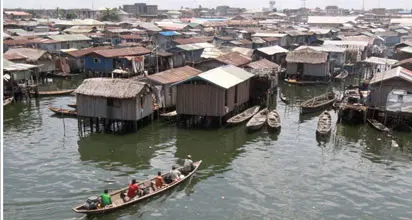
LAGOS — Grief, anger, and confusion have gripped Makoko waterfront, one of Lagos’s most iconic informal settlements, as residents continue to lament the recent demolition of homes and businesses by the Lagos State Government, which they say has left thousands homeless and jobless.
The government insists the clearance was necessary for public safety, citing violations of the 150–250 metre setback from high-tension power lines, but displaced residents allege a hidden agenda, claiming their community has been “sold to the highest bidder.”
Governor Babajide Sanwo-Olu, while defending the demolition, said affected residents were served evacuation notices more than two years ago, adding that the move was to prevent potential disaster.
“We are not demolishing Makoko entirely,” Sanwo-Olu said. “We are clearing shanties built dangerously close to high-tension lines. Safety of lives and property must come first. Still, we will offer palliatives and relocation stipends as a show of compassion.”
However, community leaders and residents dismissed the explanation as “a cover-up.” They alleged that the demolition extends far beyond the stated 100 metres, reaching over 500 metres in some parts, with homes, schools, and fishing boats destroyed.
A community leader, who asked not to be named, claimed the Makoko land had already been allocated to a private developer, FBT Coral Estate, through a Lagos State Land Allocation Committee document dated October 2025.
“They said it’s about safety, but it’s not. The truth is, they’ve sold our land,” he alleged.
High Chief Shemede Emmanuel, a Baale (traditional head) of Makoko, also confirmed long-standing concerns about FBT Coral’s activities, revealing that the company had approached community leaders years ago to sign an MoU after claiming to have acquired part of the land.
“We were deceived. They said the government wanted to demolish the area and that we would be informed before any action. We never sold our land. Now, they have gone beyond the agreed boundaries and destroyed everything,” he lamented.
Chief Emmanuel alleged that despite earlier assurances from officials, the bulldozers returned three weeks ago, tearing down homes and firing tear gas at residents who resisted. He claimed 12 people had died and over 20,000 families displaced, with hundreds of children out of school.
“They burned our boats and destroyed our homes. Many now sleep under bridges or in their canoes,” said Julia, a mother of ten who lost everything. “Even our little children are falling sick in the cold.”
Government Defends Action
Governor Sanwo-Olu denied the allegations, accusing some NGOs of exploiting Makoko for profit.
“Some international organisations have raised money in Makoko’s name and done nothing. They are crying more than the bereaved,” the governor said, maintaining that the exercise was necessary to prevent “calamity or disaster.”
He added that the government planned to redesign the area into a safer, more sustainable urban space and that relocation support would be provided for affected families.
Rights Groups, Experts Condemn Exercise
Several human rights organisations and housing advocates have condemned the demolitions, describing them as inhumane, illegal, and profit-driven.
At a joint press conference in Lagos, the groups accused the government of using violence, intimidation, and forced evictions to clear land for elite private developments, ignoring valid court injunctions and human rights standards.
Zikora Ibeh, Assistant Executive Director of Corporate Accountability and Public Participation Africa (CAPPA), said the government’s claim that NGOs were exploiting the community was “a distraction from its own failures.”
“The NGOs stepped in because the government abandoned these communities. Destroying them under the guise of safety is unjust,” she said.
Festus Adebayo, Executive Director of the Housing Development Advocacy Network (HDAN), called the demolitions “insensitive and premature,” urging the Lagos State Government to suspend further clearance and engage affected residents in a transparent resettlement process.
“Development must go hand in hand with justice,” Adebayo said. “No Lagosian should be made homeless in the name of urban renewal.”
Experts Call for Dialogue, Not Destruction
Building expert and former president of the Nigerian Institute of Building (NIOB), Kunle Awobodu, described the demolitions as “regrettable” given Makoko’s global cultural and tourism value.
“Makoko is a unique settlement with floating schools and homes that attract visitors from around the world,” he said. “If government believes the area must be upgraded, it should develop it, not destroy it. Compensation and proper relocation are essential.”
As bulldozers continue to raze structures along the waterfront, the Makoko community — once known for its vibrant fishing culture and floating architecture — now faces an uncertain future, caught between the government’s vision of urban renewal and their fight for survival and ancestral rights.