The Lagos State Government has come under fire from family, senior advocates, and civil society organizations over the Supreme Court’s decision to close Alhaja Kudirat Abiola’s murder case after it was determined that the state had given up on appealing Maj. Hamza Al-Mustapha’s (retd.) nine-year acquittal.
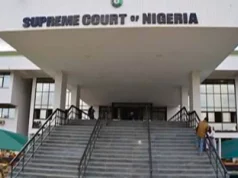
The apex court, in a unanimous judgment delivered by a five-man panel on Thursday, ruled that the state government failed to take any legal steps to prosecute its appeal within the period granted to it, thereby effectively abandoning the case.
The ruling sparked national outrage over the unresolved assassination of the wife of the winner of the June 12, 1993 presidential election, the late Chief MKO Abiola.
Kudirat was assassinated in Lagos on June 4, 1996, at the height of nationwide protests against the annulment of the June 12 election by the regime of the late Gen. Sani Abacha.
Her killing became one of the most symbolic tragedies of the pro-democracy struggle, representing the extreme measures deployed to silence opposition voices during military rule.
Al-Mustapha, the former Chief Security Officer to Abacha, alongside Mohammed Abacha and Lateef Shofolahan, was arraigned for conspiracy and murder.
On January 30, 2012, a Lagos High Court sentenced the trio to death by hanging.
However, the Court of Appeal, on July 12, 2013, overturned the conviction, citing weak and unreliable evidence, and discharged and acquitted the accused.
Unwilling to accept the verdict at the time, the Lagos State Government approached the Supreme Court in 2014 and was granted leave to appeal out of time.
A seven-man panel led by the then acting Chief Justice of Nigeria, Justice Walter Onnoghen, ordered the state to file its notice of appeal within 30 days, following its claim that it needed time to review the case and challenge the appellate court’s findings.
However, nine years later, when the matter came up again before the Supreme Court, it emerged that the state government had neither filed the required processes nor taken any steps to pursue the appeal.
Delivering the lead judgment, Justice Uwani Aba-Aji described the failure of the Lagos State Government to act as “inexcusable”.
She noted that despite being duly served with hearing notices and being aware of the proceedings since 2020, the state neither entered an appearance nor offered any explanation for its absence.
The court held that nine years was more than sufficient time for the appellant to file the required processes.