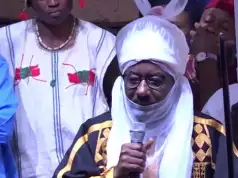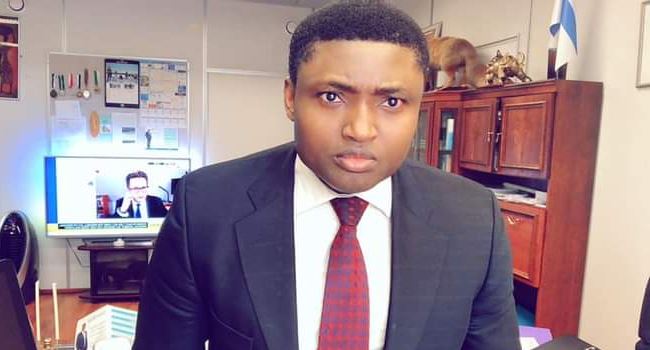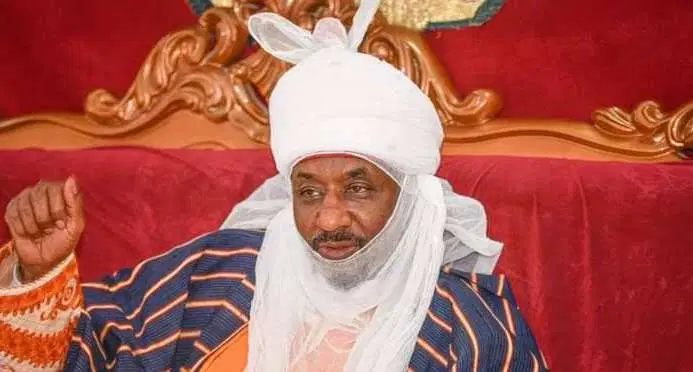
The 16th Emir of Kano, His Royal Highness Muhammadu Sanusi II, and renowned economist and founder of Stanbic IBTC Bank, Dr. Atedo Peterside, said yesterday that the reforms of the Federal Government would not translate into real gains for Nigerians unless there is a deliberate effort to cut down on the cost of governance.
Though they commended President Bola Tinubu for having the courage to remove fuel subsidy, they, however, frowned on the manner increased revenue brought about by subsidy removal was being spent.
Consequently, the duo, who spoke at the Oxford Global Think Tank Leadership Conference and Book Launch in Abuja, where top policy-makers and economic experts gathered to discuss the theme of leadership and reform in Nigeria, asked the leadership of the country to embrace economic discipline, sincerity and accountability in governance.
Minister of Finance and Coordinating Minister of the Economy, Mr Wale Edun however, said President Tinubu’s reforms are already yielding results
Why do we need 48 ministers, long convoys, endless travels? — Sanusi
In his remarks, the Emir of Kano, Muhammadu Sanusi II, who was former governor of the Central Bank of Nigeria, CBN, provided an incisive analysis of the country’s economic trajectory, saying many of Nigeria’s challenges stemmed from a failure to act on sound economic advice.
He said: “It’s extremely important for us to try to understand economics and how the economy works. A failure to understand economics sometimes leads to misplaced expectations. There’s a role for the Central Bank, there’s a role for the Ministry of Finance. You’ve got monetary policy, fiscal policy, structural policies, and institutional reforms.”
Sanusi recalled the events of 2012 when the Jonathan administration attempted to remove fuel subsidy but was resisted by protests led by opposition figures who later inherited the same problem.
“If Nigeria had allowed the Jonathan government remove subsidy in 2012, the pain would have been a very tiny fraction of what we’re facing today,” he said.
He revealed that the Central Bank of Nigeria had projected limited inflationary impact at the time and pledged to stabilise the economy within a year.
“I stood up and put my credit card on the line and said, remove the subsidy today, inflation moves up from 11% to 13%, I will bring it down in a year. We would not have had 30-something per cent inflation,” Sanusi recalled.
He explained that the CBN under his leadership, took measures to prevent hyperinflation and runaway devaluation.
Sanusi said: “Nigerians don’t realise that we were on the brink of hyperinflation. We were heading in the direction of Zimbabwe. Inflation has been reined in and the runaway devaluation has been stopped.
Yes, we are at N1,400 to the dollar, but it’s better to know it will be N1,400 for six months than to think it’s N1,400 today and N2,000 tomorrow.’’
He, however, said the real problem remains unchecked public spending and a bloated government structure.
“We’ve got to be honest, why do we need 48 ministers? Why do we need dozens of vehicles when we’re moving around in convoys or travelling all over the country?” he queried.
Responding to a question on why Nigerian leaders fail to heed expert advice, the Emir said: “What my experience has shown is that leaders listen to so many people, and they decide that they’re going to accept those that tell them what they want to hear. We have too many sycophants in government.”
He lamented that truth-tellers in government were often branded enemies of the state, saying “people like Dr. Peterside and myself are always enemies of state because people don’t like hearing bad news.
Those who tell leaders the truth are seen as enemies, while those who praise them are rewarded.’’
Sanusi urged political leaders to surround themselves with people of integrity who would offer honest counsel, rather than flattery.
“It is not to your benefit to turn yourselves into praise singers. You disgrace yourselves and the offices you hold when you do that,” he warned.
Benefits of subsidy removal can only be realised through proper governance —Peterside
On his part, Atedo Peterside commended President Bola Tinubu’s administration for removing fuel subsidy but said the real challenge laid in what was done with the additional revenue generated.
He said: “I’m somebody who, I believe, is speaking the truth all the time. So you are quoting me in 2012, you can quote me in 2025, the issues will not change. I’m not one of those people who, when you are out of government, you fight against fuel subsidy, and when you are in government, you advocate for it.”
He said the administration deserves credit for taking bold steps many governments had avoided for decades.
“I’ll be the first person to give credit to this government for removing fuel subsidy, which some of us started calling for from the very first economic summit over 30 years ago. But the same president must take the blame for sabotaging efforts to remove fuel subsidy in the past, in 2012,” Peterside added.
While commending recent economic adjustments, such as a more market-driven exchange rate, he said these were only the first steps, adding that Nigeria’s real test is ensuring accountability in how the increased revenue was used.
“Those measures improve fiscal balance. They give all three tiers of government so much more revenue. And that’s where the problem starts. What is the point of giving the thief more revenue if he’s only going to steal it?
“The real test is what is being done with that revenue in their hands. Is that revenue supposed to be used to fuel 400 cars to escort the president to the airport? The real result should be to help eliminate poverty, to get the economy functioning,’’ he said.
Peterside argued that while removal of subsidies and market reforms were necessary, their benefits could only be realised through proper governance and targeted social support.
He said: “It’s not true that gain follows pain. Gain follows pain only if you are doing the right things after putting the pain in place.’’
The businessman urged government to build an inclusive economy not dependent on connections or proximity to power.
“We want an economy where you don’t need to know the government to invest here and do business. I can clap for you for removing subsidy and for market-determined exchange rates, those are one-day actions. If you want me to keep clapping, show me the rest of your actions after those two things,” he added.
Tinubu’s reforms already yielding results — Edun
Speaking also at the event, the Minister of Finance and Coordinating Minister of the Economy, Mr. Wale Edun, said the administration of President Bola Tinubu has brought about positive leadership change and economic reform, designed to impact the lives of ordinary Nigerians.
He said: “In Nigeria, leadership changed in 2023, and President Bola Ahmed Tinubu changed it for the better. If you look at the records, if you look at the statistics, if you look at the progress made since 2023, the food growth rate, the stable exchange rate, the lowering inflation those are just one side of the story.
‘’The most important aspect is the human side, the effect on people’s daily experience, the cost of food, the cost of transport, how they are living their lives.”