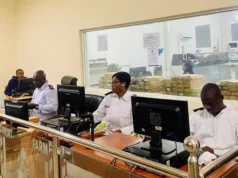
A mobile court sitting in Calabar on Wednesday convicted 34 traffic offenders for attempting to bribe officers of the Federal Road Safety Corps (FRSC).
Magistrate Abigail Asuquo, who presided over the proceedings, handed down the judgment following the arraignment of the offenders by the FRSC prosecuting officer, Mr. Presley Orhue.
Delivering the judgment, Magistrate Asuquo said, “Having listened to the plea of the offenders wherein they pleaded guilty to the charges brought against them before this court by the FRSC, they have an option of going to prison for a week or paying the fine of N10,000 each. This is the stipulated fine for attempting to corrupt marshals on duty.”
In addition, those caught overloading vehicles or driving without a driver’s license were also fined N10,000 each. Violations involving seat belt usage and speed limiting devices attracted fines of N2,000 and N3,000, respectively.
Speaking to the News Agency of Nigeria (NAN) after the hearing, the state Sector Commander of the FRSC, Innocent Etuk, condemned attempts by motorists to bribe officers, emphasizing the corps’ zero tolerance for corruption.
Etuk stated that the FRSC is committed to prosecuting and jailing motorists who try to corrupt its operatives in Cross River State.
He urged road users to comply with traffic laws, supporting the FRSC’s corporate strategic goal for 2025 to reduce road traffic fatalities and injuries by 10 percent through targeted interventions.
“Henceforth, drivers must desist from attempting to corrupt patrol operatives, overloading vehicles, refusing to use seat belts, using phones while driving, and other vices that endanger lives and property on public roads,” he warned.
NAN further reported that the FRSC command had previously applied to the Chief Judge of Cross River State for the establishment of a special or mobile court to facilitate speedy trials of traffic offenders. This application, pursuant to Section 10(8) of the FRSC Establishment Act 2007, was approved by the Chief Judge, leading to the formation of the mobile court.