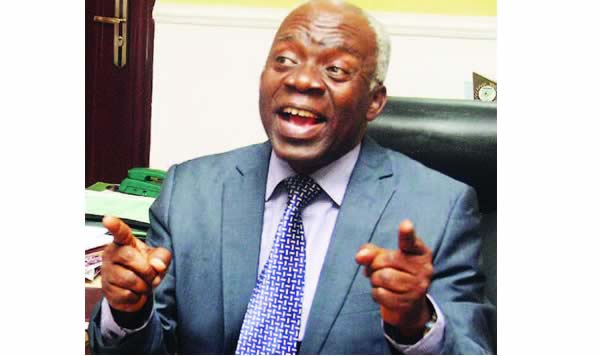
Prominent human rights lawyer and Senior Advocate of Nigeria (SAN), Femi Falana, has strongly criticized the proposed bill to make voting compulsory in Nigeria, describing it as unconstitutional and practically unenforceable under the current legal framework.
The bill, titled “A Bill for an Act to Amend the Electoral Act 2022 to Make it Mandatory for All Nigerians of Majority Age to Vote in All National and State Elections and for Related Matters”, was introduced by Speaker of the House of Representatives, Honourable Abbas Tajudeen. It reportedly passed a second reading in the House last week, sparking widespread public interest and debate.
Falana acknowledged that the bill aims to tackle voter apathy and boost electoral participation but warned that it contradicts several provisions of the 1999 Constitution, particularly those protecting citizens’ fundamental rights to privacy, freedom of thought, and conscience.
“The compulsory voting proposal is inconsistent with Sections 37, 38, 77(2), 135(5), and 178(5) of the Constitution,” Falana stated, arguing that these sections affirm the right of citizens to make political choices freely and without coercion.
To support his argument, Falana cited key judicial precedents, including:
Nwali v. Ebonyi State Independent Electoral Commission (2014), where the Court of Appeal ruled that open voting violated the right to privacy.
Medical and Dental Practitioners Disciplinary Tribunal v. Okonkwo (2001), where the Supreme Court upheld the freedom of thought and religion in a medical ethics case involving blood transfusion refusal.
Lagos State Government v. Asiyat AbdulKareem (2022), where the Supreme Court upheld the right of Muslim female students to wear hijab in public schools.
He also referenced the 2020 judgment in Digital Rights Lawyers Initiative v. National Identity Management Commission, where the court expanded the constitutional interpretation of privacy to include data protection and personal space.
Beyond legal contradictions, Falana highlighted practical challenges in enforcing compulsory voting, asking, “How do you prosecute millions of Nigerians who choose to boycott elections that have become mere exercises in recycling misgovernance and corruption?”
Falana further criticized the National Assembly for prioritizing a compulsory voting bill over more urgent electoral reforms, including the legal backing of electronic voting tools such as the Bimodal Voter Accreditation System (BVAS) and INEC’s Result Viewing Portal (IREV). Despite their introduction in recent elections, the Supreme Court ruled that these technologies lacked constitutional grounding.
“Instead of pushing for compulsory voting, the National Assembly should amend the Electoral Act to formally include BVAS and IREV, as well as implement key recommendations from the Uwais Electoral Reform Panel,” he advised.