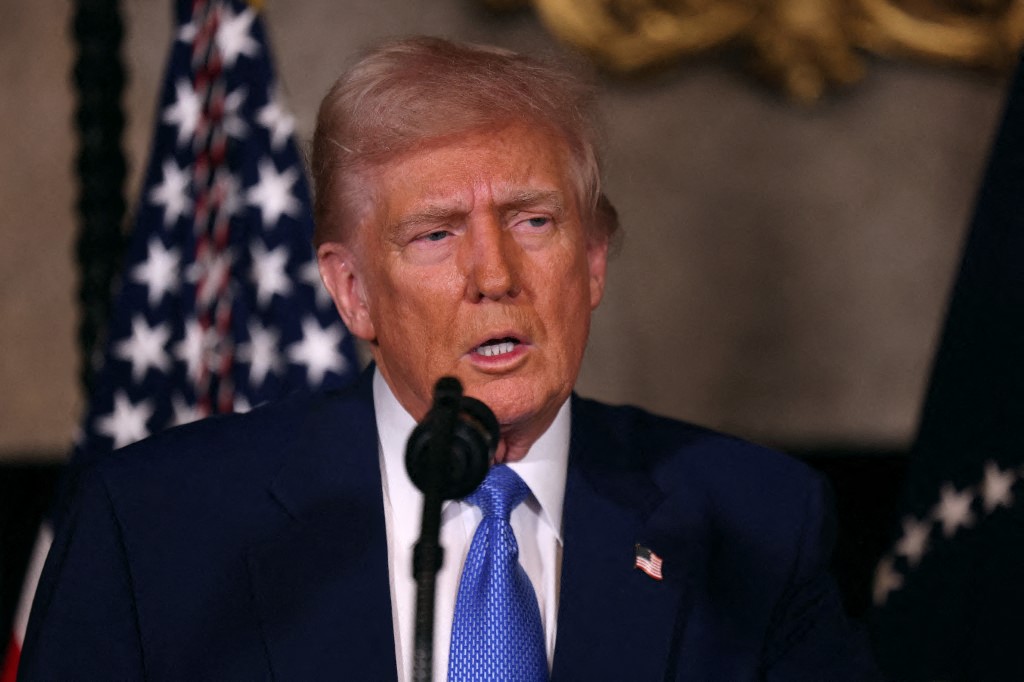
US President Donald Trump voiced concern over the dire humanitarian situation in the Gaza Strip, saying “a lot of people are starving” as the region suffers from ongoing violence. His remarks came on Friday in Abu Dhabi, where he was concluding his first foreign tour of his second term, which included visits to several Gulf countries but notably excluded Israel.
Trump’s comments came as Israeli airstrikes continued, with Gaza’s Civil Defence Agency reporting that at least 56 people had been killed since midnight and dozens more injured. The Israeli military has not commented on the strikes. Trump stated, “We’re looking at Gaza. And we’re going to get that taken care of. A lot of people are starving,” underscoring the urgency of the situation.
Since March 2, Israel has imposed a total blockade on Gaza, which humanitarian organizations say has exacerbated the already critical shortages of food and medicine. The blockade is part of Israel’s strategy to pressure Hamas, which remains in control of Gaza and continues to hold Israeli hostages taken during the October 2023 attack.
Hamas has insisted that humanitarian aid must be restored as a “minimum requirement” for any peace talks. The group has also rejected President Trump’s recent suggestion of taking over Gaza and turning it into a “freedom zone,” stating that Gaza is not “for sale.”
The latest Israeli airstrikes have caused widespread panic in northern Gaza, with residents describing harrowing scenes of destruction. One resident, Umm Mohammed al-Tatari, 57, recalled, “We were asleep when suddenly everything exploded around us. Everyone started running. We saw the destruction with our own eyes. There was blood everywhere, body parts and corpses. We didn’t know who was dead and who was still alive.”
Another resident, Ahmed Nasr, 33, said the bombing continued throughout the night, adding, “We couldn’t sleep or find any peace. There is no safety. We could die at any moment.”
The ongoing conflict began in October 2023 when Hamas launched an unprecedented attack on Israel, resulting in over 1,200 Israeli deaths, mostly civilians. According to the latest figures, the Gaza Health Ministry reports that 2,876 people have been killed since Israeli airstrikes resumed on March 18, bringing the war’s overall death toll to more than 53,000.
The conflict has raised concerns for families of hostages still held by Hamas, with some groups urging Israeli Prime Minister Benjamin Netanyahu to take immediate action to secure their release. The Hostages and Missing Families Forum stated, “Missing this historic opportunity would be a resounding failure that will be remembered in infamy forever.”
Meanwhile, other groups like the Tikva Forum are calling for more military pressure, urging Israel to impose a complete siege on Gaza, cutting off essential supplies like water and electricity.
The United Nations has warned that 70% of Gaza is either an Israeli-declared no-go zone or under evacuation orders, exacerbating the humanitarian crisis. UN agencies have also reported critical shortages of basic supplies, including food, water, and medicine.
The World Health Organization confirmed that the last hospital in Gaza offering cancer and cardiac care has been severely damaged in an Israeli airstrike and is no longer operational. UN Special Rapporteur for the Palestinian territories Francesca Albanese criticized Israel, accusing it of “killing what’s left of humanity.”
Israel justifies its actions, claiming the blockade and military pressure are necessary to force Hamas to release the remaining hostages. However, Hamas officials like Basem Naim have insisted that humanitarian aid access is a non-negotiable human right. “Access to food, water, and medicine is a fundamental human right—not a subject for negotiation,” Naim stated.
In an effort to alleviate the crisis, the Gaza Humanitarian Foundation, a US-supported NGO, announced plans to distribute humanitarian aid to Gaza this month following talks with Israeli officials. However, the United Nations has distanced itself from the initiative.
As the situation in Gaza remains dire, international calls for a cessation of hostilities and the restoration of aid grow louder.