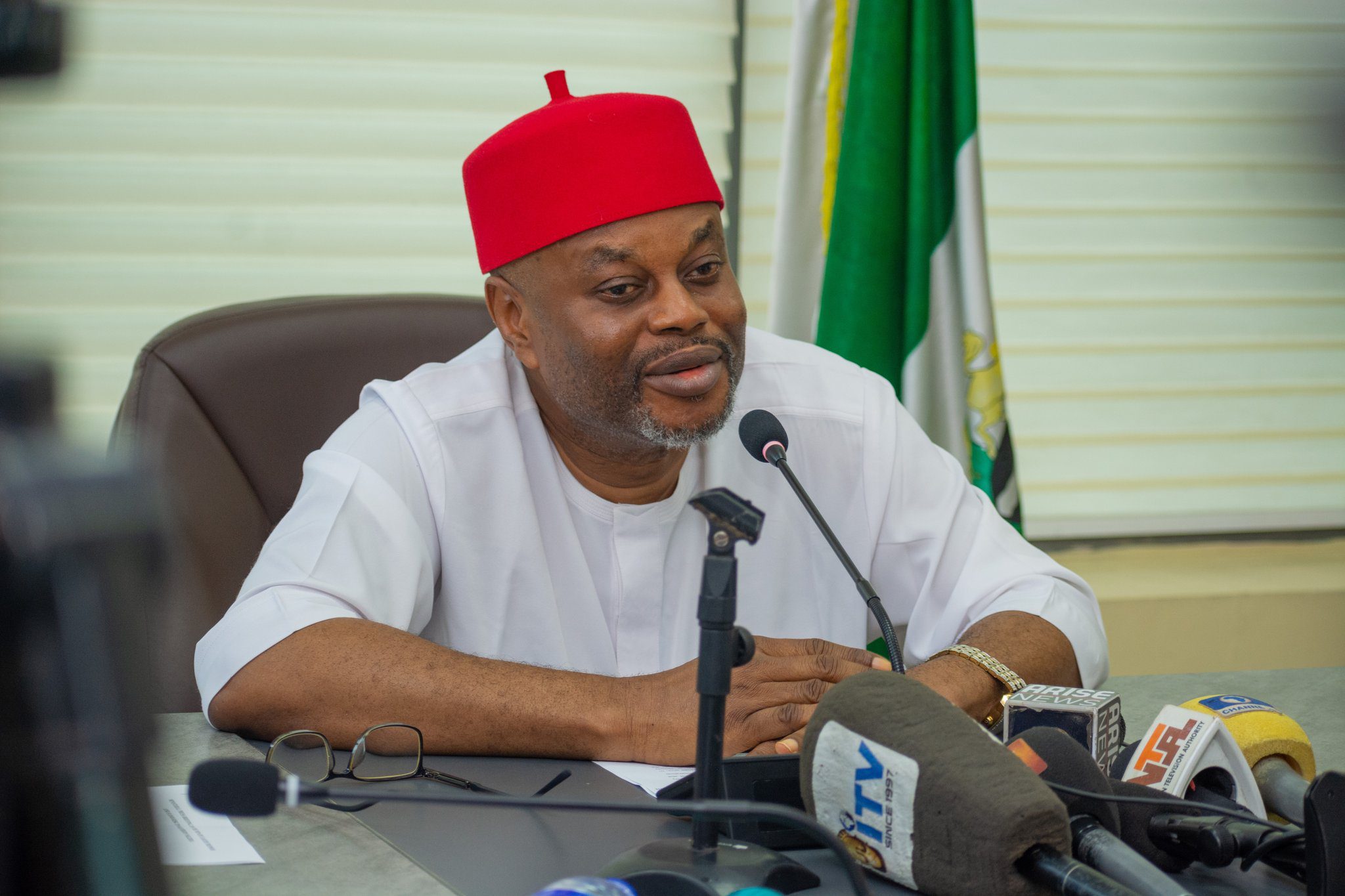
The federal government has approved the launch of four advanced satellites aimed at enhancing Earth observation and strengthening national security efforts, Minister of Innovation, Science, and Technology Chief Uche Nnaji announced on Wednesday.
Speaking at the 22nd National Council on Innovation, Science, and Technology (NCIST), held in Abuja from May 12–14, Nnaji revealed that the Federal Executive Council (FEC) recently approved the satellite initiative as part of President Bola Tinubu’s Renewed Hope Agenda.
According to the minister, the project includes three Earth observation satellites and one synthetic aperture radar (SAR) satellite, which is capable of capturing images under all weather conditions—day or night.
“These satellites, worth millions of dollars, will significantly reduce our dependence on foreign data. The SAR satellite, in particular, will provide continuous surveillance capabilities, helping the military monitor remote regions like the Sambisa forest, which currently requires us to purchase external satellite imagery,” Nnaji stated.
The theme of this year’s council meeting was “Research, Develop, Innovate, and Commercialize: A Cycle for National Prosperity”.
Policy Reforms and Research Funding
Nnaji also noted that a committee is currently reviewing the National Science, Technology, and Innovation Policy, with plans underway to establish a National Research and Innovation Fund. He emphasized that bridging the gap between research and real-world application is essential to Nigeria’s progress.
“For too long, research findings from our institutions have remained disconnected from industry needs,” he said. “We must ensure our young innovators are supported with funding, mentorship, and access to markets.”
He called for a new era in which every student sees innovation as a career path and every invention reaches commercial viability, urging deeper collaboration between government, industry, and academia.
Council Resolutions and Future Plans
Nnaji said the council’s resolutions would be forwarded to the Federal Executive Council for formal adoption. He acknowledged the delay in hosting the 22nd edition—which was scheduled for 2024—but confirmed that planning for the 23rd edition is already underway to restore the council’s annual schedule.
“We’re committed to sustaining the momentum created here and accelerating Nigeria’s drive towards innovation-led development,” he added.
Stakeholder Contributions
Permanent Secretary of the Ministry, Mrs. Esuabana Nko-Asanye, described the council as a vital platform for cross-sector collaboration in addressing national challenges such as unemployment, insecurity, climate change, and economic diversification.
She reported that 109 memoranda were submitted during the meeting, covering key areas such as commercialization of indigenous research, improved research funding, and capacity building in emerging technologies.
“These diverse submissions show a growing awareness that science, technology, and innovation are central to Nigeria’s sustainable development,” she said.
National Development and RDIC Cycle
Secretary to the Government of the Federation, Senator George Akume—represented by Dr. Morris Mbaeri, Permanent Secretary, General Services Office—highlighted the importance of a resilient innovation ecosystem to achieve national development.
“This research-development-innovation-commercialization (RDIC) cycle is vital for solving real-world problems and achieving long-term prosperity,” Akume noted.
Also speaking, President of the African University of Science and Technology, Professor Azikiwe Onwualu, recommended that Nigeria increase its research and development (R&D) funding to at least 3% of GDP. He called for the creation of more innovation hubs and clusters integrating academia, industry, and startups.
“We should operationalise the National Research and Innovation Council Fund to coordinate RDIC efforts as envisaged in the STI policy,” he said.
NAN